





World Congress 2024 Aug 20, 2024 Session details

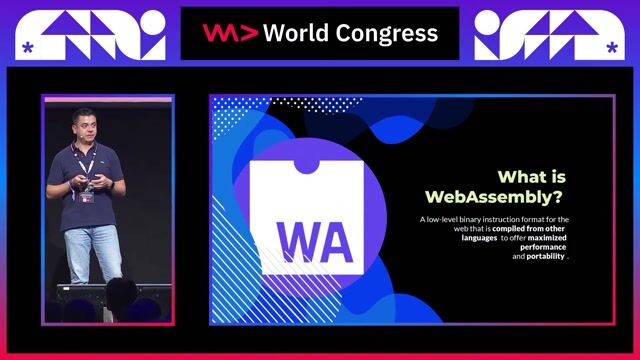
WebAssembly Revolution: Elevating JavaScript's Reach and Performance

Önder Ceylan

How did Figma triple its speed and Photoshop port decades of C++ to the web? Discover how WebAssembly breaks performance barriers and eliminates serverless cold starts.

Pause
Mute Enter Fullscreen
#1 about 3 min

Resolving performance bottlenecks for complex processing inside web browsers

Balancing the demand for intense multimedia features requires compiling native hardware logic into accessible web endpoints.

#2 about 3 min

Understanding the WebAssembly binary format and its execution sandbox

This low-level binary instruction format offers near-native execution speed while maintaining a memory-safe sandbox boundary.

#3 about 3 min

Simplifying multi-architecture deployments using a unified compiler execution target

Compiling code to a unified target removes the complexity of maintaining multiple operating system binaries.

#4 about 2 min

Porting robust native libraries like eBay barcode scanner functions

Porting a native scanning library to the web significantly improves real-world module processing success rates.

#5 about 2 min

Running heavy desktop graphics engines like AutoCAD on browsers

Shipping a massive graphics engine to the browser requires rebuilding user interfaces with modern web technologies.

#6 about 1 min

Boosting Figma rendering performance by targeting direct WebAssembly execution

Transitioning from older internal patterns to standard WebAssembly increases canvas rendering speeds for heavy interactive architectures.

#7 about 2 min

Enabling Photoshop image operations using file APIs and parallelism

Combining lightweight binaries with file system APIs and parallel processing enables complex image manipulation natively in the browser.

#8 about 2 min

Compiling the PHP stack to run WordPress fully locally

Compiling the PHP interpreter efficiently allows full local WordPress codebase testing without running a traditional server stack.

#9 about 3 min

Offloading backend server processing using pre-compiled NPM media packages

Utilizing pre-compiled packages allows secure and offline media processing directly without relying on expensive backend cloud infrastructure.

#10 about 1 min

Loading and streaming WebAssembly binary instances securely using JavaScript

Fetching byte arrays securely requires using standard streaming initialization methods over standard module script tagging.

#11 about 4 min

Bridging synchronous filesystem operations to asynchronous web frameworks using Emscripten

Translating synchronous native operations into asynchronous web runtimes heavily relies upon in-memory file systems generated by external compilation.

#12 about 4 min

Running compiled binaries outside browsers using standard system interfaces

Backend runtimes securely interact with host operating systems via the standardized WebAssembly System Interface using capability-based constraints.

#13 about 3 min

Eliminating container cold starts and payload bloat on edge networks

Eliminating cold start execution delays and reducing compilation layer footprint makes these binaries a powerful alternative to traditional containers.

#14 about 2 min

Sharing host garbage collection mechanisms for embedded low-resource devices

Advanced extensions allow modules to share host garbage collectors and consistently run efficiently on constrained edge devices.

#15 about 1 min

Porting robust logic and UI codebases using multi-platform frameworks

Compiling core logic and cross-platform UI frameworks entirely ensures deep integration across highly varied customer endpoint devices.

#16 about 2 min

Running local large language models securely using paired web GPUs

Combining compiled assemblies with web-based graphical pipelines enables efficient browser execution of large open-source artificial intelligence engines.

Matching moments

1:48 min

Introduction to WebAssembly as a compilation target

Niels Tanis Niels Tanis · WWC 2023

2:33 min

Expanding JavaScript horizons with WebAssembly and backend possibilities

Sasha Shynkevich · LIVE

1:23 min

Early implementations of WebAssembly across major industries

Niels Tanis Niels Tanis · WWC 2023

2:27 min

Introduction to WebAssembly in a cloud computing context

Edo Edo · WWC 2024

4:54 min

The origins and design principles of WebAssembly

Maurice Brinkmann · WWC 2023

3:36 min

Core concepts of WebAssembly portability and sandboxed execution

Gaurav Gahlot Gaurav Gahlot · WWC Europe 2026

Upcoming sessions on this topic

Open session

World Congress 2026 North America

Small LLM in your Browser: Huge Opportunities for Web Applications

Daniel Ostrovsky

UI/UX Architect at Payoneer | AI Architect | Full Cycle Development Expert | Public Speaker | Open Source Contributor |

Daniel Ostrovsky
Open session

World Congress 2026 North America

Fast by Design: A Masterclass in High-Performance Web Engineering

Aaron Grogg

Senior web developer, committed to improving the user experience by improving web performance

Aaron Grogg
Open session

World Congress 2026 North America

Offloading IoT State: Solving the Memory Crisis on Legacy Hardware

Pravin Nagare

Senior Software Engineer, Roku

Pravin Nagare
Open session

World Congress 2026 North America

When Humans Stop Writing Code: Rethinking Languages, Compilers, and Responsibility

Simon Auer

Organizer of flutter vienna meetup and CEO of marqably

Simon Auer
Open session

World Congress 2026 North America

From Cloud Native to Multi-Cloud Native: Write Once, Deploy Anywhere

Sandeep Pal

Principal Member of Technical Staff at Salesforce

Sandeep Pal
Open session

World Congress 2026 North America

The $0.15/month Algo-Trader: Architecting High-Performance Serverless Trading Engines

Vishwak Thatikonda

Lead Full Stack Engineer at SDH Systems

Vishwak Thatikonda