



World Congress 2023 Aug 11, 2023

WebAssembly: Disassembled

Stefan Schöberl

WebAssembly doesn't replace JavaScript—it supercharges it. Uncover the stack-based mechanics and memory manipulation that make compiling Rust and C++ to the browser both fast and secure.

Pause
Mute Enter Fullscreen
#1 about 2 min

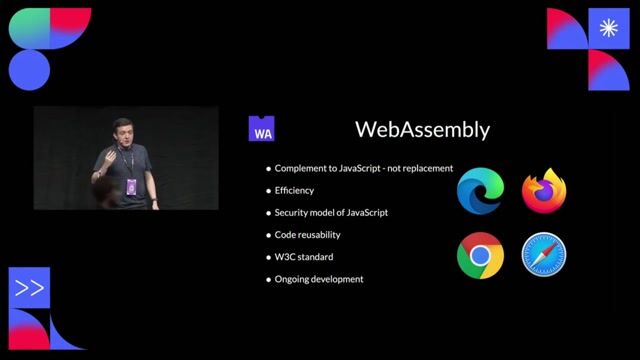
Core principles and security model of WebAssembly

How WebAssembly complements JavaScript natively while maintaining strict sandboxing and broad browser support.

#2 about 3 min

Internal structure and anatomy of a WebAssembly module

How internal code functions, predefined variables, and dynamically loaded memory operate together inside a host environment.

#3 about 2 min

Comparing binary and textual representations of WebAssembly modules

Navigating the technical differences and automated interchangeability between generated binary files and human-readable textual formats.

#4 about 4 min

Understanding stack machine design principles for byte code execution

How computational operations execute sequentially by utilizing a foundational stack machine design directly analogous to virtual environments.

#5 about 5 min

Implementing recursive Fibonacci sequences using native byte code

Constructing a stack-based arithmetic function with embedded recursion and conditional logic to efficiently calculate Fibonacci numbers.

#6 about 4 min

Structuring unrolled loops and branching execution logic safely

Managing repetitive code execution safely by statically combining statically scoped statements and precise index-based jump targets.

#7 about 5 min

Finding array maximums through direct memory loading demonstrations

Iterating over manually loaded memory arrays to conditionally compare numeric elements and efficiently retrieve maximum internal variable states.

#8 about 3 min

Resolving questions on module splitting and supply chain security

Insights addressing the interoperability of isolated modules, essential sandboxing properties, and compatible systems-level compilation languages.

Matching moments

4:54 min

The origins and design principles of WebAssembly

Maurice Brinkmann · WWC 2023

2:40 min

Core concepts and execution mechanics of WebAssembly modules

Edo Edo · WWC 2024

2:51 min

Understanding the WebAssembly binary format and its execution sandbox

Önder Ceylan Önder Ceylan · WWC 2024

2:07 min

Exploring internal WebAssembly architecture and memory safety

Edoardo Dusi · LIVE

2:20 min

Understanding hardware performance advantages of WebAssembly code

Chris Heilmann +3 · LIVE

1:56 min

Core design principles of the WebAssembly standard

Niels Tanis Niels Tanis · WWC 2023

Upcoming sessions on this topic

Open session

World Congress 2026 North America

When Humans Stop Writing Code: Rethinking Languages, Compilers, and Responsibility

Simon Auer

Organizer of flutter vienna meetup and CEO of marqably

Simon Auer
Open session

World Congress 2026 North America

Fast by Design: A Masterclass in High-Performance Web Engineering

Aaron Grogg

Senior web developer, committed to improving the user experience by improving web performance

Aaron Grogg
Open session

World Congress 2026 North America

Honey, look! I vibe-coded an OS!

Ian Smith

CTO, LYOS

Ian Smith
Open session

World Congress 2026 North America

Offloading IoT State: Solving the Memory Crisis on Legacy Hardware

Pravin Nagare

Senior Software Engineer, Roku

Pravin Nagare
Open session

World Congress 2026 North America

Small LLM in your Browser: Huge Opportunities for Web Applications

Daniel Ostrovsky

UI/UX Architect at Payoneer | AI Architect | Full Cycle Development Expert | Public Speaker | Open Source Contributor |

Daniel Ostrovsky
Open session

World Congress 2026 North America

Secure-by-Inclusion: Preventing Accessibility Barriers from Becoming Security Vulnerabilities

Radostina (Ina) Tsvetkova

Norwegian Directorate of Labour and Welfare (NAV), Senior Advisor in Digital Accessibility and Inclusive Design

Radostina (Ina) Tsvetkova