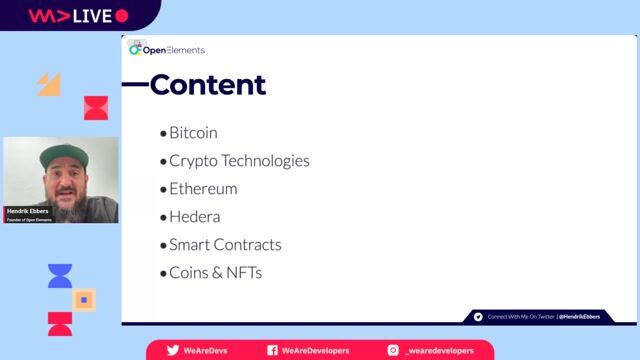
Blockchain, NFT and smart contracts for my application
A bank transfer used to take six days and cost $40. Now it's under a minute for pennies. Learn how.
#1about 5 minutes
The mysterious origins and creator of Bitcoin
Learn about the 2008 white paper, the goals of Bitcoin as an everyday currency, and the enduring mystery of its anonymous creator, Satoshi Nakamoto.
#2about 5 minutes
How crypto wallets work and why coins get lost
A crypto wallet stores your public and private keys, but losing these keys means your funds are permanently inaccessible, unlike a traditional bank account.
#3about 6 minutes
Solving cross-border payments with distributed ledgers
A proof-of-concept using Hedera between banks in South Africa and South Korea dramatically reduced international transfer times and costs from days and $40 to minutes and cents.
#4about 9 minutes
Understanding consensus mechanisms like proof of work
Distributed ledgers achieve trust by having every node execute every transaction, using consensus mechanisms like Proof of Work where nodes solve complex puzzles to validate blocks.
#5about 5 minutes
Introducing Ethereum and programmable smart contracts
Ethereum introduced the Ethereum Virtual Machine (EVM), allowing developers to deploy and execute trusted code, known as smart contracts, directly on the network.
#6about 3 minutes
Comparing the energy consumption of crypto networks
The energy usage of Proof of Work networks like Bitcoin is massive, while newer Proof of Stake systems like Ethereum 2.0 offer a significantly more sustainable alternative.
#7about 7 minutes
Exploring Hedera as a third-generation enterprise ledger
Hedera is a high-performance, carbon-negative distributed ledger governed by a council of major corporations, designed for enterprise use cases like supply chain tracking.
#8about 5 minutes
How to build applications with smart contracts
Applications are built using languages like Solidity, compiled to EVM bytecode, and deployed to the network, with transaction costs determined by computational 'gas' fees.
#9about 5 minutes
Understanding fungible tokens (FTs) and NFTs
Tokens are smart contracts that follow specific standards, with fungible tokens (like money) being interchangeable and non-fungible tokens (NFTs) representing unique digital assets.
#10about 5 minutes
Q&A on digital ownership, NFTs, and scalability
The session concludes with a discussion on the challenges of proving ownership with NFTs for digital art and strategies for ensuring security and scalability in blockchain applications.
Related jobs
Jobs that call for the skills explored in this talk.
From Hype to Code: Real Blockchain Use Cases for DevelopersSo you’ve wrapped your head around why blockchain exists . You’re on board with the concepts: decentralization, immutability, and trust-minimized infrastructure. But now comes the real question:
What can you actually build with it?
This post is for d...
Algorand Foundation
Why Blockchain? A Developer’s PerspectiveFor many developers, blockchain feels like that one friend who keeps trying to sell you on their side hustle: persistent, occasionally confusing, and often surrounded by hype. But behind the buzzwords and market noise lies a technology with real engi...
Dev Digest 177: Blockchain, jQuery and a Prompt PlaygroundInside last week’s Dev Digest 177 .
😫 Do AI tools slow down developers by 20%?
📝 The State of DevSecOps
⚠️ 2.3M Chrome and Edge browsers infected by malicious extensions
🤔 Is it still worth using jQuery?
🪦 10 dead influential programming languages
💻...
From learning to earning
Jobs that call for the skills explored in this talk.