

World Congress 2024 Aug 20, 2024 Session details

Break the Chain: Decentralized solutions for today’s Web2.0 privacy problems

Adam Larter

Centralized databases are massive honeypots waiting to be breached. Discover how decentralized identifiers and verifiable credentials completely eliminate this risk by returning data control to the user.

Pause
Mute Enter Fullscreen
#1 about 2 min

The security risks of centralized application honeypots

Why storing personally identifiable consumer data in massive consolidated databases presents severe vulnerabilities against modern threat actors.

#2 about 2 min

Assessing blockchain scalability for personal data storage

Why immutable public transaction ledgers present distinct privacy challenges when handling inherently sensitive user attribute records.

#3 about 3 min

Financial implications of failing to decentralize architecture

How significant regulatory fines and reputational costs inherently impact businesses lacking modern consumer privacy compliance practices.

#4 about 3 min

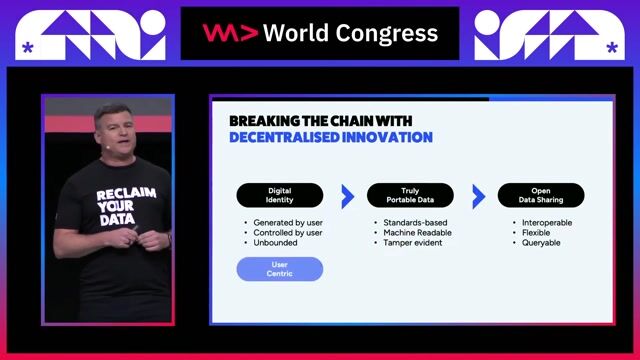
Rethinking data ownership in modern web architecture

Shifting from centralized monolithic systems to flexible architectures where users retain definitive granular consent over identity variables.

#5 about 2 min

Understanding decentralized identifiers for digital entity representation

How decentralized identifiers utilize core cryptographic procedures to uniformly declare individual digital entities without central authorities.

#6 about 3 min

Creating tamper-evident verifiable credentials for application claims

How standardized verifiable frameworks package authenticated assertions into portable cryptographically secured entities.

#7 about 1 min

Sharing selective requested data using verifiable presentations

Compiling carefully isolated demographic attributes from distinct verifiable credentials into concise verifiable presentations for relying parties.

#8 about 1 min

Querying verifiable facts with the presentation exchange format

Leveraging dynamic syntax parameters from the presentation exchange format to request and extract precise credential scopes cleanly.

#9 about 3 min

Adapting OpenID Connect for decentralized data sharing

Modifying typical OAuth delegation models to securely designate individual users as their respective active identity providers.

#10 about 3 min

Executing credential issuance and presentation flows using OIDC

Connecting conventional authentication mechanisms to sovereign digital models using dedicated OID4VCI and OID4VP protocol standards.

#11 about 3 min

Overcoming isolated digital footprints using the Affinity Trust Network

Empowering comprehensive user autonomy using explicit platform ecosystems that consolidate historically fragmented multi-environment behavioral traces safely.

#12 about 1 min

Managing local identity boundaries through the Affinity Vault

Granting isolated users granular management of diverse authentication personas via a localized edge-enabled software component.

#13 about 2 min

Implementing zero-party passwordless authentication via Affinity Login

Removing platform-dependent verification workflows by extracting critical enrollment validations directly from autonomous individual credential storage banks.

#14 about 2 min

Operating developer-friendly identity infrastructure using Affinity Elements

Supervising complex backend logistics including robust cryptographic key handling via unified administrative schema interfaces.

#15 about 3 min

Orchestrating localized consumer queries via the IOTA Framework

Decoupling monolithic query structures and targeting consumer-led interfaces to purposefully limit systemic data over-collection practices.

#16 about 2 min

Harnessing the IOTA SDK to fetch user-consented attributes

Bridging existing browser frontends to decentralized repositories by utilizing websocket connections and concise configuration files.

#17 about 2 min

Anticipating upcoming portable protocols within open-source DIDComm

Integrating open-source DIDComm protocols into decentralized ecosystems to guarantee secure peer-to-peer data transport formatting.

Matching moments

38 sec

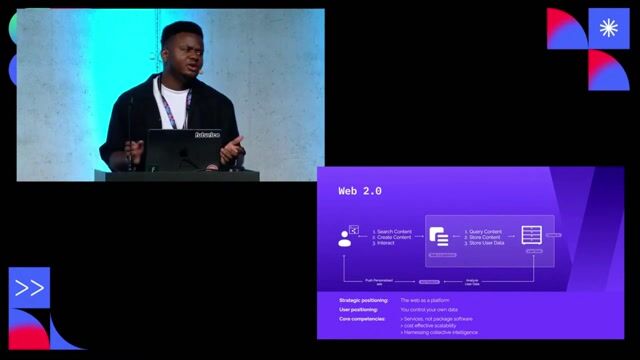
Core primitives of decentralized web applications

Angie Jones Angie Jones +4 · WWC 2024

2:53 min

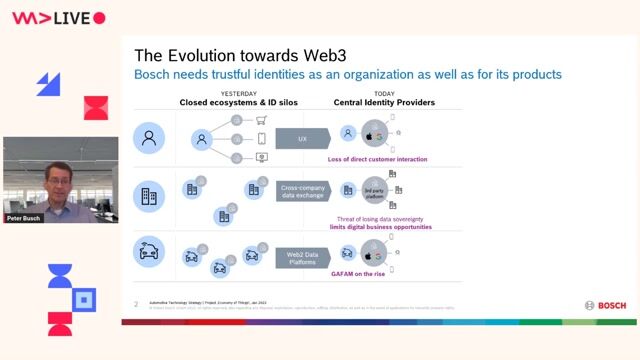
Empowering users with identity and asset ownership in Web3

Darrel Idiagbor Darrel Idiagbor · WWC 2023

6:50 min

Audience Q&A on Web5 and decentralization protocols

Angie Jones Angie Jones · WWC 2023

4:17 min

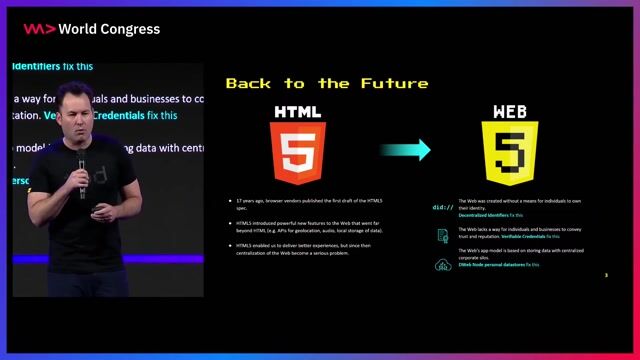
Understanding Web5 architecture and decentralized identifiers

Angie Jones Angie Jones · WWC 2023

53 sec

Securing digital identity with decentralized identifiers

Angie Jones Angie Jones +4 · WWC 2024

3:10 min

The missing identity layer of the web

Angie Jones Angie Jones · WWC 2023

Upcoming sessions on this topic

Open session

World Congress 2026 North America

Securing AI Agent Infrastructure: Identity, Attestation, and Trust at Scale

Abdel Fane

Founder of OpenA2A

Abdel Fane
Open session

World Congress 2026 North America

On the Public Clock: Open-Source Defense When You're Not in the Club

Nicholas Muy

VP Engineering Platform and Security at Scrut.io

Nicholas Muy
Open session

World Congress 2026 North America

When Agents Became Users: Rearchitecting Identity and Permissions for AI at Scale

Yoav Gal, Dor Cohen

Yoav Gal
Dor Cohen
Open session

World Congress 2026 North America

Zero-Trust Architecture for Agentic AI: Securing Multi-User Access and Third-Party Integrations

Borko Djurkovic

Member of Technical Staff at Cohere

Borko Djurkovic
Open session

World Congress 2026 North America

Responsible AI Architecture with Zero Trust Agents

Ashok Prakash

Staff ML Engineer at Apple

Ashok Prakash
Open session

World Congress 2026 North America

Secure-by-Inclusion: Preventing Accessibility Barriers from Becoming Security Vulnerabilities

Radostina (Ina) Tsvetkova

Norwegian Directorate of Labour and Welfare (NAV), Senior Advisor in Digital Accessibility and Inclusive Design

Radostina (Ina) Tsvetkova