World Congress 2024 • Aug 20, 2024 • Session details

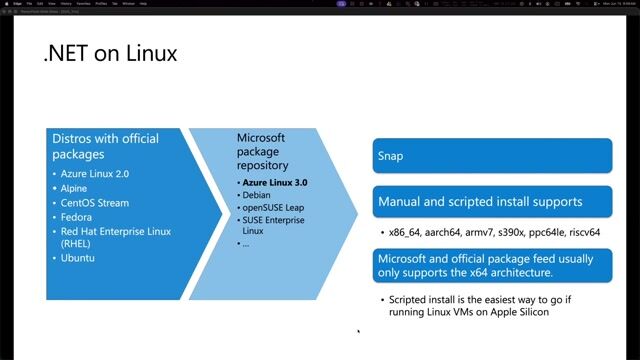
This Is Not Your Father's .NET

Don Schenck

Still think .NET is stuck on legacy Windows servers? Discover how modern .NET powers cross-platform containers, letting developers migrate legacy monolithic applications without painful rewrites.

Pause
Mute Enter Fullscreen
#1 about 4 min

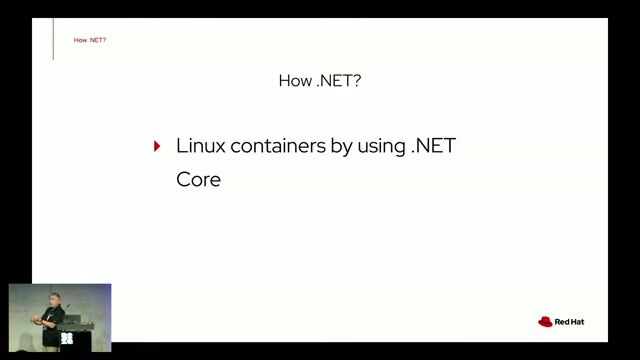
Reasons for adopting modern .NET in containerized environments

How .NET's speed, cross-platform capabilities, and large talent pool make it an ideal choice for container deployments.

#2 about 2 min

Options for deploying .NET applications onto OpenShift clusters

Running Linux containers, Windows containers, and legacy IIS workloads in an OpenShift environment simplifies transitioning legacy code.

#3 about 4 min

Building .NET containers natively using the publish command

Utilizing the dotnet publish command locally allows developers to build containers directly without managing Docker files.

#4 about 4 min

Deploying applications directly to OpenShift using the shift tool

The dotnet shift command-line tool automates the process of building and deploying applications directly into OpenShift namespaces.

#5 about 5 min

Building and running Windows containers locally on Windows servers

Utilizing the open-source Docker engine enables the compilation and execution of Windows binaries within Windows containers locally.

#6 about 4 min

Implementing the strangler pattern for legacy code migration

Running a legacy Windows application alongside modern Linux microservices demonstrates how to incrementally modernize older components.

#7 about 4 min

Running legacy IIS applications in OpenShift using virtual machines

OpenShift virtualization allows complete Windows virtual machines hosting legacy IIS applications to operate within the cluster network.

#8 about 4 min

Injecting environment variables into client-side applications at runtime

A container startup script dynamically replaces placeholders in client-side code with server environment variables before execution.

#9 about 2 min

Enhancing distributed application resilience using the Polly project

Implementing concepts like retries, circuit breakers, and timeouts with the Polly library improves the stability of distributed microservices.

Matching moments

2:14 min

Migrating storage applications to dot net core

Menaka Baskerpillai · LIVE

11:34 min

Answering audience questions on container functionality and local workflows

Rob Richardson · WWC 2021

2:29 min

Combining traditional containers and alternative binaries appropriately

Edoardo Dusi · LIVE

3:32 min

Transitioning from monolith architectures to microservices and Kubernetes

Liviu Costea · LIVE

4:31 min

Addressing local development challenges with Podman Desktop

Stevan Le Meur Stevan Le Meur · WWC 2024

1:54 min

Comparing a legacy e-commerce application with modernized architecture

Niklas Heidloff · LIVE

Upcoming sessions on this topic

Open session

World Congress 2026 North America

Stop Running Mystery Meat in Production

Jeroen van Erp

Technical Advocate @ SUSE

Jeroen van Erp
Open session

World Congress 2026 North America

Run your agents in Kubernetes: Build once, deploy anywhere. But really?

Michal Salanci

Senior Systems Engineer at ESET Cybersecurity

Michal Salanci
Open session

World Congress 2026 North America

From Cloud Native to Multi-Cloud Native: Write Once, Deploy Anywhere

Sandeep Pal

Principal Member of Technical Staff at Salesforce

Sandeep Pal
Open session

World Congress 2026 North America

rm -rf: Horror Stories From Unsandboxed AI Agents (and How Docker Fixes This)

Rishab Kumar

Staff Developer Evangelist @ Twilio

Rishab Kumar
Open session

World Congress 2026 North America

It’s Alive! Taming the MLOps Franken-Stack: Write, Run, and Serve with Michelangelo

Paul Zimmerman, Eric Wang

Paul Zimmerman
Eric Wang
Open session

World Congress 2026 North America

One Repo, One Strategy: Scalable Full-Stack Testing in a Monorepo World

Bartosz Leczycki, Paweł Matynia

Bartosz Leczycki
Paweł Matynia