
World Congress 2024 • Aug 20, 2024 • Session details

A Brief History of Data Storage

Eli (they/them)

Why do modern codebases retain limits inspired by 1800s textile looms? Discover the evolution of data storage and why physical hardware is useless without the language to decode it.

Pause
Mute Enter Fullscreen
#1 about 3 min

The challenge of data storage and durable encodings

Translating concepts into physical objects requires evaluating both medium resilience and the long-term accessibility of formats.

#2 about 3 min

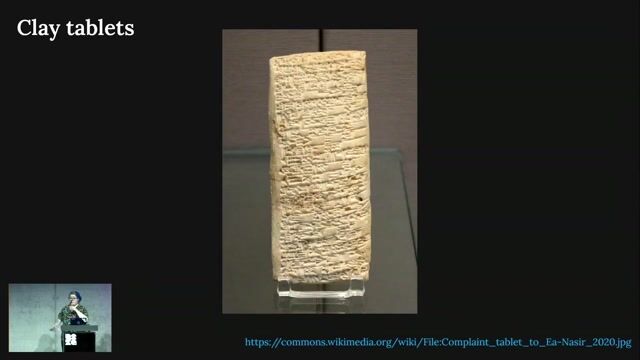
Physical durability of ancient data storage mediums

Historical artifacts like clay tablets and paper manuscripts demonstrate vulnerabilities in both physical formats and lost linguistic encodings.

#3 about 4 min

Origins of automation and punch cards in textiles

Mechanical looms utilized early punch cards to automate complex weaving patterns and inspire computational data encodings.

#4 about 1 min

Vinyl records and the spinning disc storage paradigm

Analog audio formats introduced the concept of encoding data along continuous tracks on a rotating surface.

#5 about 2 min

Computer punch cards and terminal character limits

Tabulation systems utilized standardized electrical punch cards that permanently shaped line length conventions in software development.

#6 about 2 min

Changing magnetic states in core memory

Early magnetic random access memory relied on traversing currents to manipulate bits via a destructive readout process.

#7 about 1 min

Encoding software into core rope memory

Weaving specific wiring topologies into magnetic cores resulted in physically immutable software appropriate for spaceflight applications.

#8 about 3 min

Magnetic sector storage on floppy discs

Portable magnetic media divided rotating surfaces into sectors to manage varying storage densities relative to angular velocity.

#9 about 3 min

Using surface reflectivity for optical media storage

Lasers interpret variations in crystalline alloys or distinct physical indentations across polycarbonate surfaces to retrieve digital information.

#10 about 2 min

Durable cold storage with magnetic tapes

Ferromagnetic tape remains widely functional for robust cloud archives despite significant latency during sequential data access.

#11 about 2 min

Superparamagnetism constraints in dense hard drives

Advancements in magnetic density face fundamental limitations as heat fluctuations randomly flip intensely miniaturized magnetic bits.

#12 about 1 min

Storing charge in MOSFETs for flash memory

Solid state devices maintain states using sub-components capable of indefinitely preserving electrical charge despite eventual physical wear.

#13 about 1 min

High-density synthetic DNA for physical data storage

Engineering specific arrangements of foundational biological compounds yields extreme physical resilience capable of maintaining enormous data footprints.

#14 about 2 min

Engraving durable fused quartz for 5D optical storage

Creating multifaceted structural variations within transparent materials generates exceptionally stable long-term archives resistant to environmental deterioration.

#15 about 2 min

Exploring time crystals for quantum computing memory

Utilizing theoretical subatomic structures oscillating continuously at lowest energy states provides potential mechanisms to retain quantum information.

#16 about 2 min

The importance of documenting data encodings

Persisting data effectively demands strict comprehensive documentation of formats so future developers properly decode the preserved information.

Matching moments

2:06 min

Storing data in hardware and collaborative digital art projects

Chris Heilmann +2 · LIVE

2:45 min

Questioning the enterprise data hoarding mentality

Perf + AI

3:00 min

Preserving objective history on a distributed format

Evan Freeman · LIVE

4:53 min

Examining outdated interface element artifacts in modern software applications

Chris Heilmann +2 · LIVE

2:32 min

Economic incentives for verifiable permanent data storage

Evan Freeman · LIVE

1:50 min

Establishing systemic memory state for organizational digital employees

Dennis Zielke Dennis Zielke +1 · WWC 2025

Upcoming sessions on this topic

Open session

World Congress 2026 North America

You Can’t Re-Run Sunlight: Designing ML Data Architectures for Physical AI

An Phan

Senior Data Infrastructure Engineer @ Hippo Harvest

An Phan
Open session

World Congress 2026 North America

Offloading IoT State: Solving the Memory Crisis on Legacy Hardware

Pravin Nagare

Senior Software Engineer, Roku

Pravin Nagare
Open session

World Congress 2026 North America

When Humans Stop Writing Code: Rethinking Languages, Compilers, and Responsibility

Simon Auer

Organizer of flutter vienna meetup and CEO of marqably

Simon Auer
Open session

World Congress 2026 North America

Honey, look! I vibe-coded an OS!

Ian Smith

CTO, LYOS

Ian Smith
Open session

World Congress 2026 North America

Making Science Larger, not just Faster

Yuval Dvir

Commercial Executive, SandboxAQ

Yuval Dvir
Open session

World Congress 2026 North America

From Software Agents to Physical Devices: Inside the Agentic Hardware Stack

Michael Yuan, Vivian Hu

Michael Yuan
Vivian Hu