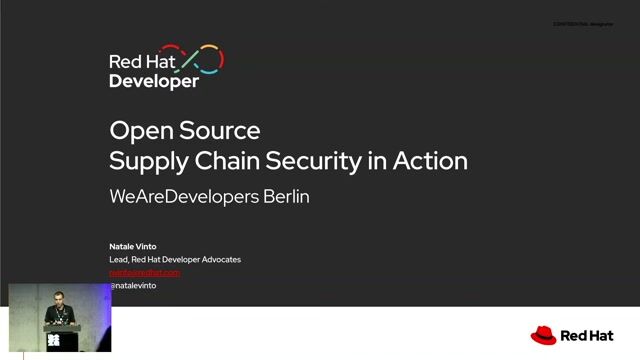

Open Source Secure Software Supply Chain in action
How can you trust the open-source code that makes up your application? This talk demonstrates a verifiable chain of trust using tools like Sigstore and Tekton.
#1about 2 minutes
Understanding the rising threat to software supply chains
The dramatic increase in supply chain attacks necessitates new security standards and government regulations to mitigate risk.
#2about 2 minutes
Exploring the core domains of supply chain security
Securing the supply chain involves understanding software composition with SBOMs, continuous scanning, content signing, and runtime policy enforcement.
#3about 5 minutes
Using open source tools to secure the entire SDLC
A suite of open source tools like Sigstore, Tecton, and Clair can be used to prevent malicious code, safeguard build systems, and monitor deployments.
#4about 2 minutes
Defining key standards and terminology in supply chain security
Understanding critical concepts like SALSA levels, CVEs, provenance, attestation, and SBOMs is essential for implementing robust security.
#5about 3 minutes
Building a secure and opinionated CI/CD pipeline
A secure pipeline can be constructed using Tecton for SALSA compliance and Sigstore for keyless signing of commits and artifacts.
#6about 4 minutes
Comparing a generic vs a security-augmented workflow
A security-augmented workflow integrates checks like local dependency scanning, commit signature verification, and SALSA compliance into the standard development process.
#7about 4 minutes
Demo: Initiating a secure code update for an application
The demonstration begins by scaffolding a microservice from a secure software template and making a code change to update inventory.
#8about 3 minutes
Demo: Scanning and remediating vulnerabilities locally in the IDE
Using an IDE extension, transitive dependencies are scanned for vulnerabilities, which are then fixed by updating the framework and base image versions.
#9about 4 minutes
Demo: Triggering the secure pipeline with a keyless signed commit
The developer uses keyless signing with an OIDC provider to sign the commit, which automatically triggers a secure pipeline that verifies the signature and generates an SBOM.
#10about 3 minutes
Demo: Verifying deployment and monitoring runtime security
The demo concludes by showing the successfully deployed application and using a security dashboard to check for runtime policy violations and visualize network traffic.
Related jobs
Jobs that call for the skills explored in this talk.

Now is the time for industrialized software developmentNow is the time for industrialized software development
Recently, I received a letter from my car’s manufacturer alerting me to a recall. They had discovered a defective part and wanted to replace it.
It was easily fixed, and I might have forgotten a...
Dev Digest 216: CyberSec + Mythos, Stack Overflow for Agents & DOOM in TTFInside last week’s Dev Digest 216 .
🧠 Prompts are now tools in Chrome
📜 The AI Coding Agent Manifesto
🔐 How Claude Mythos changes Cyber Security
🧱 GitHub Stacked PRs to battle AI slop
⚙️ Git commands to run before reading code
🐍 A Python framework f...
Christina Schaireiter
Why Attend a Developer Event?Modern software engineering moves too fast for documentation alone. Attending a world-class event is about shifting from tactical execution to strategic leadership.
Skill Diversification: Break out of your specific tech stack to see how the industry...
From learning to earning
Jobs that call for the skills explored in this talk.