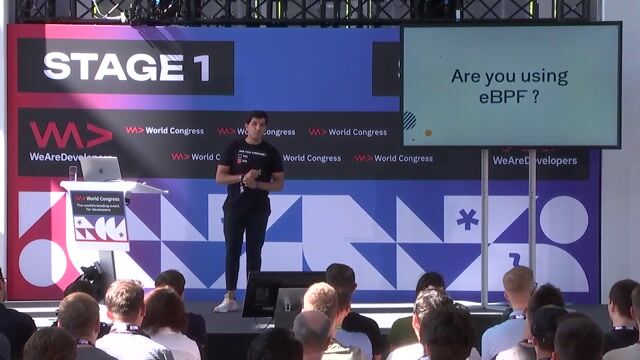
What if you could safely program the Linux kernel without changing its source? Discover how eBPF makes it possible.
#1about 3 minutes
Understanding the origins and naming of eBPF
Learn how eBPF evolved from the classic Berkeley Packet Filter (BPF) and why the names are now used interchangeably in the Linux community.
#2about 4 minutes
Why extending the Linux kernel is traditionally difficult
The Linux kernel manages all system resources, and modifying it historically required either a lengthy core contribution process or maintaining unstable kernel modules.
#3about 4 minutes
Exploring the eBPF architecture and runtime flow
An eBPF program is compiled to bytecode, validated by a verifier for safety, and then JIT-compiled into native code that runs securely inside the kernel.
#4about 3 minutes
A live demo showing eBPF's continuous delivery capability
This simple Python demo illustrates how eBPF programs can be loaded and updated in a running kernel, highlighting benefits like security, efficiency, and continuous delivery.
#5about 5 minutes
Core components of an eBPF program
Discover the essential building blocks of eBPF, including event-driven hooks, key-value maps for state management, and helper functions for interacting with the kernel.
#6about 2 minutes
Practical use cases and libraries for eBPF development
Explore how eBPF is used for network optimization, security, tracing, and profiling, along with popular libraries for Go, Rust, and Python.
#7about 1 minute
Achieving portability with CORE and BTF
The 'Compile Once, Run Everywhere' (CORE) principle, enabled by BPF Type Format (BTF), solves the challenge of running eBPF programs across different kernel versions.
#8about 5 minutes
The eBPF ecosystem, tooling, and future trends
Review popular eBPF-based tools like Cilium and Katran, see how eBPF is changing the sidecar model, and look ahead to its future in hot-fixing and microkernels.
Related jobs
Jobs that call for the skills explored in this talk.
Why Attend a Developer Event?Modern software engineering moves too fast for documentation alone. Attending a world-class event is about shifting from tactical execution to strategic leadership.
Skill Diversification: Break out of your specific tech stack to see how the industry...
Christina Schaireiter
5 Reasons Why Attending Conferences in 2026 Matters More Than You ThinkIt’s 2026, and the “remote vs. office” debate has finally settled into a high-tech hybrid reality. While we’ve perfected the art of shipping production-grade code from decentralized hubs and home setups, something shifted. We realized that while AI c...