Agentic AI - From Theory to Practice: Developing Multi-Agent AI Systems on Azure
"I have a better feeling about that one." If this is your AI evaluation strategy, you need a better way. Learn to measure agent performance with concrete KPIs.
#1about 3 minutes
Understanding the core components of an AI agent
AI agents evolve beyond simple chatbots by using large language models, instructions, and tools to integrate directly into business processes.
#2about 2 minutes
Solving developer challenges with Azure AI Foundry
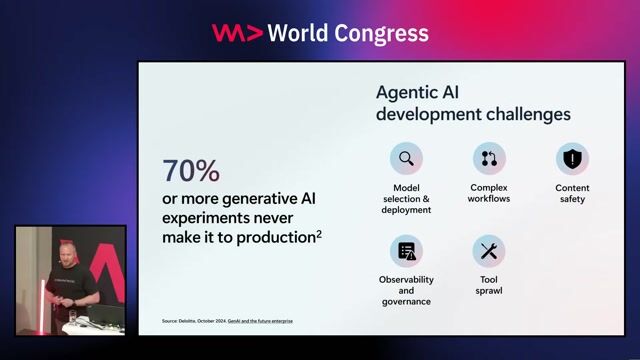
Azure AI Foundry provides a comprehensive platform to address common developer challenges like model selection, security, and observability when building AI agents.
#3about 1 minute
Exploring the Azure AI Foundry Agent Service
The Agent Service offers enterprise-grade features including orchestration, SDK integrations, knowledge tools, and built-in content safety for robust agent development.
#4about 2 minutes
The development lifecycle from ideation to production
The AI application lifecycle consists of ideation, implementation, and operations, starting with low-cost experimentation in GitHub Models before moving to Azure Foundry.
#5about 4 minutes
Experimenting with prompts and models in GitHub
Use GitHub Models to rapidly prototype by comparing different prompts and models against test datasets and using evaluators to generate performance KPIs.
#6about 3 minutes
Integrating evaluation and monitoring into your workflow
Implement a robust evaluation strategy by incorporating KPI checks into CI/CD pipelines and using continuous monitoring with end-to-end tracing in production.
#7about 7 minutes
Building a multi-agent contract analysis application
A practical example demonstrates a multi-agent system that analyzes contracts, checks compliance, and uses automated evaluations for continuous quality assurance.
#8about 2 minutes
Choosing the right multi-agent interaction pattern
Design effective multi-agent systems by selecting the appropriate interaction pattern, such as sequential, concurrent, or group chat, based on your process and outcome goals.
#9about 2 minutes
Implementing agent workflows with Semantic Kernel
Use the Semantic Kernel agent and process frameworks to implement complex multi-agent workflows and deploy them scalably across various environments.
Related jobs
Jobs that call for the skills explored in this talk.
The Web We Broke (And Why AI Agents Are Paying the Price) - AgentCon BerlinThis is the accompanying post to the talk Chris Heilmann gave at AgentCon in Berlin on 19/05/2026, you can also see the slides and listen to it in this screencast:
Thirty years of developer shortcuts, bloated JavaScript, and inaccessible HTML have l...
Elizabeth Fuentes Leone, AWS Developer Advocate, GenAI
From Prototype to Production: Build AI Agents with This Free 4-Course Learning PathAI agents are moving from demos to production systems. However, most developers face challenges bridging this gap. This learning path shows you how.
Interest in AI agents continues to grow in 2025. Developers are building autonomous systems that reas...
Chris Heilmann
With AIs wide open - WeAreDevelopers at All Things Open 2025Last week our VP of Developer Relations, Chris Heilmann, flew to Raleigh, North Carolina to present at All Things Open . An excellent event he had spoken at a few times in the past and this being the “Lucky 13” edition, he didn’t hesitate to come and...
Daniel Cranney
Panel Discussion: Responsible AI in Practice - Real-World Examples and ChallengesIntroductionIn the ever-evolving landscape of artificial intelligence, the concept of "responsible AI" has emerged as a cornerstone for ethical and practical AI implementation. During the WWC24 Panel discussion, three eminent experts—Mina, Bjorn Brin...
From learning to earning
Jobs that call for the skills explored in this talk.