Micro-Frontends with Module Federation: Beyond the Basics
Can you integrate a React app inside an Angular app? Discover the 'Frankenstein architecture' and other advanced patterns for building real-world micro-frontends.
#1about 5 minutes
The role of micro-frontends in scaling development teams
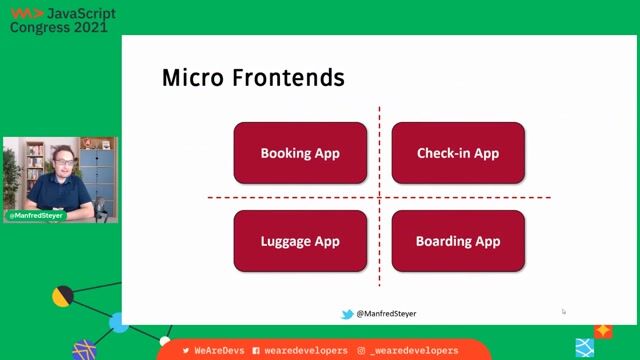
Micro-frontends enable scaling by splitting large applications into smaller parts managed by autonomous teams, with module federation providing the necessary runtime integration.
#2about 8 minutes
The basics of configuring module federation
Module federation uses a host and remote model, where the host application uses dynamic imports to load exposed files from separately deployed remote applications.
#3about 7 minutes
Strategies for managing library version mismatches
Module federation handles version mismatches by default by selecting the highest compatible version, but can be configured with singletons or strict version checks for more control.
#4about 8 minutes
Loading micro-frontends with dynamic federation
Dynamic federation allows loading micro-frontends without upfront configuration by using a helper function and the Webpack runtime API to dynamically construct routes.
#5about 6 minutes
Comparing mono-repos and multiple repos for micro-frontends
Choosing between multiple repositories for strict decoupling or a mono-repository for easier code sharing involves trade-offs in dependency management and version control.
#6about 7 minutes
Building a multi-framework Frankenstein architecture
It is possible to integrate applications built with different frameworks like React or Vue by using a wrapper component to bootstrap them inside a host application.
#7about 2 minutes
Key takeaways for advanced module federation usage
A summary of advanced module federation techniques including version mismatch strategies, dynamic loading, repository structures, and multi-framework integration.
Related jobs
Jobs that call for the skills explored in this talk.
Dev Digest 215: Agent Memory, JS2026, Googlebot Analysis & Canvas❤️HTMLInside last week’s Dev Digest 215 .
🗿 Make AI talk like a caveman
🧠 A guide to context engineering for LLMs
🤖 Simon Willison on agentic engineering
🔐 Axios supply chain attack post mortem
🛡️ Designing AI agents to resist prompt injection
🎨 HTML in c...
Benjamin Ruschin
The HTML Elements That You’re Probably Over-EngineeringAs frameworks have become more and more commonplace in the world of web development, so too has the over-engineering of features made possible by our humble old friend, HTML.
The mental models that come with using state management in React, Vue and o...
Daniel Cranney
Exploring TypeScript: Benefits for Large-Scale JavaScript ProjectsJavaScript is the backbone of web development, powering everything from small websites to large-scale enterprise applications. However, as projects grow in complexity, maintaining JavaScript code can become increasingly difficult. This is where TypeS...
Chris Heilmann
Micro Components - a different approach to a simpler component-based webThere has been a lot of heated discussion lately in the web community about component based development. One side argued that Web Components are a standard we should follow whereas others complained that they still lag behind in what frameworks offer...
From learning to earning
Jobs that call for the skills explored in this talk.