How does a standard web app interact with the blockchain? Learn to connect a front-end to a smart contract using MetaMask and the Web3.js library.
#1about 2 minutes
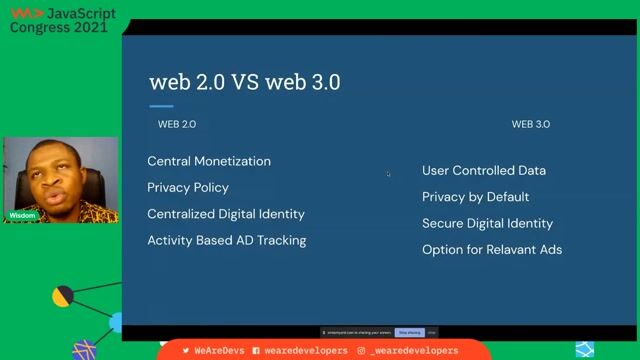
Comparing the core principles of Web2 and Web3
Web2 is characterized by centralized monetization and a lack of user privacy, whereas Web3 offers user control and privacy by default.
#2about 2 minutes
Understanding blockchain as the foundation of Web3
Web3 uses blockchain's distributed ledger technology to create a more secure, open, and trusted internet, solving many of Web2's inherent problems.
#3about 3 minutes
Defining blockchain's key concepts like immutability
Blockchain is an immutable, distributed digital ledger where data is stored in encrypted blocks across a network, making it secure and decentralized.
#4about 3 minutes
Introducing MetaMask and the Web3.js library
MetaMask is a browser extension that functions as a wallet and enables browsers to interact with Ethereum, while Web3.js is the JavaScript library used to communicate with the blockchain.
#5about 4 minutes
Prerequisites for connecting dApps with MetaMask
To connect a front-end application to the blockchain, you need the Web3.js library, a MetaMask wallet, and the specific smart contract's ABI and address.
#6about 8 minutes
Reading and writing to a smart contract via Etherscan
You can directly interact with a deployed smart contract on a block explorer like Etherscan to read data or write new data, which requires signing the transaction with MetaMask.
#7about 7 minutes
Setting up a React front-end with Web3.js
The front-end is built with React and uses an interaction utility file to import Web3.js, the contract ABI, and the contract address to create a contract instance.
#8about 12 minutes
Writing data to the blockchain from a React app
To write data, a transaction object is created with the recipient address and encoded function data, then sent using `window.ethereum.request` which prompts the user to sign in MetaMask.
#9about 8 minutes
Live demo and recap of the dApp architecture
A live demonstration shows the full workflow of updating a smart contract's state from a React front-end, followed by a recap of the project's architecture and a link to the source code.
Related jobs
Jobs that call for the skills explored in this talk.
From Hype to Code: Real Blockchain Use Cases for DevelopersSo you’ve wrapped your head around why blockchain exists . You’re on board with the concepts: decentralization, immutability, and trust-minimized infrastructure. But now comes the real question:
What can you actually build with it?
This post is for d...
Dev Digest 215: Agent Memory, JS2026, Googlebot Analysis & Canvas❤️HTMLInside last week’s Dev Digest 215 .
🗿 Make AI talk like a caveman
🧠 A guide to context engineering for LLMs
🤖 Simon Willison on agentic engineering
🔐 Axios supply chain attack post mortem
🛡️ Designing AI agents to resist prompt injection
🎨 HTML in c...
Algorand Foundation
Why Blockchain? A Developer’s PerspectiveFor many developers, blockchain feels like that one friend who keeps trying to sell you on their side hustle: persistent, occasionally confusing, and often surrounded by hype. But behind the buzzwords and market noise lies a technology with real engi...
From learning to earning
Jobs that call for the skills explored in this talk.