



WeAreDevelopers LIVE Apr 6, 2022

Retooling and refactoring - an investment in people.

Andrew Holway

Cloud migrations frequently stall because complex abstractions paralyze developers. Fix this by treating foundational platform refactoring as a direct, hands-on investment in your engineering team's continuous education.

Pause
Mute Enter Fullscreen
#1 about 2 min

Applying instructional design to technical knowledge acquisition

Using structured instructional design transforms the acquisition of difficult technical paradigms into deliberate, trackable learning outcomes.

#2 about 5 min

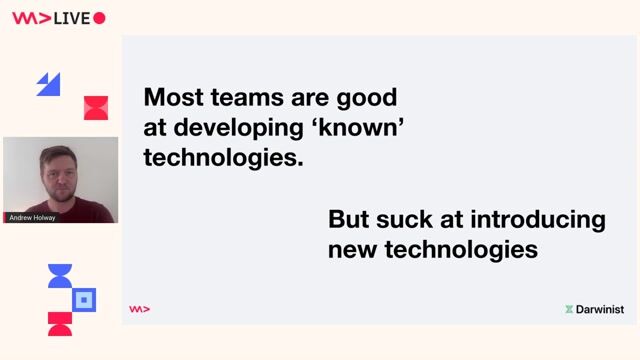
Why agile frameworks fail at new technology adoption

Relying on short research spikes places undue pressure on solo engineers and fails to surface optimal architectural patterns.

#3 about 4 min

Limitations of traditional training and external technical consultants

Traditional abstract IT training ignores the forgetting curve, while outsourcing externalizes tacit tool-using knowledge.

#4 about 2 min

Case study on adopting Kubernetes and Golang effectively

Providing a clear, simple deployment pattern cleanly unblocks legacy migration efforts into modern Kubernetes clusters.

#5 about 2 min

Automating infrastructure to eliminate traditional DevOps roles

Leveraging Kubernetes effectively allows developers to own their deployment lifecycles without handing off work to dedicated DevOps engineers.

#6 about 2 min

Simplifying cloud infrastructure by avoiding complex configuration tools

Dropping heavy orchestration tools like Terraform or Helm for native CLIs directly reduces unneeded declarative abstraction layers.

#7 about 3 min

Separating platform provisioning from application development concerns

Isolating deployment complexity strictly inside Kubernetes allows application developers to independently own schemas and CI/CD pipelines.

#8 about 3 min

Comparing cloud providers and their learning curves

Why simpler default setups in Google Cloud Platform reduce corporate dependencies on specialized platform engineers compared to AWS.

#9 about 6 min

Building internal capabilities through structured organizational skill sprints

Delivering on-the-job educational outcomes ensures teams deeply assimilate new architectural patterns without building permanent vendor dependence.

#10 about 3 min

Insights on transitioning from supercomputing to technical education

How an early career building high-performance computing systems organically shaped a shift towards structured software engineering education.

#11 about 3 min

Refactoring a complex legacy monolith into microservices

How sequentially adopting Kubernetes, modernizing Elasticsearch, and transitioning to Golang solved deep architectural debt for a legacy application.

#12 about 7 min

Convincing organizations to actively invest in engineering skills

Aligning technical learning paths directly with business goals secures corporate funding and structured time for holistic developer growth.

#13 about 4 min

Accelerating productivity and technology adoption in new teams

Pre-defining broad architectural compliance guidelines reduces initial team storming and heavily accelerates project time-to-first-value.

#14 about 3 min

Identifying and advocating for new technical skill requirements

Drafting clear educational roadmaps enables individual developers to effectively pitch large-scale stack migrations directly to executive leadership.

#15 about 4 min

Critical infrastructure and performance skills for modern developers

Mastering CI/CD, database indexing, and SQL query optimization ensures software engineers can efficiently architect and deploy robust codebases.

#16 about 3 min

Evaluating the future of container orchestration and virtualization

A fundamental shift in containerization technology is strictly required before any meaningful new alternative to Kubernetes can emerge.

#17 about 2 min

Leveraging instructional design to improve technical knowledge transfer

Applying formal instructional design principles is ultimately essential for cultivating diverse engineering teams and rapidly onboarding junior developers.

Matching moments

1:57 min

Rethinking corporate training platforms for technical teams

Piet Van Dongen · LIVE

2:24 min

Using failed adoption to drive necessary architectural improvements

Sonja Nesic Sonja Nesic · World Congress 2026 Europe

4:30 min

Transitioning from software engineering into a DevOps trajectory

Davide Imola Davide Imola · LIVE

4:42 min

Fostering team collaboration through common infrastructure abstractions

Chad Carlson · World Congress 2021

3:50 min

Introduction to cloud native infrastructure and platform engineering

Christian Strack · LIVE

1:43 min

Summarizing the organizational benefits of platform engineering

Christian Strack · LIVE

Upcoming sessions on this topic

Open session

World Congress 2026 North America

Culture Doesn't Scale Itself: Leading Engineering Teams Through Hypergrowth and the AI Transition

Thanos Baskous

VP of Engineering and Co-founder of Cogent Security

Thanos Baskous
Open session

World Congress 2026 North America

The Broken Rung: How AI is Rebuilding Software Development from the Ground Up

Tomislav Tipurić

Chief Technology Officer, Nephos

Tomislav Tipurić
Open session

World Congress 2026 North America

Agentic Drift: keeping pace with your agents

John Coghlan

Senior Director, Developer Advocacy at GitLab

John Coghlan
Open session

World Congress 2026 North America

Boring Failover: Predictable Region Recovery Across 5,000 Microservices

Garvit Kataria, Sahil Sabharwal

Garvit Kataria
Sahil Sabharwal
Open session

World Congress 2026 North America

When Humans Stop Writing Code: Rethinking Languages, Compilers, and Responsibility

Simon Auer

Organizer of flutter vienna meetup and CEO of marqably

Simon Auer
Open session

World Congress 2026 North America

Why Infrastructure Forecasting Fails – Building a Self-Serve Forecasting Platform

Ankur Gupta

LinkedIn, Senior Staff Technical Program Manager

Ankur Gupta