

Robots are coming into the wild! Full-Stack Robotics Engineers, be ready!
How are autonomous drones and legged robots transforming dangerous industrial jobs? Discover the rise of the Full-Stack Roboticist and the skills needed to succeed.
#1about 4 minutes
Robots are moving beyond factories into human spaces
The trend of "robots in the wild" signifies a new level of autonomy where robots operate in human environments with minimal supervision.
#2about 2 minutes
Using robots as mobile sensors for data acquisition
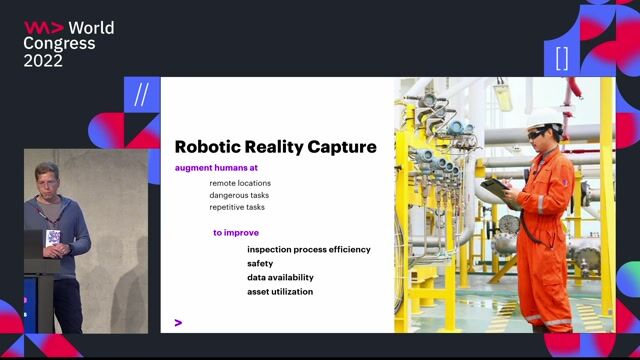
Robotic reality capture is the first enterprise-ready application, using autonomous robots to perform inspections in dangerous or remote locations.
#3about 2 minutes
Automating container bridge inspections with autonomous drones
A case study demonstrates how autonomous drones significantly reduce inspection time and costs for large container bridges in a harbor.
#4about 2 minutes
Using a legged robot for thermal data collection
An energy company uses a legged robot with a thermal camera to autonomously collect equipment performance data in a geothermal plant.
#5about 4 minutes
Visualizing robot-captured data in a 3D digital twin
A demonstration shows how data from robots, like thermal images and 360-degree views, is integrated and visualized within a 3D model of an industrial plant.
#6about 2 minutes
The business case for scaled robotic adoption
Beyond time savings, the business case for robotics includes richer data for maintenance, improved job attractiveness, and enhanced safety.
#7about 3 minutes
Integrating robots into enterprise systems and architecture
A typical robotics system architecture involves connecting the robot platform to a digital twin, IoT sensors, and core enterprise systems like SAP.
#8about 4 minutes
Defining the full-stack enterprise robotics engineer
A full-stack roboticist requires a broad understanding of skills from human-robot interaction and embedded systems to cloud infrastructure and business strategy.
#9about 3 minutes
Exploring the modern robotics technology stack
The robotics technology stack combines open-source tools like ROS with cloud services from AWS and Azure for development, simulation, and fleet management.
#10about 4 minutes
Q&A on transfer learning, ROS, and client adoption
The discussion covers how robots can learn from each other via transfer learning, the growing commercial importance of ROS, and how automation addresses labor shortages.
Related jobs
Jobs that call for the skills explored in this talk.
With AIs wide open - WeAreDevelopers at All Things Open 2025Last week our VP of Developer Relations, Chris Heilmann, flew to Raleigh, North Carolina to present at All Things Open . An excellent event he had spoken at a few times in the past and this being the “Lucky 13” edition, he didn’t hesitate to come and...
Daniel Cranney
Panel Discussion: Responsible AI in Practice - Real-World Examples and ChallengesIntroductionIn the ever-evolving landscape of artificial intelligence, the concept of "responsible AI" has emerged as a cornerstone for ethical and practical AI implementation. During the WWC24 Panel discussion, three eminent experts—Mina, Bjorn Brin...
Christina Schaireiter
5 Reasons Why Attending Conferences in 2026 Matters More Than You ThinkIt’s 2026, and the “remote vs. office” debate has finally settled into a high-tech hybrid reality. While we’ve perfected the art of shipping production-grade code from decentralized hubs and home setups, something shifted. We realized that while AI c...
Christina Schaireiter
Why Attend a Developer Event?Modern software engineering moves too fast for documentation alone. Attending a world-class event is about shifting from tactical execution to strategic leadership.
Skill Diversification: Break out of your specific tech stack to see how the industry...
From learning to earning
Jobs that call for the skills explored in this talk.