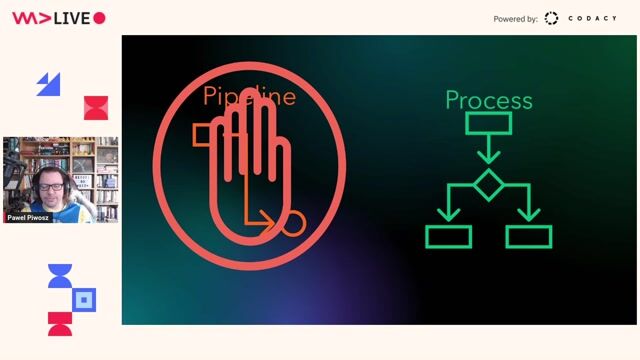
Stop building CI/CD pipelines. Start architecting an enterprise delivery process that aligns your entire organization.
#1about 4 minutes
Moving beyond tools to architect CI/CD processes
Traditional CI/CD planning is often limited to tools and environments, but a broader, organizational perspective is required for enterprise success.
#2about 5 minutes
How organizational structure shapes your system design
Conway's Law demonstrates that a system's architecture will mirror the organization's communication structure, making team topologies a critical starting point.
#3about 2 minutes
Planning your environment strategy and access control
A comprehensive environment strategy must consider not just names but also structure, ownership, and access levels, which directly impacts tooling requirements.
#4about 3 minutes
Selecting a branching strategy that fits your architecture
The choice between strategies like trunk-based development or GitFlow depends on the application architecture, repository design, and access management policies.
#5about 4 minutes
Differentiating continuous delivery and continuous deployment
Continuous delivery involves a manual approval step before production, whereas continuous deployment is fully automated, requiring different quality gates and deployment strategies.
#6about 2 minutes
Defining a robust artifact management strategy
Artifact management involves decisions on storage, naming conventions, and retention policies, which can be dictated by industry compliance requirements.
#7about 2 minutes
Defining quality gates and team responsibilities
The CI/CD process must define quality gates, whether manual or automated, and establish clear responsibilities and escalation paths for failures.
#8about 3 minutes
Evaluating team capabilities and system constraints
Designing a CI/CD process requires assessing team maturity and knowledge alongside business, technical, and security constraints that shape what is possible.
#9about 4 minutes
Designing release strategies and rollback procedures
Release strategies must account for business constraints like approval windows, and a clear plan for rollbacks and roll-forwards is essential for system stability.
#10about 4 minutes
Measuring CI/CD performance with DORA metrics
Key performance indicators like SLAs and SLOs, particularly the four DORA metrics, provide objective measurements of CI/CD process throughput and stability.
#11about 3 minutes
Mapping value streams to identify process bottlenecks
Viewing the CI/CD pipeline as the core of a value stream allows teams to map the entire process and identify waste and bottlenecks for improvement.
#12about 5 minutes
Integrating security throughout the CI/CD process
Security must be a core part of the CI/CD architecture, covering secrets management, dependency scanning, SBOM generation, and secure tool integrations.
#13about 3 minutes
A framework for aligning stakeholders on CI/CD
The mind map of CI/CD components serves as a shared language or "Rosetta Stone" to facilitate discussion and alignment between all stakeholders.
#14about 13 minutes
Q&A on the future of CI/CD and tooling
The speaker answers audience questions on topics including the future role of AI, preferred monitoring stacks, popular scripting languages, and multi-cloud strategies.
Related jobs
Jobs that call for the skills explored in this talk.
Now is the time for industrialized software developmentNow is the time for industrialized software development
Recently, I received a letter from my car’s manufacturer alerting me to a recall. They had discovered a defective part and wanted to replace it.
It was easily fixed, and I might have forgotten a...
Why Attend a Developer Event?Modern software engineering moves too fast for documentation alone. Attending a world-class event is about shifting from tactical execution to strategic leadership.
Skill Diversification: Break out of your specific tech stack to see how the industry...
From learning to earning
Jobs that call for the skills explored in this talk.