Reverse Vending Machine (RVM) Security: Real World Exploits / Vulnerabilities
Security is often an optional, paid feature. Learn how this choice enabled researchers to print fraudulent cash receipts from a supermarket's reverse vending machines.
#1about 3 minutes
The financial incentive for hacking reverse vending machines
Reverse vending machines present a security risk because they exchange returned bottles for money, creating an opportunity for financial exploits.
#2about 4 minutes
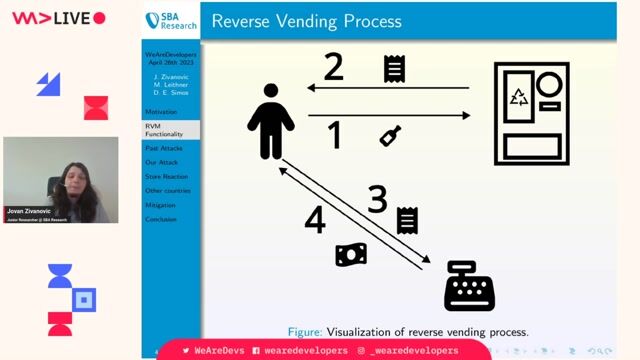
Understanding the bottle detection and refund process
RVMs use a combination of sensors like barcode scanners, weight sensors, shape detectors, and material analysis to validate and process returned bottles.
#3about 4 minutes
Categorizing common reverse vending machine attack vectors
Attacks on RVMs fall into three main categories: insider manipulation, tricking the bottle acceptance system, and misclassifying bottles for higher payouts.
#4about 4 minutes
Analyzing supermarket receipts to find security flaws
By collecting and comparing receipts from different supermarket chains, researchers identified patterns in barcode generation to find potential vulnerabilities.
#5about 4 minutes
Discovering a predictable and static barcode vulnerability
One supermarket chain used a static EAN-13 barcode on receipts where the refund amount was directly encoded, making it easy to forge.
#6about 2 minutes
Forging a valid receipt with a script and printer
A simple script and a thermal printer can generate a forged receipt with a custom refund amount that is accepted by the store's checkout system.
#7about 2 minutes
The vendor response to the disclosed vulnerability
The RVM manufacturer confirmed the vulnerability and stated that the secure, cloud-validated solution is an optional feature that customers must pay extra for.
#8about 3 minutes
Finding similar and new exploits in Finland's RVMs
An investigation in Finland revealed the same receipt forgery vulnerability, plus a new attack involving swapping barcode stickers on bottles to claim a higher refund.
#9about 2 minutes
Mitigating receipt fraud with a cloud validation system
The most effective way to prevent receipt forgery is to use a centralized data store that generates a unique ID for each receipt and invalidates it after one use.
#10about 9 minutes
Q&A on blockchain, pentesting, and ethical implications
The speaker discusses using blockchain for validation, the importance of early security involvement and pentesting, and the ethics of exploiting recycling systems.
Related jobs
Jobs that call for the skills explored in this talk.
Dev Digest 138 - Are you secure about this?Hello there! This is the 2nd "out of the can" edition of 3 as I am on vacation in Greece eating lovely things on the beach. So, fewer news, but lots of great resources. Many around the topic of security. Enjoy! News and ArticlesGoogle Pixel phones t...
Daniel Cranney
Dev Digest 191: Malware interviews, EU ❤️ Open Source and Skilled AgentsInside last week’s Dev Digest 191 .
💻 Want to write for the WeAreDevelopers Magazine?
⚒️ Claude skills - a less token hungry MCP?
🫰 How much does Cursor spend on AWS?
🧠 LLMs and Brain Rot
🟥 Change your NPM tokens now!
🧑 Fake AI recruiters delivering...
Daniel Cranney
The Overflow: Security and PrivacyEvery week we dig through hundreds of links from all over the web, and it’s often hard for developers keep up. So, we thought we’d put together some links we couldn’t fit in the Dev Digest in what we call The Overflow.
This week, we’re looking at wha...