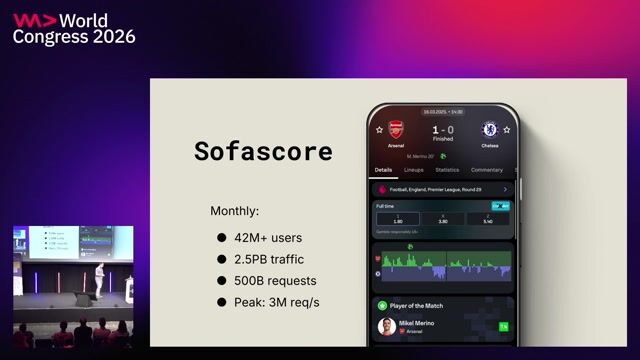


Our first server crashed so often, we survived by manually uploading an HTML file via FTP. Now, we serve 20 million users on a global scale.
#1about 2 minutes
An overview of scaling a sports app to millions of users
The initial single-server architecture for a sports results app struggled with exponential user growth, leading to frequent server crashes under load.
#2about 6 minutes
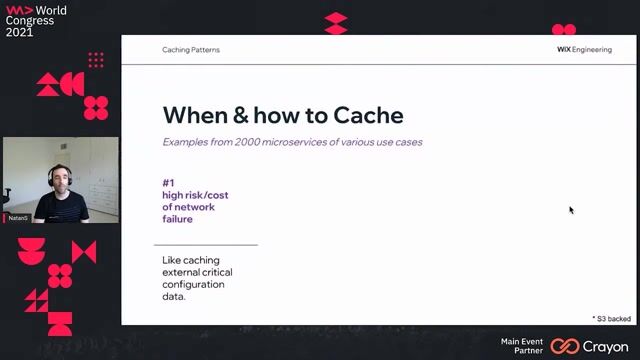
Using proactive and manual caching to survive traffic spikes
Early scaling involved using Memcached with proactive caching to pre-load live data, culminating in a manual static HTML file hack to handle a massive event.
#3about 3 minutes
Moving to the cloud and implementing Varnish cache
The first cloud migration to AWS introduced Varnish for superior HTTP caching and request coalescing, alongside stateless AMIs for effective auto-scaling.
#4about 2 minutes
Migrating from MongoDB to Postgres for data reliability
After encountering data type errors and a lack of locking in MongoDB, a live migration to Postgres was performed to gain stability and analytical power.
#5about 2 minutes
Optimizing cache efficiency with a dedicated sharded layer
To solve cache inefficiency from auto-scaling, the architecture was changed to a dedicated, sharded Varnish layer in front of application servers.
#6about 2 minutes
Migrating from cloud to on-premise to reduce costs
High AWS traffic costs prompted a move back to an over-provisioned on-premise data center, drastically reducing infrastructure expenses relative to user growth.
#7about 4 minutes
Solving global latency with a distributed cache network
To improve performance for international users, a globally distributed cache was implemented with geo-routing, reducing average latency from 500ms to 80ms.
#8about 2 minutes
Adopting Kubernetes for multi-datacenter redundancy
After a provider's data center fire, a second data center was added and managed with Kubernetes to ensure high availability and simplify deployments.
#9about 1 minute
Implementing real-time updates with NATS messaging
To eliminate polling delays and deliver instant updates, a pub/sub architecture using NATS messaging was implemented for millions of concurrent client connections.
#10about 2 minutes
Managing petabyte-scale analytics data with ClickHouse
To power AI/ML models and analyze nearly a petabyte of data on-premise, ClickHouse was chosen for its high-performance analytical capabilities.
#11about 2 minutes
Key principles for building scalable and efficient infrastructure
The core lessons learned include prioritizing statelessness, aggressive caching, using queues for slow tasks, and choosing the right tool for each specific job.
Related jobs
Jobs that call for the skills explored in this talk.

Why Attend a Developer Event?Modern software engineering moves too fast for documentation alone. Attending a world-class event is about shifting from tactical execution to strategic leadership.
Skill Diversification: Break out of your specific tech stack to see how the industry...
All the videos of Halfstack London 2024!Last month was Halfstack London, a conference about the web, JavaScript and half a dozen other things. We were there to deliver a talk, but also to record all the sessions and we're happy to share them with you. It took a bit as we had to wait for th...