
Imran Nazar
Brewing Tea over the Internet
#1about 3 minutes
The early design and limitations of HTTP 0.9
The initial HTTP protocol only had a single 'GET' verb and lacked status codes, making it difficult to programmatically distinguish between successful responses and errors.
#2about 3 minutes
Standardizing HTTP 1.0 with verbs and status codes
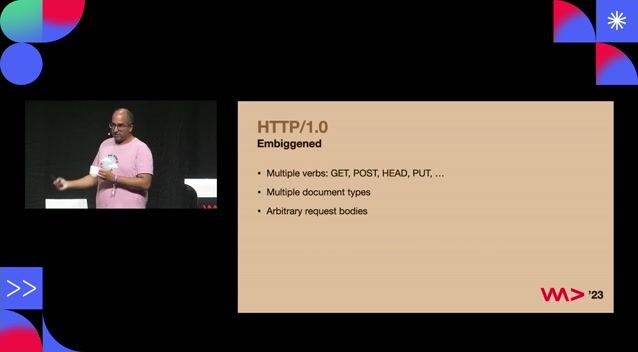
HTTP 1.0 formalized the protocol by adding multiple verbs like POST and PUT, standardized status codes for programmatic error handling, and headers like the misspelled 'Referer'.
#3about 4 minutes
The challenge of submitting complex form data over HTTP
To handle file uploads in web forms, developers reused email standards, forcing web servers to parse email-formatted requests sent over HTTP.
#4about 4 minutes
Satirizing protocol extensions with the coffee pot protocol
RFC 2324, an April Fools' standard, satirized inappropriate HTTP extensions by creating the Hyper Text Coffee Pot Control Protocol (HTCPCP) with a 'BREW' verb and the famous '418 I'm a teapot' error.
#5about 2 minutes
Extending the coffee pot protocol to support brewing tea
RFC 7168 extends the coffee pot protocol for tea, using the '300 Multiple Options' status code to allow a client to select from a list of available teas.
#6about 2 minutes
Evaluating REST APIs and proper use of status codes
While REST is a logical extension of HTTP's verbs for database operations, returning a 200 OK status with an error in the body undermines the purpose of status codes.
#7about 2 minutes
Exploring other notable April Fools' internet standards
Other humorous yet insightful April Fools' RFCs include specifying an 'evil bit' in TCP packets for firewalls and defining IP over Avian Carriers.
#8about 1 minute
Physical implementations of the coffee pot control protocol
While no fully compliant HTCPCP coffee pots exist due to the protocol's joke nature, many systems implement the '418 I'm a teapot' response and a hackathon project built a working device.
#9about 3 minutes
Q&A on IP over Avian Carriers and HTTP/2
The Q&A session addresses the practical limitations of IP over Avian Carriers, such as high latency and packet loss, and touches on the non-human-readable nature of HTTP/2.
Related jobs
Jobs that call for the skills explored in this talk.
Matching moments
00:38 MIN
Exploring bizarre headlines about IoT and robotics
Fake or News: Coding on a Phone, Emotional Support Toasters, ChatGPT Weddings and more - Anselm Hannemann
08:00 MIN
The future of cURL security without a bounty program
Don’t Insert Crazy! On cURL and AI Slop - Daniel Stenberg
02:50 MIN
Planning for project continuity and the bus factor
Don’t Insert Crazy! On cURL and AI Slop - Daniel Stenberg
04:30 MIN
Understanding browser APIs that rely on company services
Developer Time Is Valuable - Use the Right Tools - Kilian Valkhof
01:06 MIN
Malware campaigns, cloud latency, and government IT theft
Fake or News: Self-Driving Cars on Subscription, Crypto Attacks Rising and Working While You Sleep - Théodore Lefèvre
03:18 MIN
Monetizing open source with commercial support contracts
Don’t Insert Crazy! On cURL and AI Slop - Daniel Stenberg
06:33 MIN
The security challenges of building AI browser agents
AI in the Open and in Browsers - Tarek Ziadé
03:31 MIN
The value of progressive enhancement and semantic HTML
WeAreDevelopers LIVE – You Don’t Need JavaScript, Modern CSS and More
Featured Partners
Related Videos
The year 3000, a brief history of Web Development
Lorenzo Pieri
Closing Keynote by Joel Spolsky
Joel Spolsky
Awful APIs: A History Lesson in Industry Mistakes and Mishaps
James Seconde
API = Some REST and HTTP, right? RIGHT?!
Rustam Mehmandarov
Coffee with Developers: David Heinemeier Hansson
David Heinemeier Hansson
REST in Peace? What does the API protocol of the future look like? Or do we have it already?
Simon Auer
The State Of The Web
Jeremy Keith
The Resilience of the World Wide Web
Niels Leenheer
Related Articles
View all articles


From learning to earning
Jobs that call for the skills explored in this talk.



Teads
Paris, France
Remote
Azure
Kafka
Terraform
TypeScript
+2

Pronetx
Leeds, United Kingdom
Remote
Intermediate
API
GIT
JIRA
Python
+7

Tether Operations Limited
Amsterdam, Netherlands
Remote
Senior
API
C++
React
SQLite
+6