Simon Auer
REST in Peace? What does the API protocol of the future look like? Or do we have it already?
#1about 3 minutes
Why REST APIs are still the industry standard
Despite its age, REST remains the dominant API protocol, similar to other long-lasting technologies from the early 2000s.
#2about 1 minute
Identifying the key limitations of REST APIs
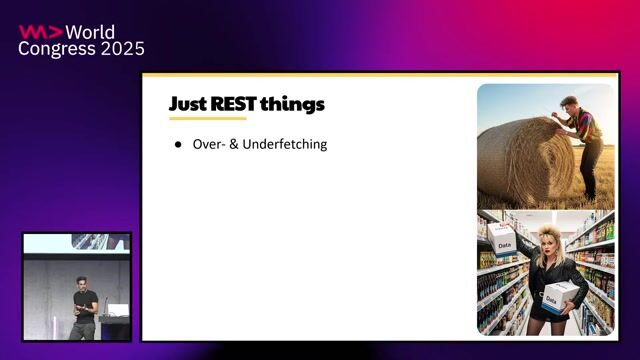
REST APIs commonly suffer from over-fetching, under-fetching, undefined structures, request overhead, and a lack of real-time support.
#3about 4 minutes
Categorizing different types of API technologies
APIs can be grouped into resource-oriented (REST, GraphQL), procedure-oriented (RPC), and server-driven UI approaches.
#4about 3 minutes
Deconstructing REST for a future API wishlist
REST provides foundational features like authentication, caching, and a vast client ecosystem, which are essential for any future API protocol.
#5about 3 minutes
How GraphQL improves upon REST's limitations
GraphQL addresses REST's data fetching issues with strong schema-based typing, built-in introspection, and flexible querying capabilities.
#6about 3 minutes
Exploring gRPC for high-performance communication
gRPC offers high performance and low latency for internal services through its remote procedure call model and efficient Protobuf serialization.
#7about 2 minutes
Learning from Firebase's developer experience features
Firebase provides valuable developer experience features like offline persistence, declarative permission rules, and automatic scaling that are desirable in a future API.
#8about 2 minutes
Compiling the wishlist for the API of the future
The ideal future API combines the best features for developer experience, performance, and security, potentially enhanced with AI for documentation and optimization.
#9about 1 minute
Choosing the right API protocol for today's needs
While the ideal future API doesn't exist, developers can choose REST for simplicity, GraphQL for complex data, and gRPC for high-performance microservices.
Related jobs
Jobs that call for the skills explored in this talk.
Matching moments
02:07 MIN
Exploring alternatives to REST like gRPC and GraphQL
API = Some REST and HTTP, right? RIGHT?!
02:52 MIN
Tracing the evolution of APIs from RPC to GraphQL
The Great API Debate: REST, GraphQL, or gRPC?
03:35 MIN
Evaluating the pros and cons of REST, GraphQL, and gRPC
The Great API Debate: REST, GraphQL, or gRPC?
02:21 MIN
Architectural differences between REST, GraphQL, and gRPC
The Great API Debate: REST, GraphQL, or gRPC?
01:46 MIN
Choosing the right API for different project needs
The Great API Debate: REST, GraphQL, or gRPC?
02:43 MIN
Designing APIs for trust and backward compatibility
API‑First: How Twilio Designs for Developers - Justin Kitagawa (Twilio)
02:59 MIN
Questioning the default need for a REST API
Seven Myths, Three Reasons, One Goal
02:03 MIN
Key takeaways and further API design topics
API Design - Getting Started
Featured Partners
Related Videos
API = Some REST and HTTP, right? RIGHT?!
Rustam Mehmandarov
The Great API Debate: REST, GraphQL, or gRPC?
Alexis Yushin
Awful APIs: A History Lesson in Industry Mistakes and Mishaps
James Seconde
GraphQL: Does it replace SQL, REST or Something Else?
Gregor Bauer
Lessons from Our API Past: Evolving to a Resilient API Future
Yousaf Nabi
Designing gRPC APIs - The things they don't tell you
Bastian Eicher
Lessons learned from observing a billion API requests
Pratim Bhosale
Evolving your APIs, a step-by-step approach
Nicolas Fränkel
Related Articles
View all articles


From learning to earning
Jobs that call for the skills explored in this talk.

Code Healers LLC
Hinesville, United States of America
Remote
€40-50K
Intermediate
Senior
PHP
.NET
React
+2

PiNCAMP GmbH
Berlin, Germany
Senior
React
GraphQL
Next.js

&why GmbH
Berlin, Germany
€50-70K
Junior
Intermediate
Senior
React
Next.js
TypeScript

Confideck GmbH
Vienna, Austria
Remote
Intermediate
Senior
Node.js
MongoDB
TypeScript

Api Workflowoscar Associates (uk) Limited
Hay-on-Wye, United Kingdom
API
REST


adesso SE
Saarbrücken, Germany
Remote
Senior
API
Continuous Integration

