Is your backend a hodgepodge of queues, event stores and cron jobs? Durable Execution to the Rescue.
Your code fails, a server reboots, and your process continues exactly where it left off. This is the promise of durable execution.
#1about 4 minutes
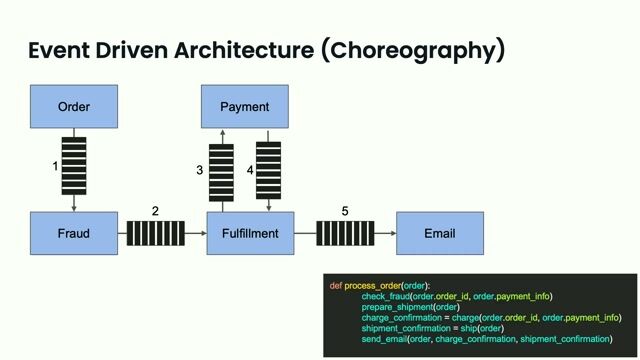
The hidden complexity of event-driven architectures
Event-driven systems using queues create a complex web of dependencies that makes state management, error handling, and long-running operations difficult.
#2about 2 minutes
Why traditional orchestration engines often fail developers
While orchestration centralizes logic, traditional workflow engines suffer from poor programming models that rely on visual designers or restrictive DSLs instead of real code.
#3about 2 minutes
Introducing the durable execution programming paradigm
Durable execution is a concept where application code and its state are automatically preserved across process crashes, machine failures, and deployments.
#4about 3 minutes
How state is recovered using event logging and replay
The durable execution model is implemented by logging the results of external operations and replaying the code from the beginning, feeding it the logged results to restore state.
#5about 5 minutes
The challenge of writing deterministic code for replay
To ensure reliable recovery via replay, the application code must be deterministic, requiring special handling for non-deterministic operations like random numbers, system time, and concurrency.
#6about 3 minutes
Temporal as an open source durable execution system
Temporal is an open-source platform that implements the durable execution paradigm, providing a backend service and SDKs to build resilient applications.
#7about 3 minutes
Writing a durable workflow with the Python SDK
A practical example shows how to define workflows and activities in Python using the Temporal SDK, which handles state persistence and retries automatically.
#8about 3 minutes
Common use cases for durable execution systems
Durable execution is a general-purpose abstraction applicable to a wide range of problems, including infrastructure provisioning, CI/CD pipelines, data processing, and complex business transactions.
#9about 3 minutes
Q&A on idempotency and business logic boundaries
The platform handles infrastructure failures, but developers are still responsible for business logic concerns like activity idempotency and handling data changes over time.
Related jobs
Jobs that call for the skills explored in this talk.
Why Attend a Developer Event?Modern software engineering moves too fast for documentation alone. Attending a world-class event is about shifting from tactical execution to strategic leadership.
Skill Diversification: Break out of your specific tech stack to see how the industry...