Diana Todea
Serverless Observability: where SLOs meet transforms
#1about 3 minutes
Using transforms to solve scaling challenges in serverless
Elasticsearch transforms are used to create summarized indices from large datasets, addressing scaling issues during a serverless migration.
#2about 3 minutes
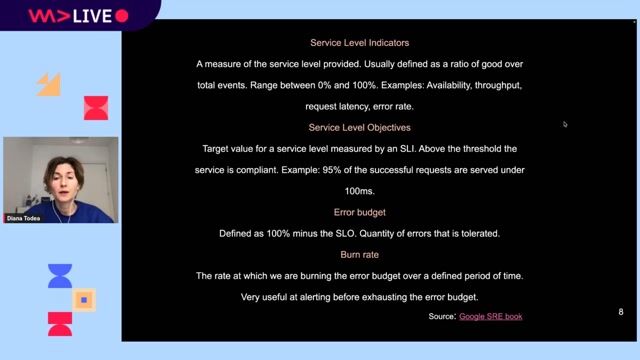
Understanding core SRE concepts like SLIs and SLOs
Service Level Indicators (SLIs) measure performance, while Service Level Objectives (SLOs) set targets to meet agreements (SLAs), with error budgets defining tolerance.
#3about 4 minutes
Exploring different SLO indicator types in Elasticsearch
A review of various SLO indicator types like APM availability, APM latency, and custom KQL helps in choosing the right metric for service monitoring.
#4about 3 minutes
How transforms power the underlying SLO architecture
The SLO architecture relies on a multi-layered transform service to roll up source data into summarized, entity-centric indices for efficient querying.
#5about 4 minutes
Creating transforms and setting up health alerts
Learn to create a transform through the Kibana UI and configure a transform health alert to monitor its status and trigger notifications via connectors.
#6about 2 minutes
Implementing burn rate alerting for proactive monitoring
Burn rate alerting uses multiple time windows to track how quickly the error budget is consumed, providing early warnings before an SLO is breached.
#7about 4 minutes
A practical demo of creating SLOs and dashboards
This demonstration walks through creating a transform, defining a custom SLO with a burn rate alert, and visualizing the results in a Kibana dashboard.
#8about 2 minutes
Managing SLOs and transforms with Elasticsearch APIs
Use the Dev Tools console in Kibana to interact with APIs for programmatically managing SLOs and transforms, which is useful for automation and troubleshooting.
#9about 3 minutes
Fostering cross-team collaboration with SLOs
Implementing SLOs is an organizational effort that requires collaboration between SRE, developers, product, and support teams to align on reliability goals.
#10about 5 minutes
Actionable takeaways for SREs on incident management
SREs should focus on understanding user expectations, defining key SLIs, balancing reliability and innovation, and using historical data to inform decisions.
#11about 9 minutes
Q&A on setting realistic SLOs and choosing tools
The discussion covers how to set achievable SLO targets, handle variance in serverless environments, and the benefits of in-house versus open-source monitoring tools.
#12about 7 minutes
Q&A on team alignment and prioritizing SLO work
This section addresses how to align multiple teams on SLOs through regular communication and how to prioritize improvements in the backlog, often driven by incidents or user feedback.
#13about 10 minutes
Q&A on third-party dependencies and new features
The final questions cover strategies for managing SLOs tied to third-party dependencies and balancing the introduction of new features with service reliability.
Related jobs
Jobs that call for the skills explored in this talk.
ROSEN Technology and Research Center GmbH
Osnabrück, Germany
Senior
TypeScript
React
+3
SD Worx
Antwerp, Belgium
Intermediate
Senior
Azure
DevOps
+1
Matching moments
01:32 MIN
Organizing a developer conference for 15,000 attendees
Cat Herding with Lions and Tigers - Christian Heilmann
03:34 MIN
The business case for sustainable high performance
Sustainable High Performance: Build It or Pay the Price
05:12 MIN
How to build structure and culture without killing agility
From Data Keeper to Culture Shaper: The Evolution of HR Across Growth Stages
04:57 MIN
Increasing the value of talk recordings post-event
Cat Herding with Lions and Tigers - Christian Heilmann
02:55 MIN
Why developers often undervalue their time and paid tools
Developer Time Is Valuable - Use the Right Tools - Kilian Valkhof
02:20 MIN
The evolving role of the machine learning engineer
AI in the Open and in Browsers - Tarek Ziadé
03:39 MIN
Breaking down silos between HR, tech, and business
What 2025 Taught Us: A Year-End Special with Hung Lee
09:10 MIN
How AI is changing the freelance developer experience
WeAreDevelopers LIVE – AI, Freelancing, Keeping Up with Tech and More
Featured Partners
Related Videos
End the Monolith! Lessons learned adopting Serverless
Nočnica Fee
DevOps for AI: running LLMs in production with Kubernetes and KubeFlow
Aarno Aukia
Leverage Cloud Computing Benefits with Serverless Multi-Cloud ML
Linda Mohamed
Observability with OpenTelemetry & Elastic
Iulia Feroli
Serverless deployment of (large) NLP models
Marek Suppa
Serverless: Past, Present and Future
Oliver Arafat
Server Side Serverless in Swift
Sebastien Stormacq
Applying Agile Principles to Incident Management
Tobias Dunn-Krahn
Related Articles
View all articles

.gif?w=240&auto=compress,format)

From learning to earning
Jobs that call for the skills explored in this talk.

Salve.Inno Consulting
Municipality of Madrid, Spain
Senior
DevOps
Python
Gitlab
Docker
Grafana
+7

Plexus Tech
Municipality of Madrid, Spain
Go
DevOps
Python
Kubernetes
Amazon Web Services (AWS)

Client Server
Esher, United Kingdom
Remote
£60-70K
Senior
Linux
DevOps
Docker
+5

SlashMobility
Barcelona, Spain
Bash
Azure
DevOps
Python
Ansible
+6

Bluelight Consulting
San Salvador, Spain
Remote
Azure
DevOps
Gitlab
Puppet
+9

Downforce Technologies
Bristol, United Kingdom
Intermediate
DevOps
Continuous Integration
Amazon Web Services (AWS)

theHRchapter
Calp, Spain
Remote
DevOps
Agile Methodologies
Continuous Integration

SlashMobility
Municipality of Madrid, Spain
YAML
DevOps
Docker
TypeScript
Kubernetes

Siemens AG
Berlin, Germany
C++
GIT
CMake
Linux
DevOps
+7