





World Congress 2026 Europe • Jul 9, 2026 • Session details

Let’s Talk Quality!

Lilia Gargouri

AI rapidly accelerates coding. However, it also introduces untested flaws and severe cognitive overload. True quality engineering must remain a strictly human responsibility.

Pause
Mute Enter Fullscreen
#1 about 2 min

Introduction to software quality assurance in enterprise applications

A senior quality engineer introduces the focus on complex, long-life enterprise systems and the agenda for software quality parameters.

#2 about 2 min

Defining quality as more than fixing existing defects

Relying purely on testing reduces quality to defect correction, whereas shifting attention to non-functional attributes prevents technical debt.

#3 about 2 min

Applying quality characteristics across the software test pyramid

Different test levels support targeted quality attributes like fault tolerance at the component level and recoverability at the system level.

#4 about 2 min

Evaluating quality characteristics specifically for artificial intelligence systems

Integrating agentic behavior requires addressing new attributes like adaptability, probabilistic reliability, transparency, and user controllability.

#5 about 2 min

Aligning software quality directly with critical stakeholder needs

Prioritizing defined quality requirements mitigates business risks and prevents teams from unconsciously accepting potential project failures.

#6 about 2 min

Understanding software engineering as more than just coding

Successful engineering depends heavily on requirement gathering, architectural design, and rigorous system validation alongside the actual coding phase.

#7 about 2 min

Asking critical engineering questions to prevent software defects

Actively analyzing specifications, scalability, dependencies, and security during every stage builds quality before issues can emerge.

#8 about 3 min

Scaling test breadth and depth based on project risk

Systematically breaking down requirements into specific test conditions prevents over-testing while securing critical coverage for higher-risk functionalities.

#9 about 3 min

Mastering project languages for efficient communication and collaboration

Using unified terminology across domain, technical, and architectural categories reduces chaotic communication and prevents implementation misunderstandings.

#10 about 2 min

Implementing agentic software development systems for rapid delivery

Agentic systems allow single developers to complete complex coding cycles significantly faster by synthesizing intent and context into reviewed increments.

#11 about 3 min

Recognizing developer fatigue and poor test generation issues

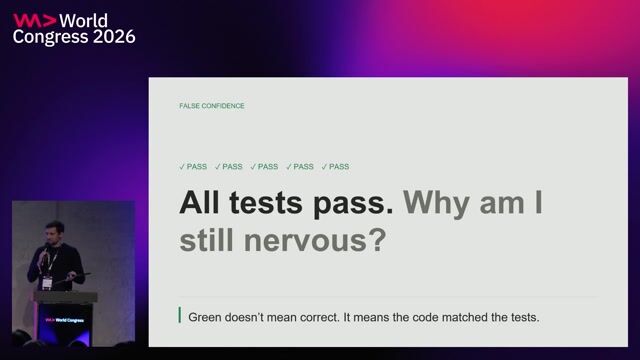
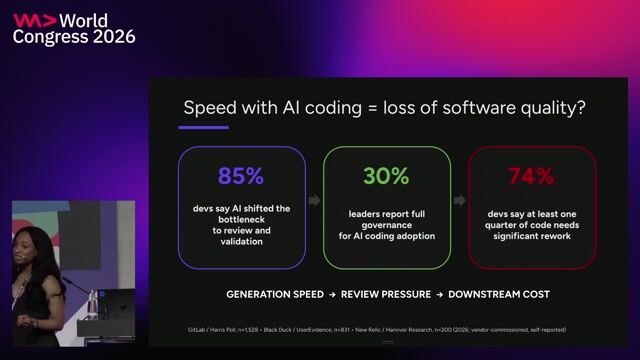
Relying heavily on AI coding assistants causes decision fatigue, unreviewable black-box logic, and the proliferation of low-quality test generation.

#12 about 1 min

Using test coverage visualization tools to detect code fluff

Integrating specialized coverage tools exposes untested code gaps left by AI, allowing engineers to compel the system to improve reliability.

#13 about 2 min

Maintaining human accountability in artificial intelligence software development

Human engineering foundations remain crucial since artificial intelligence changes how software is built without transferring ultimate accountability away from developers.

#14 about 1 min

Cultivating a shared team mindset for software quality

Quality engineering is a shared responsibility demanding rigorous definition rather than an isolated testing phase tacked onto the end.

#15 about 2 min

Feeding software standards into artificial intelligence coding tools

The deep contextual knowledge and project history required to properly guide agentic systems make experienced human developers irreplaceable.

#16 about 3 min

Mitigating excessive fluff generation in automated test suites

Forcing strict traceability directly from requirements into test outputs gives deterministic structure to probabilistic AI coding models.

#17 about 3 min

Advocating for human interaction and usability testing investments

The inherent impossibility of automating usability analysis proves that building a successful product requires dedicated human testing resources.

Matching moments

2:45 min

Approaching software quality as a subjective social science

Ingo Philipp · LIVE

2:18 min

Transforming software quality from assurance to enablement

Ondřej Gróf Ondřej Gróf · World Congress 2026 Europe

2:30 min

The shifting mindset of modern quality assurance engineers

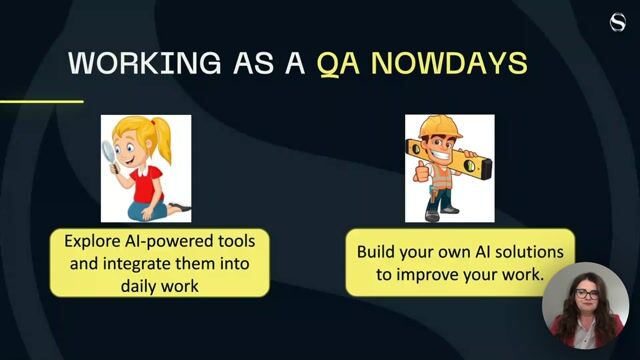
Alisa Hrustic Alisa Hrustic · Europe 2026 Virtual

1:01 min

Introduction to the speaker and visual testing journey

Ramona Schwering Ramona Schwering · LIVE

5:16 min

Motivations for adopting AI to enhance developer productivity

2:02 min

Establishing a company-wide approach to software quality assurance

Daniel Strmečki +1 · World Congress 2022