


World Congress 2026 Europe Jul 9, 2026 Session details

Let’s Talk Quality!

Lilia Gargouri

AI rapidly accelerates coding. However, it also introduces untested flaws and severe cognitive overload. True quality engineering must remain a strictly human responsibility.

Pause
Mute Enter Fullscreen
#1 about 2 min

Introduction to software quality assurance in enterprise applications

A senior quality engineer introduces the focus on complex, long-life enterprise systems and the agenda for software quality parameters.

#2 about 2 min

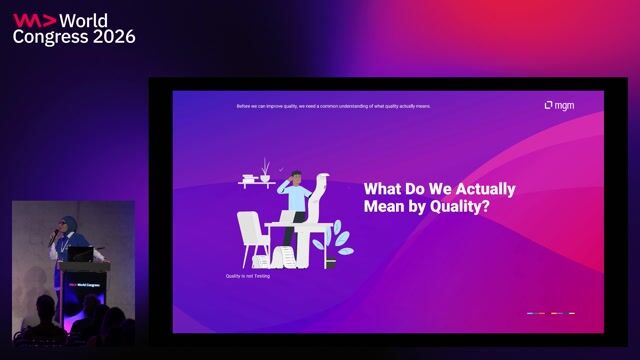
Defining quality as more than fixing existing defects

Relying purely on testing reduces quality to defect correction, whereas shifting attention to non-functional attributes prevents technical debt.

#3 about 2 min

Applying quality characteristics across the software test pyramid

Different test levels support targeted quality attributes like fault tolerance at the component level and recoverability at the system level.

#4 about 2 min

Evaluating quality characteristics specifically for artificial intelligence systems

Integrating agentic behavior requires addressing new attributes like adaptability, probabilistic reliability, transparency, and user controllability.

#5 about 2 min

Aligning software quality directly with critical stakeholder needs

Prioritizing defined quality requirements mitigates business risks and prevents teams from unconsciously accepting potential project failures.

#6 about 2 min

Understanding software engineering as more than just coding

Successful engineering depends heavily on requirement gathering, architectural design, and rigorous system validation alongside the actual coding phase.

#7 about 2 min

Asking critical engineering questions to prevent software defects

Actively analyzing specifications, scalability, dependencies, and security during every stage builds quality before issues can emerge.

#8 about 3 min

Scaling test breadth and depth based on project risk

Systematically breaking down requirements into specific test conditions prevents over-testing while securing critical coverage for higher-risk functionalities.

#9 about 3 min

Mastering project languages for efficient communication and collaboration

Using unified terminology across domain, technical, and architectural categories reduces chaotic communication and prevents implementation misunderstandings.

#10 about 2 min

Implementing agentic software development systems for rapid delivery

Agentic systems allow single developers to complete complex coding cycles significantly faster by synthesizing intent and context into reviewed increments.

#11 about 3 min

Recognizing developer fatigue and poor test generation issues

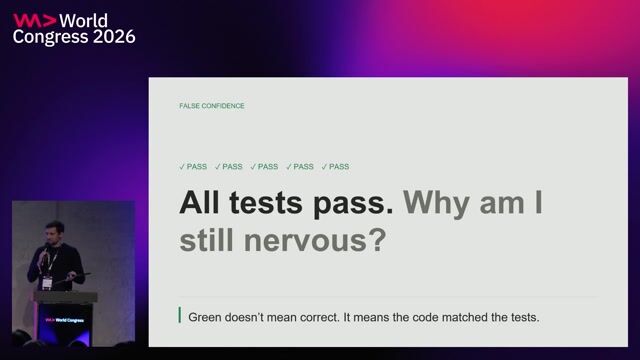
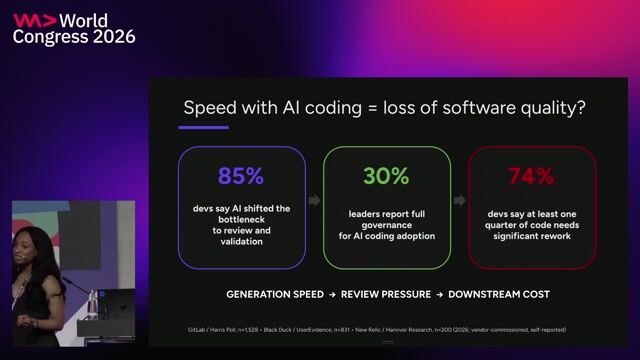
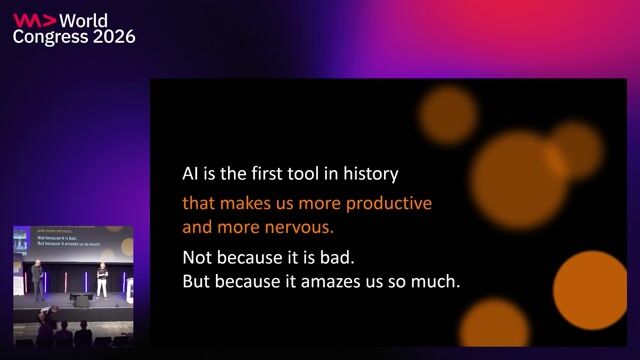
Relying heavily on AI coding assistants causes decision fatigue, unreviewable black-box logic, and the proliferation of low-quality test generation.

#12 about 1 min

Using test coverage visualization tools to detect code fluff

Integrating specialized coverage tools exposes untested code gaps left by AI, allowing engineers to compel the system to improve reliability.

#13 about 2 min

Maintaining human accountability in artificial intelligence software development

Human engineering foundations remain crucial since artificial intelligence changes how software is built without transferring ultimate accountability away from developers.

#14 about 1 min

Cultivating a shared team mindset for software quality

Quality engineering is a shared responsibility demanding rigorous definition rather than an isolated testing phase tacked onto the end.

#15 about 2 min

Feeding software standards into artificial intelligence coding tools

The deep contextual knowledge and project history required to properly guide agentic systems make experienced human developers irreplaceable.

#16 about 3 min

Mitigating excessive fluff generation in automated test suites

Forcing strict traceability directly from requirements into test outputs gives deterministic structure to probabilistic AI coding models.

#17 about 3 min

Advocating for human interaction and usability testing investments

The inherent impossibility of automating usability analysis proves that building a successful product requires dedicated human testing resources.

Matching moments

2:45 min

Approaching software quality as a subjective social science

Ingo Philipp · LIVE

2:18 min

Transforming software quality from assurance to enablement

Ondřej Gróf Ondřej Gróf · WWC Europe 2026

2:30 min

The shifting mindset of modern quality assurance engineers

Alisa Hrustic Alisa Hrustic · Europe 2026 Virtual

1:01 min

Introduction to the speaker and visual testing journey

Ramona Schwering Ramona Schwering · LIVE

5:16 min

Motivations for adopting AI to enhance developer productivity

2:02 min

Establishing a company-wide approach to software quality assurance

Daniel Strmečki +1 · WWC 2022

Upcoming sessions on this topic

Open session

World Congress 2026 North America

Who Tests the AI? Building Trustworthy AI Systems at Enterprise Scale

Him Raj Singh

PayPal, Manager, Software Engineer

Him Raj Singh
Open session

World Congress 2026 North America

Reinventing Testing Practices in the AI Era

Eric Deandrea

Java Champion & Senior Principal Software Engineer, IBM

Eric Deandrea
Open session

World Congress 2026 North America

The spectrum of agentic coding: From vibe coding to high-quality software engineering

YK Sugi

Developer Experience Manager at Eventual

YK Sugi
Open session

World Congress 2026 North America

When Humans Stop Writing Code: Rethinking Languages, Compilers, and Responsibility

Simon Auer

Organizer of flutter vienna meetup and CEO of marqably

Simon Auer
Open session

World Congress 2026 North America

Evals Are Infra: Building AI Systems Developers Can Actually Trust

Phoebe Wang

Member of Technical Staff at OpenAI

Phoebe Wang
Open session

World Congress 2026 North America

Beyond the Code: Human-AI Synergies in Product Development

Ajita Kanchivakam Ananth

Staff Technical Program Manager at Google

Ajita Kanchivakam Ananth