World Congress 2026 Europe Jul 9, 2026 Session details

Scaling GraphRAG: Efficient Knowledge Retrieval for AI

Gal Shubeli

Why do 95% of enterprise AI pilots fail from confident hallucinations? Discover how scaling GraphRAG connects isolated facts to enable complex multi-hop reasoning and sub-millisecond retrieval.

Pause
Mute Enter Fullscreen
#1 about 3 min

Overcoming failure rates in generative AI production pipelines

Enterprise AI pilots frequently fail because large language models receive disconnected and contextless textual data during retrieval.

#2 about 2 min

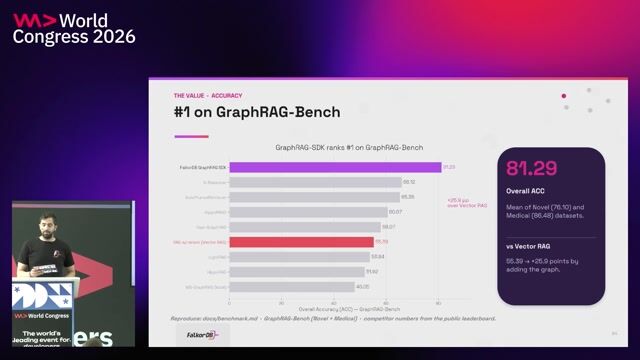
Analyzing graph retrieval accuracy against baseline vector search

Adding knowledge graph interactions into retrieval augmentation closes critical accuracy gaps over standard vector processing logic.

#3 about 3 min

Limitations of flat vector architectures for multi-hop reasoning

Traditional vector databases break down on complex queries because text chunks lack underlying semantic linkages.

#4 about 3 min

Structuring unstructured domain data into a queryable knowledge graph

Knowledge graphs organize textual facts by directly binding relevant entities together via structured directional relationships.

#5 about 2 min

Building a knowledge extraction pipeline with local NER models

Applying high-speed local entity recognition alongside broader language processing establishes rapid network relationship foundations.

#6 about 2 min

Resolving and deduplicating entities for large scale graph queries

Grouping varying entity mentions into unified semantic communities maintains a consistent centralized reference for LLM mapping.

#7 about 2 min

Executing multi-hop reasoning by traversing interconnected graph entities

Graph retrieval models isolate factual sub-graphs to fetch highly specific contextual routes for complete answer generation.

#8 about 2 min

Gaining explicit answer explainability through direct source citations

Tying individual response facts directly back to precise document files prevents silent extrapolation and arbitrary guessing.

#9 about 2 min

Evaluating computational costs against persistent retrieval accuracy benefits

Extracting robust relationships requires initial inference tokens but provisions an ultra-responsive database optimized for persistent multi-tenant applications.

#10 about 2 min

Transforming code repositories into interactive architecture knowledge graphs

Translating software bases into interconnected modules allows engineering teams to trace inheritance dependencies seamlessly inside typical development environments.

#11 about 2 min

Modeling semantic database layers for reliable SQL queries

Structuring complex relational database schemas into graph models enables accurate SQL translations beyond standard context window restrictions.

#12 about 2 min

Empowering autonomous agents with persistent relationship memory architectures

Attaching structural session memories allows AI deployments to continuously reason across prolonged interactive events naturally.

#13 about 4 min

Managing restricted document permissions via isolated multi-tenant architectures

Handling disparate user access rights requires provisioning fully distinct node environments within an underlying unified graph server.

Matching moments

3:26 min

Using advanced retrieval methods like graph rag and raptor

Tomek Porożyński Tomek Porożyński · WWC Europe 2026

1:44 min

Introduction to generative AI and knowledge graphs

Michael Hunger Michael Hunger · WWC 2024

2:26 min

Enhancing language models with graph retrieval augmented generation

2:22 min

Unlocking generative AI capabilities using knowledge graphs

Zaid Zaim Zaid Zaim +1 · WWC Europe 2026

1:57 min

Understanding overarching retrieval and generation steps in RAG architectures

Csenge Szabo Csenge Szabo · Europe 2026 Virtual

1:44 min

Understanding basic retrieval-augmented generation architectures in chatbots

Stan Girard Stan Girard · WWC 2024

Upcoming sessions on this topic

Open session

World Congress 2026 North America

Building World-Aware Robots with Agent Memory and Context Graphs

Zaid Zaim

Developer Advocate EMEA at Neo4j | Microsoft AI MVP

Zaid Zaim
Open session

World Congress 2026 North America

Beyond SQL Generation: How to Teach Agents What Your Database Actually Means

Kris Jenkins

Lead Developer Advocate at Snowflake

Kris Jenkins
Open session

World Congress 2026 North America

DeepAgents: Build Multi-Agent AI Systems That Actually Work

Anagha Rumade, Apoorva Jaiswal, Anjana Umapathy

Anagha Rumade
Apoorva Jaiswal
Anjana Umapathy
Open session

World Congress 2026 North America

Closing the Visibility Gap: Lessons from Safety Critical Agentic Systems

Vivek Pandit

Principal Engineer at Cadence

Vivek Pandit
Open session

World Congress 2026 North America

Building Stuff with GenAI - The Open Minded Workshop beyond OpenAI

Andreas Erben

CTO for Applied AI and Metaverse at daenet

Andreas Erben
Open session

World Congress 2026 North America

Agents That Own Their Inference: Building Production AI Agents on Dedicated GPUs

Duan Lightfoot

Sr. AI Engineer, Akamai

Duan Lightfoot