

World Congress 2026 Europe Jul 9, 2026 Session details

Small, Secure, Interconnected: The next Internet Protocol

Ross Kukulinski

Stop treating IP addresses as proxies for trust. Discover how programmable, zero-trust private networks eliminate clunky VPNs and make secure access as easy as sharing a Google Doc.

Pause
Mute Enter Fullscreen
#1 about 3 min

Balancing connectivity and usability in network infrastructure

Establishing reliable network connectivity remains a fundamental engineering challenge despite modern technological advancements.

#2 about 2 min

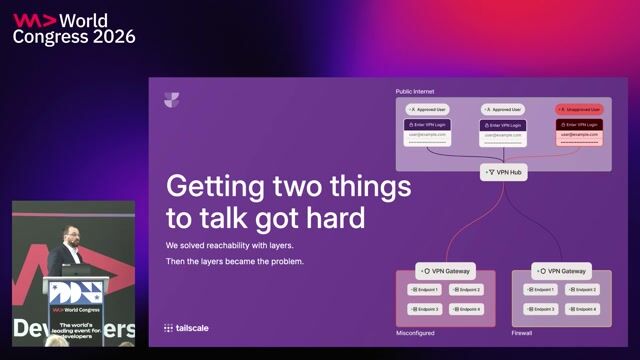
Solving private access with redundant network layers

Stacking tools like virtual private networks and firewalls transforms simple connectivity into complex topology problems.

#3 about 3 min

Fixing insecure network defaults with identity-based perimeters

Applying public reachability models to internal systems creates unnecessary security vulnerabilities and latency bottlenecks.

#4 about 2 min

Scaling system architectures with small comprehensible networks

Breaking monolithic architectures into smaller configurations allows developers to define structured intent clearly.

#5 about 3 min

Shifting network trust from subnets to combined identities

Verifying user authorization based on human accounts, device origin, and workload identity coordinates precision access without lateral vulnerabilities.

#6 about 3 min

Centralizing network policy with distributed endpoint enforcement

Maintaining human-readable access rules in a single repository while pushing direct execution to the network edge accelerates connection speed.

#7 about 3 min

Collaborating across organizations without network merging

Explicit resource sharing eliminates the need to integrate disparate identity providers or provision redundant virtual private networks.

#8 about 2 min

Managing temporary network access for contractors and containers

Binding expiration dates to short-term users and container lifecycles removes the risk of persistent unauthorized backdoors.

#9 about 3 min

Securing artificial intelligence networks matching machine speeds

Evaluating automation capabilities requires rigorous identity enforcement to securely revoke permissions and track autonomous network behaviors.

#10 about 2 min

Replacing traditional security workarounds with foundational access controls

Replacing layered security workarounds with primitive access controls eliminates the friction traditionally associated with network provisioning.

#11 about 4 min

Embedding zero-trust network connectivity directly into application code

Importing network identity functions as programming libraries transforms rigid infrastructure into dynamic application capabilities.

#12 about 2 min

Handling dynamic permissions and ephemeral identities in platforms

Integrating container labels and workload identity standards enables automated access control limits outside primary network policies.

#13 about 2 min

Evaluating fallback policies and network traffic configurations

Implementing peer relays and latency-aware routing improves performance reliability when direct point-to-point connections fail.

#14 about 2 min

Isolating department resources with declarative network sharing

Creating logically separated internal networks simplifies complexity by ensuring independent groups efficiently interact with appropriate databases.

#15 about 2 min

Merging application authorization layers with network identity states

Extending foundational network handshake protocols into unified authentication boundaries allows teams to systematically protect proprietary systems.

Matching moments

1:55 min

Mitigating agent risks with zero trust networking

Oren Penso Oren Penso · World Congress 2026 Europe

3:07 min

Integrating secure connectivity and responsible artificial intelligence practices

Duan Lightfoot Duan Lightfoot · World Congress 2024

3:12 min

Leveraging the dynamic network for scalable applications

Evan Freeman · LIVE

5:21 min

Protecting infrastructure with the shared responsibility model

Mustafa Toroman · World Congress 2023

2:04 min

Designing a reference architecture with network trust zones

Jose Manuel Ortega Jose Manuel Ortega · Europe 2026 Virtual

3:58 min

Implementing zero trust on traditional cloud providers and serverless

Jan Peer Stöcklmair Jan Peer Stöcklmair · World Congress 2026 Europe

Upcoming sessions on this topic

Open session

World Congress 2026 North America

September 24, 2026 · 17:30–18:00

Stage 5

Securing AI Agent Infrastructure: Identity, Attestation, and Trust at Scale

Abdel Fane

Founder of OpenA2A

Abdel Fane
Open session

World Congress 2026 North America

September 24, 2026 · 14:50–15:20

Stage 7

When Agents Became Users: Rearchitecting Identity and Permissions for AI at Scale

Yoav Gal, Dor Cohen

Yoav Gal
Dor Cohen
Open session

World Congress 2026 North America

September 24, 2026 · 10:20–10:50

Stage 7

Zero-Trust Architecture for Agentic AI: Securing Multi-User Access and Third-Party Integrations

Borko Djurkovic

Member of Technical Staff at Cohere

Borko Djurkovic
Open session

World Congress 2026 North America

September 25, 2026 · 17:30–18:00

Mainstage

One Boundary for the Agentic Era

Mark Lechner

Chief Information Security Officer, Dokcer

Mark Lechner
Open session

World Congress 2026 North America

September 24, 2026 · 16:10–16:40

Stage 3

Responsible AI Architecture with Zero Trust Agents

Ashok Prakash

Staff ML Engineer at Apple

Ashok Prakash
Open session

World Congress 2026 North America

September 25, 2026 · 12:20–12:50

Stage 4

Give the Agent a Budget, Not a Token

Sachin Malhotra

MTS @Anthropic

Sachin Malhotra