
World Congress 2026 Europe Jul 10, 2026 Session details

Photonic Computing: Programming a New Class of AI Accelerators (incl. Live Coding)

Christoph Lohrmann , Utz Bacher

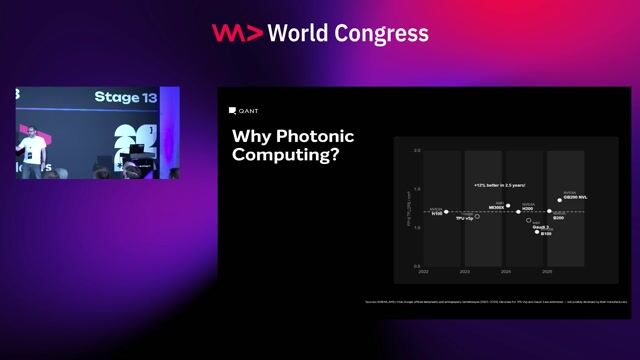
Photonic computing bypasses GPU constraints by using light to process operations natively, cutting model sizes in half. Watch us live code standard PyTorch models directly to optical chips.

Pause
Mute Enter Fullscreen
#1 about 2 min

Transitioning from quantum to photonic computing paradigms

The strategic shift from quantum processing experiments to designing deployable optical accelerators solves early manufacturing difficulties.

#2 about 2 min

Physical constraints of classical AI hardware scaling

Massive datacenter energy consumption reveals how conventional CMOS transistors struggle against escalating data transfer burdens.

#3 about 1 min

Modulating light through lithium niobate photonic crystals

Running low voltages directly across wafer structures successfully alters light refractive traits without generating friction heat.

#4 about 2 min

Encoding analog data across multidimensional light states

Mapping complex variables directly against light wavelengths guarantees instantaneous math updates independent of clock tick rhythms.

#5 about 2 min

Hardware design of native processing unit integrations

Combining PCIe form factors with translation circuits connects cutting-edge optical silicon directly to standard server operating systems.

#6 about 1 min

Eliminating complex data center cooling footprint limits

Swapping kilowatt chipsets for milliwatt lasers permits massive computational cluster scaling devoid of specialized cooling dependencies.

#7 about 2 min

Validating standard neural networks on photonic silicon

Confirming traditional visual routing topologies over light pathways validates practical image recognition without restructuring conventional model theories.

#8 about 4 min

Deploying non-linear mathematical operations natively through physics

Relying on physical optics instead of digital estimation reduces necessary AI model parameter structures when performing Fourier analysis.

#9 about 2 min

Compiling PyTorch environments for advanced time forecasting

Adapting diffusion logic natively from standard ML frameworks reduces dependency on niche hardware interaction languages.

#10 about 4 min

Mapping network convolutions through native Fourier domains

Keeping signal throughput insulated inside continuous analog bounds avoids sluggish performance penalties inflicted by conversion hops.

#11 about 3 min

Leveraging inherent stateful components for recurrent architectures

Exploring naturally retaining wave oscillators supplies unique passive memory blocks ideal for iterative state machine tasks.

#12 about 3 min

Exposing native functionality via the MLIR compiler

Hooking low-level algorithms into standardized infrastructure bridges abstract tensor declarations with the actual linear accelerator hardware.

#13 about 3 min

Demonstrating live MNIST digit mapping through Python

Initializing pre-built forward propagation modules directly from visual programming interfaces applies native hardware sorting immediately.

#14 about 2 min

Hardware availability through datacenter partners and SDKs

Launching specialized silicon clusters onto publicly available platforms invites remote engineering experimentation scaling parallel workflow requests.

#15 about 3 min

Resolving signal noise variables across hardware converters

Pairing finely tuned conversion arrays manages expected accuracy offsets encountered when transitioning across the physical analog barriers.

Matching moments

2:42 min

Dissecting artificial intelligence layers from compute to applications

Christian Nagel Christian Nagel +3 · WWC Europe 2026

3:27 min

Exploring physical limits and alternatives to silicon chips

Stephen Jones · Coffee With Developers

2:21 min

Transitioning to accelerated computing for application developers

Ankit Patel Ankit Patel · WWC 2024

1:19 min

Accelerating artificial intelligence algorithms using quantum mathematical superposition

Alexander Wallner Alexander Wallner +3 · WWC 2024

8:17 min

Practical applications and hybrid solutions for quantum computing advantage

Alexander Glätzle Alexander Glätzle +3 · WWC 2025

4:06 min

Combining quantum, neural, and classical computing paradigms

Stephen Jones · Coffee With Developers

Upcoming sessions on this topic

Open session

World Congress 2026 North America

You Can’t Re-Run Sunlight: Designing ML Data Architectures for Physical AI

An Phan

Senior Data Infrastructure Engineer @ Hippo Harvest

An Phan
Open session

World Congress 2026 North America

From Software Agents to Physical Devices: Inside the Agentic Hardware Stack

Michael Yuan, Vivian Hu

Michael Yuan
Vivian Hu
Open session

World Congress 2026 North America

Compute for your AI model: GPUs, LPUs, TPUs and beyond..

Kushaagra Goyal

Tech Lead at Rubrik, ex-CTO at Gan.AI, ex-Databricks

Kushaagra Goyal
Open session

World Congress 2026 North America

Look What Java Can Do Now: Live-Coding a GenAI MCP Server with the JAQ Stack

Suren Konathala

Senior Engineering Leader, Marketing & AdTech, AI GTM & Digital Experience Platforms, Java x AI

Suren Konathala
Open session

World Congress 2026 North America

Trust, But Verify: Continuous GPU Validation at Scale

Kyle Bell

VP of AI @ TensorWave

Kyle Bell
Open session

World Congress 2026 North America

Building Stuff with GenAI - The Open Minded Workshop beyond OpenAI

Andreas Erben

CTO for Applied AI and Metaverse at daenet

Andreas Erben