
World Congress 2026 Europe • Jul 10, 2026 • Session details

Open Source Is Not Just Code: Designing Communities That Actually Scale

Sinduri Guntupalli

Open source fails when treated purely as a code problem. Learn how prioritizing community design and structured contribution paths saves projects from the maintainer trap and AI spam.

Pause
Mute Enter Fullscreen
#1 about 4 min

Reimagining open source as a socio-technical system

Open source software functions as a socio-technical system where healthy social structures prevent eventual project failure regardless of code quality.

#2 about 1 min

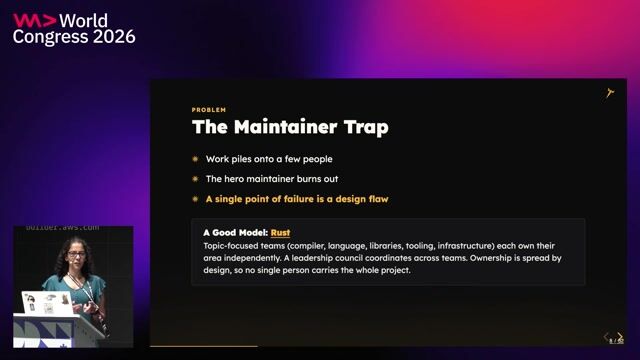
Avoiding the open source maintainer trap

Relying on a few hero maintainers introduces a single point of failure that ultimately breaks community sustainability.

#3 about 1 min

Core pillars of healthy open source community design

Adopting structured community pillars ensures the long-term viability of open source projects by preventing isolated burnouts.

#4 about 3 min

Designing effective open source governance structures

Distributing authority through clear models like foundational councils prevents corporate dominance and sudden project collapses.

#5 about 2 min

Simplifying the initial contributor experience in projects

Publishing specific progression ladders and onboarding guidelines removes the friction hindering new developers from joining.

#6 about 2 min

Recognizing invisible open source work and contributions

Implementing public credit systems for administrative tasks like code review prevents the eventual disappearance of crucial but unglamorous efforts.

#7 about 2 min

Fostering belonging through local open source communities

Pairing major global events with small regional workshops cultivates the personal connections necessary for lasting member retention.

#8 about 1 min

Communicating the value of open source projects

Investing effort into accessible documentation and tutorials bridges the gap between obscure applications and widespread developer adoption.

#9 about 2 min

Securing sustainable funding for critical open source maintenance

Directing financial support toward tedious maintenance and security tasks prevents the quiet burnout of vital infrastructure authors.

#10 about 1 min

Evaluating the long-term health of software communities

Monitoring signals like the bus factor and contributor retention provides an early warning system against project exhaustion.

#11 about 2 min

Prioritizing practical open source community design efforts

Establishing explicit expectations early while delaying complex governance protocols safeguards small initiatives from suffocating bureaucracy.

#12 about 2 min

Navigating the impact of AI on open source maintenance

Automated contributions introduce severe asymmetric burdens onto volunteer reviewers by flooding repositories with unverified vulnerability reports.

#13 about 1 min

Identifying slow decay in open source projects

Piling decision constraints onto a minor nucleus of maintainers silently decays a project until its structural collapse.

#14 about 3 min

Practical actions to support open source ecosystems

Dedicating minor efforts toward documenting edge cases, reviewing early pull requests, and sponsoring individuals significantly stabilizes global infrastructure.

#15 about 4 min

Audience questions on open source contribution and AI

Best practices cover how newcomers can target relevant technologies and utilize automated code adjustments without spamming active repositories.

Matching moments

1:51 min

Balancing open source contributions with sustainable careers

Stormy Peters · World Congress 2023

3:12 min

Scaling open source impact through community acceleration and infrastructure

Demetris Cheatham Demetris Cheatham +1 · World Congress 2024

2:16 min

Fostering soft skills and ethics in open source contributions

Mike Swift · Coffee With Developers

6:28 min

Setting healthy boundaries in open source maintainer relationships

David Heinemeier Hansson David Heinemeier Hansson +1 · World Congress 2024

4:16 min

Refocusing Hacktoberfest on open source artificial intelligence

Mike Swift · Coffee With Developers

2:18 min

Handling the surge of AI-generated open-source code contributions

Michele Zuccala Michele Zuccala +4 · World Congress 2026 Europe

Upcoming sessions on this topic

Open session

World Congress 2026 North America

September 25, 2026 · 14:10–14:40

Stage 1

The Broken Rung: How AI is Rebuilding Software Development from the Ground Up

Tomislav Tipurić

Chief Technology Officer, Nephos

Tomislav Tipurić
Open session

World Congress 2026 North America

September 24, 2026 · 16:10–16:40

Outdoor Stage

When Humans Stop Writing Code: Rethinking Languages, Compilers, and Responsibility

Simon Auer

Organizer of flutter vienna meetup and CEO of marqably

Simon Auer
Open session

World Congress 2026 North America

September 24, 2026 · 12:15–12:45

Stage 6

AI vs. AI: Defending the open source supply chain with agentic workflows

Manfred Moser

Senior Principal DevRel Engineer at Chainguard

Manfred Moser
Open session

World Congress 2026 North America

September 24, 2026 · 15:30–16:00

Mainstage

Our Brains in the AI Era

Cassidy Williams

Senior Director of Developer Advocacy, GitHub

Cassidy Williams
Open session

World Congress 2026 North America

September 25, 2026 · 13:30–14:00

Stage 3

Lessons from 20 Years of Bootstrapping an Open Source Business to $50M+

Peter Farkas

Percona, Founder

Peter Farkas
Open session

World Congress 2026 North America

September 25, 2026 · 13:30–14:00

Stage 9

On the Public Clock: Open-Source Defense When You're Not in the Club

Nicholas Muy

VP Engineering Platform and Security at Scrut.io

Nicholas Muy