
World Congress 2026 Europe • Jul 10, 2026 • Session details

Open Source Is Not Just Code: Designing Communities That Actually Scale

Sinduri Guntupalli

Open source fails when treated purely as a code problem. Learn how prioritizing community design and structured contribution paths saves projects from the maintainer trap and AI spam.

Pause
Mute Enter Fullscreen
#1 about 4 min

Reimagining open source as a socio-technical system

Open source software functions as a socio-technical system where healthy social structures prevent eventual project failure regardless of code quality.

#2 about 1 min

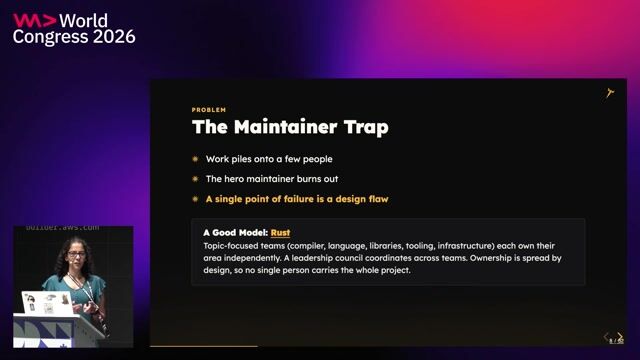
Avoiding the open source maintainer trap

Relying on a few hero maintainers introduces a single point of failure that ultimately breaks community sustainability.

#3 about 1 min

Core pillars of healthy open source community design

Adopting structured community pillars ensures the long-term viability of open source projects by preventing isolated burnouts.

#4 about 3 min

Designing effective open source governance structures

Distributing authority through clear models like foundational councils prevents corporate dominance and sudden project collapses.

#5 about 2 min

Simplifying the initial contributor experience in projects

Publishing specific progression ladders and onboarding guidelines removes the friction hindering new developers from joining.

#6 about 2 min

Recognizing invisible open source work and contributions

Implementing public credit systems for administrative tasks like code review prevents the eventual disappearance of crucial but unglamorous efforts.

#7 about 2 min

Fostering belonging through local open source communities

Pairing major global events with small regional workshops cultivates the personal connections necessary for lasting member retention.

#8 about 1 min

Communicating the value of open source projects

Investing effort into accessible documentation and tutorials bridges the gap between obscure applications and widespread developer adoption.

#9 about 2 min

Securing sustainable funding for critical open source maintenance

Directing financial support toward tedious maintenance and security tasks prevents the quiet burnout of vital infrastructure authors.

#10 about 1 min

Evaluating the long-term health of software communities

Monitoring signals like the bus factor and contributor retention provides an early warning system against project exhaustion.

#11 about 2 min

Prioritizing practical open source community design efforts

Establishing explicit expectations early while delaying complex governance protocols safeguards small initiatives from suffocating bureaucracy.

#12 about 2 min

Navigating the impact of AI on open source maintenance

Automated contributions introduce severe asymmetric burdens onto volunteer reviewers by flooding repositories with unverified vulnerability reports.

#13 about 1 min

Identifying slow decay in open source projects

Piling decision constraints onto a minor nucleus of maintainers silently decays a project until its structural collapse.

#14 about 3 min

Practical actions to support open source ecosystems

Dedicating minor efforts toward documenting edge cases, reviewing early pull requests, and sponsoring individuals significantly stabilizes global infrastructure.

#15 about 4 min

Audience questions on open source contribution and AI

Best practices cover how newcomers can target relevant technologies and utilize automated code adjustments without spamming active repositories.

Matching moments

1:51 min

Balancing open source contributions with sustainable careers

Stormy Peters · WWC 2023

3:12 min

Scaling open source impact through community acceleration and infrastructure

Demetris Cheatham Demetris Cheatham +1 · WWC 2024

2:16 min

Fostering soft skills and ethics in open source contributions

Mike Swift · Coffee With Developers

6:28 min

Setting healthy boundaries in open source maintainer relationships

David Heinemeier Hansson David Heinemeier Hansson +1 · WWC 2024

4:16 min

Refocusing Hacktoberfest on open source artificial intelligence

Mike Swift · Coffee With Developers

2:18 min

Handling the surge of AI-generated open-source code contributions

Michele Zuccala Michele Zuccala +4 · WWC Europe 2026

Upcoming sessions on this topic

Open session

World Congress 2026 North America

The Broken Rung: How AI is Rebuilding Software Development from the Ground Up

Tomislav Tipurić

Chief Technology Officer, Nephos

Tomislav Tipurić
Open session

World Congress 2026 North America

When Humans Stop Writing Code: Rethinking Languages, Compilers, and Responsibility

Simon Auer

Organizer of flutter vienna meetup and CEO of marqably

Simon Auer
Open session

World Congress 2026 North America

Lessons from 20 Years of Bootstrapping an Open Source Business to $50M+

Peter Farkas

Percona, Founder

Peter Farkas
Open session

World Congress 2026 North America

On the Public Clock: Open-Source Defense When You're Not in the Club

Nicholas Muy

VP Engineering Platform and Security at Scrut.io

Nicholas Muy
Open session

World Congress 2026 North America

Culture Doesn't Scale Itself: Leading Engineering Teams Through Hypergrowth and the AI Transition

Thanos Baskous

VP of Engineering and Co-founder of Cogent Security

Thanos Baskous
Open session

World Congress 2026 North America

The spectrum of agentic coding: From vibe coding to high-quality software engineering

YK Sugi

Developer Experience Manager at Eventual

YK Sugi