


World Congress 2026 Europe • Jul 10, 2026 • Session details

In-depth .NET Azure Functions: Isolated mode, performance and durable AI agents

Stas Lebedenko

The smallest compute tier in Azure Flex Consumption actually worsens cold starts. Discover the optimal .NET configurations for Isolated workers to slash latency and orchestrate resilient AI agents.

Pause
Mute Enter Fullscreen
#1 about 3 min

Azure functions hosting plans and migration challenges

Because older consumption plans use Windows containers, teams must update applications to adopt the superior Flex consumption model.

#2 about 3 min

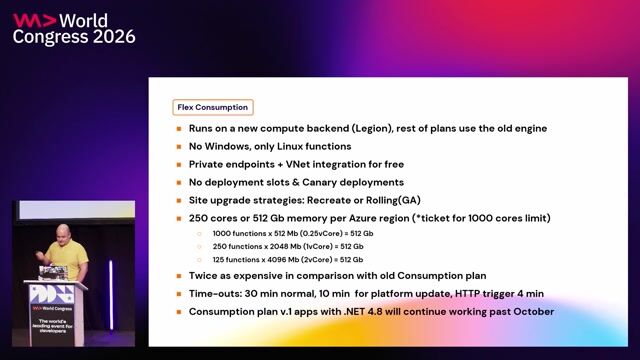
Flex consumption plan features and capacity limitations

Managing the Linux-only Flex consumption plan requires acknowledging missing deployment slots and requesting adequate regional compute quotas.

#3 about 3 min

Adopting the .NET isolated worker model for functions

Transitioning away from legacy in-process logic enables teams to deploy standard console applications featuring multiple output bindings.

#4 about 6 min

Load testing and native AOT pre-compilation performance

Testing unoptimized cold starts reveals how native AOT compilation significantly reduces startup latency across various compute sizes.

#5 about 2 min

Optimizing durable functions scaling with sub-orchestrators

Processing heavy event streams necessitates deploying sub-orchestrators to eliminate single-node bottlenecks found in traditional fan-in patterns.

#6 about 3 min

Tuning dynamic concurrency and durable tasks in host.json

Tuning the default configuration parameters allows Azure to automatically manage concurrent activity execution and reduce host logging overhead.

#7 about 3 min

Best practices for function builds and durable orchestration

Reducing cold start footprints requires trimming framework dependencies and carefully managing connection pools within orchestrated activity functions.

#8 about 4 min

Building durable AI agents with Microsoft agent framework

Executing long-running workflows with human feedback benefits from adopting integrated durability structures within the Microsoft agent framework.

#9 about 5 min

Key takeaways for isolated mode and future migrations

Ensuring predictable performance upon scaling highly depends on establishing thorough load tests before the isolated mode deprecation deadline.

Matching moments

2:10 min

Introduction to serverless websites with Blazor and Azure Functions

Menaka Baskerpillai · LIVE

22:32 min

Audience Q&A on language support, performance, and tradeoffs

Akmal Chaudhri Akmal Chaudhri · LIVE

1:55 min

Shifting developer workloads and realistic AI productivity gains

Chris Heilmann +2 · LIVE

4:21 min

Scaling operations using Azure AI Foundry tools

Maxim Salnikov Maxim Salnikov · WWC 2025

1:31 min

Overview of serverless architectures and function as a service

Ingo Weichsel · WWC 2023

2:54 min

Comparing serverless functions against traditional monolithic architectures

Developersteve · LIVE

Upcoming sessions on this topic

Open session

World Congress 2026 North America

Boring Failover: Predictable Region Recovery Across 5,000 Microservices

Garvit Kataria, Sahil Sabharwal

Garvit Kataria
Sahil Sabharwal
Open session

World Congress 2026 North America

Agents That Own Their Inference: Building Production AI Agents on Dedicated GPUs

Duan Lightfoot

Sr. AI Engineer, Akamai

Duan Lightfoot
Open session

World Congress 2026 North America

AI Agents are Only as Smart as their Context: Building a Real-Time Context Engine at Intuit

Bharat Patel

Lead Software Engineer at Intuit

Bharat Patel
Open session

World Congress 2026 North America

MicroAgents: The Microservices of the Agentic Era

Ashish Shubham

Runs the show bussiness at ThoughtSpot

Ashish Shubham
Open session

World Congress 2026 North America

Run your agents in Kubernetes: Build once, deploy anywhere. But really?

Michal Salanci

Senior Systems Engineer at ESET Cybersecurity

Michal Salanci
Open session

World Congress 2026 North America

Autonomous Infrastructure: Building AI Agents for Global-Scale Capacity Efficiency

Tommy Tran, Gregoire Colin

Tommy Tran
Gregoire Colin