







CH
Chris Heilmann
HalfStack Vienna 2026
•
Nov 19, 2026
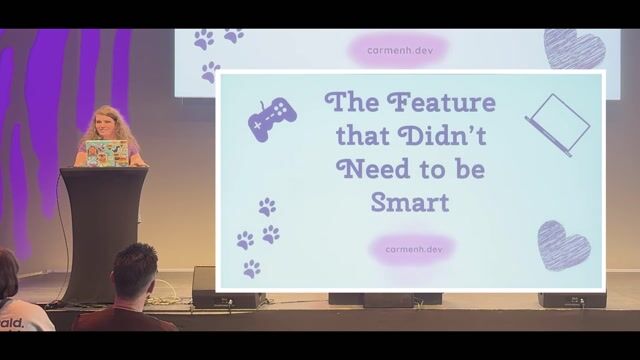
The Feature That Didn’t Need to Be Smart
Carmen Huidobro
- Discuss this with your agent
- Open in Claude
- Open in ChatGPT
How do you build a genuinely useful LLM feature without relying on cloud APIs or sacrificing user privacy? See how a skeptical developer tamed local open-weight models using strict JSON validation and zero-temperature retries.
Starting at 0:42 · Watch from the beginning
Matching moments
3:24 min
Preserving artificial intelligence history with localized open-source models
 Audrey Kim · World Congress 2026 North America
1:44 min
Summarizing developer experience and artificial intelligence companions
 Robert Hoffmann +1 · LIVE
4:29 min
Designing AI applications defensively for inevitable failures
 Krzysztof Cieślak · World Congress 2026 Europe
5:43 min
Pushing back against predictable AI interfaces
1:12 min
Enhancing conversational intent through modern large language models
 Nathaniel Okenwa · World Congress 2025
4:46 min
How generative models disrupt traditional machine interaction
 Mary Grygleski · LIVE
More from HalfStack Vienna 2026
The Little iFrame That Wanted to Become the Biggest Payment Platform
Eduardo Aparicio Cardenes
Upcoming sessions on this topic
Starts in 6 days
Conference India 2026
November 25–26, 2026
Bengaluru, India
-
Your AI Agents Are Bleeding Tokens: Building a Runtime Cost Control Plane for LLMs

 Aakriti Aggarwal & Bhavishya Pandit
Wed 25 Nov · Stage 1 - powered by IBM
Related videos
Command and Conquer: How we let an LLM control our Software
Simon A.T. Jiménez · chax.at
Europe Virtual · 2026
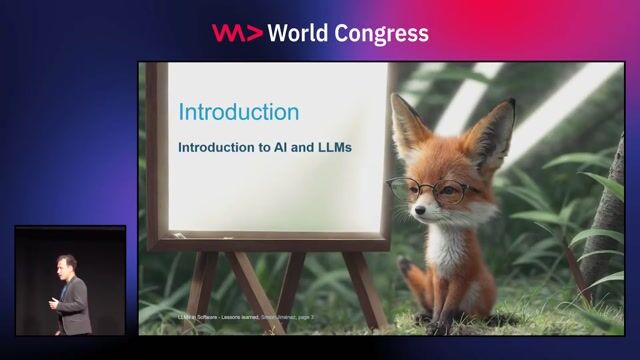
Three years of putting LLMs into Software - Lessons learned
Simon A.T. Jiménez · chax.at
World Congress · 2025
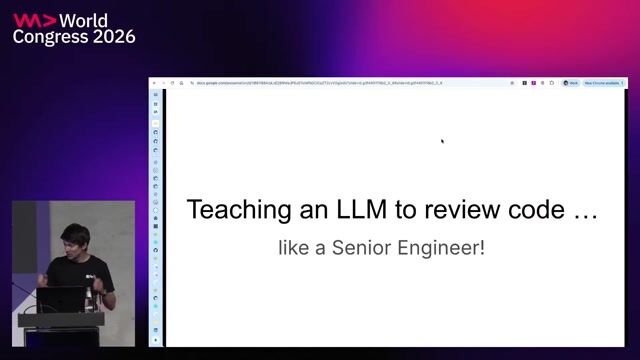
Teaching an LLM to review code … like a Senior Engineer!
Kesha Mykhailov · Fin
World Congress Europe · 2026
Beyond the IDE: A new era of agent collaboration
Ryan J. Salva · Google Cloud
World Congress · 2025
Related articles
CH
Chris Heilmann

BB
Benedikt Bischof

LM
Luis Minvielle

From learning to earning
Jobs that call for the skills explored in this talk.
about 2 months ago
•
AI Software Engineer (Germany)

Sunhat
Berlin, Germany
Expert
€70k–100k
Remote
REST
TypeScript
AI Frameworks
9 days ago
Principal Software Engineer, Copilot Code Review

GitHub
Beverly Hills, CA, United States
Expert
Remote
Ruby
Golang
Github
4 days ago
Staff Software Engineer, Copilot Code Review
GitHub
Beverly Hills, CA, United States
Experienced
Remote
Ruby
Golang
Github
2 months ago
•
AI & Machine Learning Engineer (all genders)

msg
Frankfurt am Main, Germany
Experienced
Hybrid · 3 days on-site
Python
Langchain
Machine Learning
20 days ago
Machine Learning Engineer 2

Twilio
San Francisco, CA, United States
$128k–160k
Remote
Twilio
Backend
Raw Data
16 days ago
•
Senior Data & AI Architect

reeeliance IM GmbH
Berlin, Germany
Expert
Hybrid · 3 days on-site · Remote
Python
Microsoft SQL Server
Cloud (AWS/Google/Azure)