Your Dockerfile is a critical form of infrastructure as code. Learn to write secure, minimal images and automate security checks before deployment.
#1about 2 minutes
Why Dockerfile security is a critical foundation
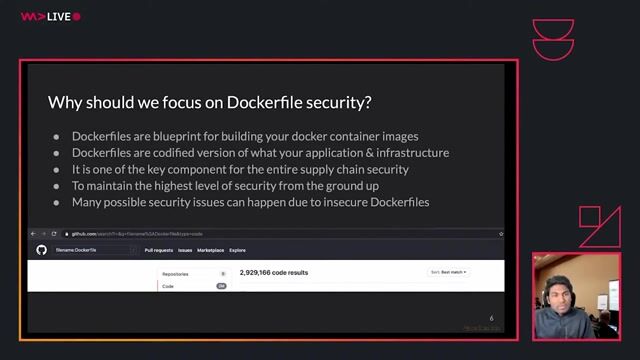
Dockerfiles act as the blueprint for container images, making their security essential for preventing supply chain attacks and infrastructure compromise.
#2about 5 minutes
Following official Docker best practices for images
Start with small base images, use multi-stage builds, and manage the build context with a .dockerignore file to create efficient and secure containers.
#3about 4 minutes
Advanced security practices for hardening Dockerfiles
Enhance security by running containers as a non-root user, using COPY instead of ADD, avoiding hardcoded secrets, and pulling from trusted image registries.
#4about 4 minutes
Using Docker BuildKit to handle secrets securely
Docker's BuildKit allows mounting secrets and forwarding SSH agents during the build process, preventing sensitive credentials from being stored in image layers.
#5about 5 minutes
Automating checks with linters like Hadolint and Dockle
Use automated linters like Hadolint for best practices and Dockle for CIS benchmark compliance to enforce security standards in your CI/CD pipeline.
#6about 2 minutes
Reducing attack surface with Docker-slim
Docker-slim minifies container images by removing unnecessary files and can automatically generate seccomp and AppArmor profiles to harden runtime security.
#7about 3 minutes
Analyzing image layers for security with Dive
The Dive tool provides a layer-by-layer inspection of a Docker image, helping to identify inefficiencies and potential security risks like backdoors.
#8about 4 minutes
Introducing Open Policy Agent for custom policies
Open Policy Agent (OPA) and its language Rego provide a general-purpose engine for enforcing custom, organization-specific security policies on structured data like Dockerfiles.
#9about 6 minutes
Writing custom Dockerfile policies with Conftest
Leverage Conftest to write and apply custom Rego policies that validate Dockerfiles against specific organizational rules, such as only allowing images from a trusted private registry.
#10about 2 minutes
Next steps for implementing Dockerfile security
Implement security best practices early using linters in your IDE, integrate automated checks into CI/CD pipelines, and create standardized custom policies for your organization.
Related jobs
Jobs that call for the skills explored in this talk.
Now is the time for industrialized software developmentNow is the time for industrialized software development
Recently, I received a letter from my car’s manufacturer alerting me to a recall. They had discovered a defective part and wanted to replace it.
It was easily fixed, and I might have forgotten a...
Daniel Cranney
The Overflow: 5 Security and Privacy Tools for DevelopersWe’re back again with another edition of the Overflow, where we share some of the best tools we’ve found from around the web that we just couldn’t cram into the already jam-packed editions of the Dev Digest.
So let’s take a look at five security and ...
Chris Heilmann
Dev Digest 138 - Are you secure about this?Hello there! This is the 2nd "out of the can" edition of 3 as I am on vacation in Greece eating lovely things on the beach. So, fewer news, but lots of great resources. Many around the topic of security. Enjoy! News and ArticlesGoogle Pixel phones t...
Daniel Cranney
Building AI Solutions with Rust and DockerIn recent years, artificial intelligence has surged in popularity in the world of development. While Python remains a popular choice in the realm of AI, Rust - often known as Rust Lang - is quickly emerging as a formidable alternative.Rust programmin...
From learning to earning
Jobs that call for the skills explored in this talk.