Building AI Applications with LangChain and Node.js
Go beyond simple AI chains. Learn to orchestrate complex, multi-agent systems and debug them effectively using the modern Node.js stack.
#1about 4 minutes
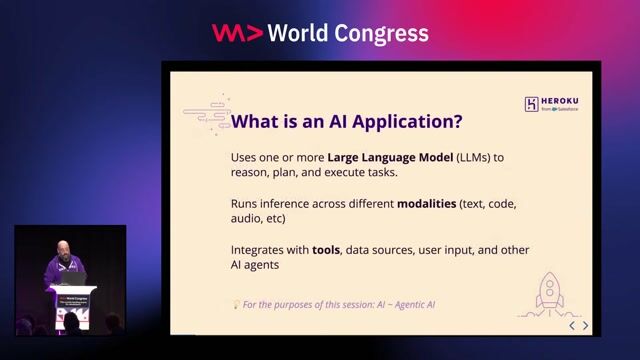
Defining modern AI applications and core concepts
An overview of what constitutes a generative AI application and a review of fundamental concepts like LLMs, inference, context windows, and model evaluation.
#2about 2 minutes
Exploring common AI application patterns
A breakdown of the four primary architectural patterns for AI applications: chat, retrieval-augmented generation (RAG), single-agent, and multi-agent systems.
#3about 2 minutes
Understanding the modern LLM application stack
A look at the key components of the LLM stack, including the agent runtime, inter-agent communication, data retrieval with vector databases, and LLMops.
#4about 1 minute
Introducing key protocols for agent communication
An explanation of the Model Context Protocol (MCP) for extending agent context and the Agent-to-Agent (A2A) protocol for enabling communication between different agents.
#5about 3 minutes
How to choose the right tools for your AI application
Guidance on selecting the appropriate tools for your project, including programming language, LLM provider, and vector database, with a focus on Node.js and PostgreSQL.
#6about 2 minutes
Getting started with LangChain for Node.js
An introduction to the LangChain.js ecosystem, covering its core packages, community integrations, and the powerful LangChain Expression Language (LCEL) for composing chains.
#7about 2 minutes
Building complex agents with LangGraph
Learn when to use LangGraph instead of standard LangChain for building complex, stateful multi-agent systems with branching logic and retry mechanisms.
#8about 5 minutes
Composing a basic chain with the expression language
A practical example of how to use the LangChain Expression Language (LCEL) to pipe together a prompt template, an LLM, and an output parser in a few lines of code.
#9about 4 minutes
Live code demo of various AI application patterns
A walkthrough of runnable code examples demonstrating structured output, chat with memory, retrieval-augmented generation (RAG), and a multi-agent supervisor architecture.
#10about 1 minute
Using LangSmith for observability and debugging
An overview of how LangSmith provides essential observability, allowing you to trace, debug, and evaluate the performance of complex agent and chain executions.
Related jobs
Jobs that call for the skills explored in this talk.
The Web We Broke (And Why AI Agents Are Paying the Price) - AgentCon BerlinThis is the accompanying post to the talk Chris Heilmann gave at AgentCon in Berlin on 19/05/2026, you can also see the slides and listen to it in this screencast:
Thirty years of developer shortcuts, bloated JavaScript, and inaccessible HTML have l...
Daniel Cranney
Dev Digest 210: AI Agents Are Go! Is MCP Dead? LLMs Crack AnonymityInside last week’s Dev Digest 210 .
🪦 Is MCP already dead?
🐍 Secure snake on the CLI
🏗️ The architecture behind open source LLMs
⚖️ AI companies and governments at odds
🦫 Is Go the best language for AI agents?
🕵️ “Security research” bot hacks Micros...
Daniel Cranney, Chris Heilmann
Dev Digest 215: Agent Memory, JS2026, Googlebot Analysis & Canvas❤️HTMLInside last week’s Dev Digest 215 .
🗿 Make AI talk like a caveman
🧠 A guide to context engineering for LLMs
🤖 Simon Willison on agentic engineering
🔐 Axios supply chain attack post mortem
🛡️ Designing AI agents to resist prompt injection
🎨 HTML in c...