

World Congress 2025 • Aug 20, 2025 • Session details

Building resilient .NET applications for the modern age

Sander ten Brinke

System outages cost millions. Stop relying on naive error handling. Build fault-tolerant .NET applications using Polly, Aspire, and chaos engineering to prevent cascading failures.

Pause
Mute Enter Fullscreen
#1 about 4 min

The growing cost of system outages and microservice failures

As microservices introduce network latency and complexity, system resilience becomes an essential upfront requirement to maintain application availability.

#2 about 5 min

Defining software resilience and layers of system architecture

Comprehensive resilience requires strategic planning across infrastructure scaling, disaster recovery plans, software architecture choices, and system observability.

#3 about 4 min

Replacing manual retry logic with the Polly library

Hardcoded retry loops cause traffic spikes and scaling issues, which can be mitigated by using dedicated transient fault handling libraries.

#4 about 3 min

Configuring resilience pipelines and exponential backoff retry strategies

Implementing a retry pattern with exponential backoff and jitter spreads out network requests to prevent thundering herd problems.

#5 about 3 min

Halting traffic to failing dependencies using circuit breakers

The circuit breaker pattern evaluates failure thresholds over time and halts outgoing requests to allow failing downstream services time to recover.

#6 about 2 min

Preventing service overloads with concurrency rate limiting

Applying concurrency limiters manages sudden traffic surges by restricting the maximum number of simultaneous requests allowed through a pipeline.

#7 about 2 min

Integrating resilience pipelines directly into HTTP client registrations

Attaching resilience handlers directly to HTTP client configurations simplifies integration and cleanly separates cross-cutting technical concerns from core business logic.

#8 about 3 min

Testing application robustness by injecting faults with chaos engineering

Testing pipeline robustness in production can be achieved by injecting deliberate latency, faults, and custom failure behaviors into the system.

#9 about 6 min

Applying reliable defaults using Microsoft Extensions HTTP Resilience

Official HTTP resilience extensions streamline setup by providing curated pipeline defaults for rate limiting, sliding timeouts, and retry policies.

Matching moments

2:00 min

Enhancing distributed application resilience using the Polly project

Don Schenck Don Schenck · World Congress 2024

3:00 min

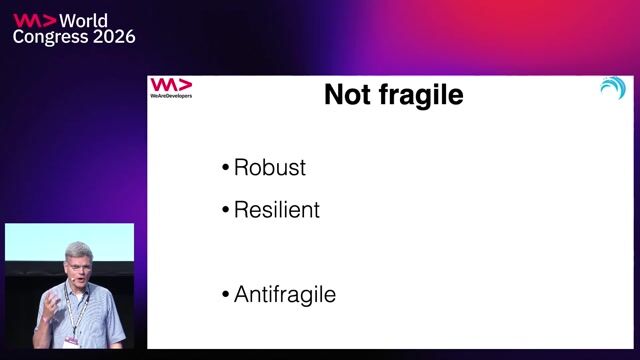
Identifying examples of system resilience and fragility in technology

Jan de Vries Jan de Vries · World Congress 2026 Europe

5:05 min

Balancing strict application boundaries with resilient execution architectures

André Behrens André Behrens · World Congress 2026 Europe

3:46 min

Understanding system resilience and the costs of failure

Mihaela-Roxana Ghidersa · LIVE

5:00 min

Navigating complexity and anti-patterns in modern software architecture

Mihaela-Roxana Ghidersa · LIVE

3:20 min

Building robust system resilience across all stack layers

Mihaela-Roxana Ghidersa · LIVE

Upcoming sessions on this topic

Open session

World Congress 2026 North America

September 25, 2026 · 12:55–13:25

Stage 3

Replay-Safe Architecture: Building Event-Driven Systems That Can Recover With Confidence

Ishan Shah

PayPal, Software Engineer | Distributed Systems, AI, and Platform Engineering

Ishan Shah
Open session

World Congress 2026 North America

September 24, 2026 · 17:30–18:00

Stage 4

Boring Failover: Predictable Region Recovery Across 5,000 Microservices

Garvit Kataria, Sahil Sabharwal

Garvit Kataria
Sahil Sabharwal
Open session

World Congress 2026 North America

September 25, 2026 · 16:10–16:40

Stage 6

Designing APIs That Survive AI Agents at Scale

Phani Pendurthi

Mastercard, Principal Software Engineer

Phani Pendurthi
Open session

World Congress 2026 North America

September 24, 2026 · 14:10–14:40

Stage 3

Real-Time Data Platforms at Trillion-Event Scale

Diptamay Sanyal

Principal Engineer | Data, AI & Cybersecurity Platforms

Diptamay Sanyal
Open session

World Congress 2026 North America

September 25, 2026 · 13:30–14:00

Outdoor Stage

The Geometry of Incidents: What User-Impact Shapes Reveal About Platform Architecture

Bala Subrahmanyam Kambala

Staff Platform Engineer at Oracle Cloud Infrastructure

Bala Subrahmanyam Kambala
Open session

World Congress 2026 North America

September 25, 2026 · 09:40–10:10

Stage 3

Still on 4.8 or lower? A Practical Guide to Moving Your "Un-Migratable" .NET Apps

Isaac Levin

Developer Advocate

Isaac Levin