World Congress 2021 β€’ Jun 29, 2021

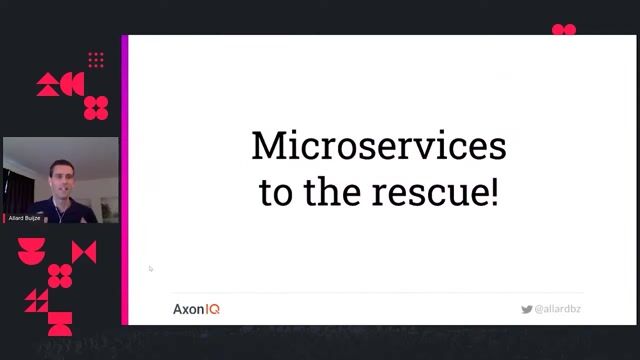
CQRS and Event Sourcing without the pixie dust

Allard Buijze

Microservices aren't magic. An event bus alone just creates a distributed ball of mud. Learn how true CQRS and event sourcing achieve genuine architectural modularity.

Pause
Mute Enter Fullscreen
#1 about 3 min

The evolution of monolithic layered architectures

How the traditional layered architectural pattern inevitably evolves into an unmaintainable big ball of mud.

#2 about 3 min

Splitting monoliths into distributed microservices architectures

Increasing the number of deployment units without increasing modularity results in a distributed big ball of mud.

#3 about 2 min

Combating technical debt and anti-modularity forces

Day-to-day workarounds and deferred refactoring actively degrade application architecture over time by accumulating unstructured dependencies.

#4 about 4 min

Decoupling microservices using event-driven communication models

Using publish-subscribe event models reduces direct service coupling but can obscure execution flow and logical dependency tracking.

#5 about 3 min

The false promises of event-driven microservices

Applying simplistic monolithic methodologies to modern message brokers often reproduces identical coupling issues inside distributed systems.

#6 about 5 min

Differentiating event streaming from true event sourcing

Event sourcing uses historical past decisions to explicitly dictate future application states rather than safely streaming update notifications between tables.

#7 about 4 min

Preserving historical state interactions for reliable auditability

Persisting absolute raw state modification sequences ensures uncompromised audit trails and simplifies managing inherently complex conceptual domain representations.

#8 about 4 min

Managing current state with CQRS and data projections

CQRS safely circumvents the query limitations of aggregated event logs by cleanly separating write models from read-optimized data projections.

#9 about 5 min

Building disciplined domain models for event-driven systems

Sustaining a successful event-centric integration strategy requires embracing domain-driven design modeling techniques instead of purely relying upon broker technologies.

#10 about 3 min

Defining commands, events, and queries in messaging

Understanding the explicit routing behaviors of different interaction patterns provides significantly better runtime decoupling between bounded domain functionalities.

#11 about 2 min

Achieving location transparency across distributed deployment units

Designing modules to communicate agnostically removes the brittle requirement to explicitly hardcode particular network recipient locations.

#12 about 4 min

Implementing CQRS and event sourcing in Java

Demonstrating a robust command validation model that safely enforces consistent backend business behaviors under concurrent transaction loads inside a monolithic setup.

#13 about 8 min

Dynamically splitting monoliths into distributed microservice components

Extracting previously composed backend modules into independent operational runtimes verifies the deployment agility produced by strict interface decoupling.

Matching moments

3:19 min

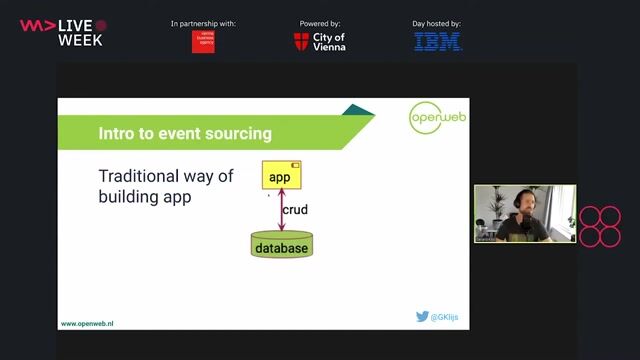
Core principles of transitioning to full event sourcing

Gerard Klijs Β· LIVE

5:37 min

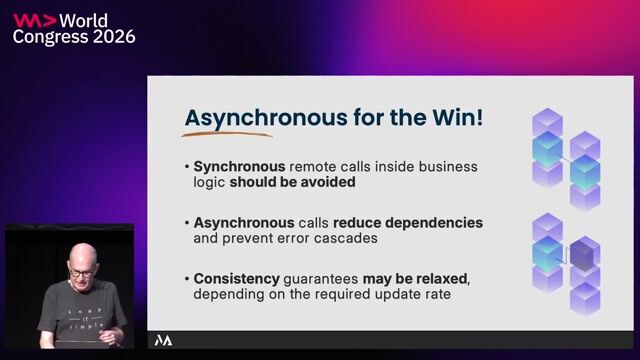
Transitioning from synchronous microservices to event sourcing

Denis Washington +1 Β· World Congress 2021

4:23 min

Clarifying terminology around different event computing software forms

Mary Grygleski Mary Grygleski Β· LIVE

1:26 min

Implementing diverse architectural patterns beyond basic data operations

Vincent Amstoutz Vincent Amstoutz Β· Europe 2026 Virtual

2:08 min

Introducing beneficial architectural patterns like event sourcing

Stefan Priebsch Β· World Congress 2021

5:02 min

Audience Q&A on monolithic versioning and configuration boundaries

Oliver Bestwalter Β· LIVE

Upcoming sessions on this topic

Open session

World Congress 2026 North America

September 25, 2026 Β· 10:20–10:50

Outdoor Stage

MicroAgents: The Microservices of the Agentic Era

Ashish Shubham

Runs the show bussiness at ThoughtSpot

Ashish Shubham
Open session

World Congress 2026 North America

September 24, 2026 Β· 17:30–18:00

Stage 3

Scaling Distributed Queues for AI workloads

Jasmit Kaur Saluja

Staff Software Engineer at Meta Platforms Inc

Jasmit Kaur Saluja
Open session

World Congress 2026 North America

September 24, 2026 Β· 14:10–14:40

Stage 3

Real-Time Data Platforms at Trillion-Event Scale

Diptamay Sanyal

Principal Engineer | Data, AI & Cybersecurity Platforms

Diptamay Sanyal
Open session

World Congress 2026 North America

September 25, 2026 Β· 09:00–09:30

Stage 1

Test Before Release, Enforce at Runtime: Governance for Tool-Using AI Agents

Sachin Gupta

Technical Leader at eBay

Sachin Gupta
Open session

World Congress 2026 North America

September 24, 2026 Β· 16:10–16:40

Stage 3

Sandboxing the Swarm: Building Secure, Serverless AI Agents with Wasm

Thorsten Hans

Sr. Developer Advocate @ Akamai Technologies

Thorsten Hans
Open session

World Congress 2026 North America

September 24, 2026 Β· 17:30–18:00

Stage 2

From Guesswork to Governance: Data Contracts Bring API Discipline to Apache Kafka

Sandon Jacobs

Senior Developer Advocate at IBM

Sandon Jacobs