Optimizing Discovery: PostgreSQL's Role in Transforming GetYourGuide's Search
Can a relational database replace your search engine? GetYourGuide migrated from OpenSearch to PostgreSQL, cutting latency by 40% and simplifying their architecture.
#1about 4 minutes
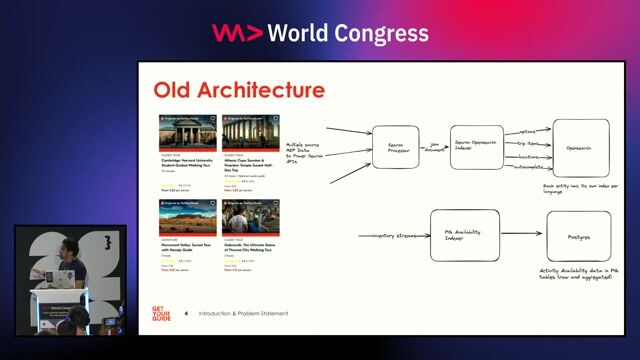
Understanding the original search architecture at GetYourGuide
The previous system used OpenSearch for marketplace data and PostgreSQL for availability, coordinated by a central API layer.
#2about 2 minutes
Identifying the limitations of the OpenSearch implementation
The OpenSearch setup lacked relational joins, had a complex query DSL, and suffered from performance issues and high maintenance overhead.
#3about 2 minutes
Why PostgreSQL was chosen for the migration
PostgreSQL was selected for its mature relational capabilities, JSONB support with GIN indexes, lower operational complexity, and team familiarity with SQL.
#4about 3 minutes
Analyzing PostgreSQL performance concerns for search queries
Initial concerns focused on the performance of GIN indexes, which rely on bitmap heap scans instead of faster index-only scans.
#5about 3 minutes
The challenge of real-time aggregations in PostgreSQL
OpenSearch excels at aggregations due to compressed data structures like roaring bitmaps, a feature not natively available in PostgreSQL for OLTP workloads.
#6about 2 minutes
Designing a hybrid schema and query pattern
The solution involved a denormalized schema using array columns with GIN and BRIN indexes, queried via a "single query, multiple data" (SQMD) pattern using CTEs.
#7about 2 minutes
Implementing dynamic queries and caching strategies
High-cardinality aggregation queries were cached, while the jOOQ library was used to dynamically generate complex SQL from the internal search DSL.
#8about 2 minutes
Operational benefits and limitations of using AWS Aurora
While AWS Aurora provided easy scaling with read replicas, it limited the use of specialized PostgreSQL extensions like roaring bitmaps for performance tuning.
#9about 3 minutes
Handling large objects and replication conflicts
Storing large JSON blobs triggered PostgreSQL's TOAST mechanism, which required tuning and led to replication conflicts on read replicas during vacuum operations.
#10about 3 minutes
Migration results and future roadmap
The migration resulted in a 40% end-to-end latency improvement, and future plans include consolidating text search into PostgreSQL and removing the caching layer.
Related jobs
Jobs that call for the skills explored in this talk.
Dev Digest 168: Hacking Postgres, Blocking Meta and Fixing CSSInside last week’s Dev Digest 168 .
📊 The state of OpenAI’s GPT models
🤖 20% of Salesforce code written by AI
👩💻 Hacking Postgres
🙅♂️ How to block Meta AI from your Instagram
🔧 How to fix common CSS mistakes
💻 Make your GitHub profile stand out
🥱 ...
Chris Heilmann
SEO in an AI world - Google vs. ChatGPT and survival tips for content creatorsIn the ever-evolving world of technology, the landscape of search engines and AI tools is shifting at an unprecedented pace. This transformational journey is being shaped by the rising influence of AI-powered tools like ChatGPT, which are increasingl...
Dev Digest 151: SEO in an AI world, security fixes and Doomed PDFsInside last week’s Dev Digest 151 .
🔎 How ChatGPT compares to search and what that means for SEO
✂️ Job cuts across the board as companies curb DEI programs
🟨 @Microsoft releases 161 Windows security updates
⚠️ @Google’s OAuth bug endangers million...
From learning to earning
Jobs that call for the skills explored in this talk.