
World Congress 2026 Europe - Virtual Stage Jul 2, 2026

Designing and Deploying Distributed Multimodal Multi-Agent Systems with Google's AI Stac

Saoussen Chaabnia

Tired of brittle integrations and monolithic AI workflows? Discover how to build scalable, multi-agent microservices using Google's AI stack to execute complex multimodal tasks in seconds.

Pause
Mute Enter Fullscreen
#1 about 1 min

Introduction to distributed multi-agent systems

An overview of building distributed AI workflows utilizing infrastructure stacks.

#2 about 2 min

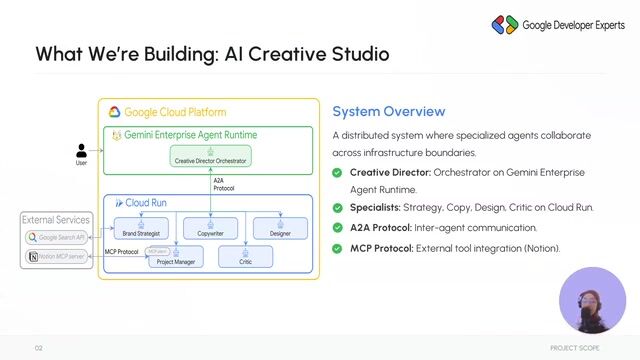
Overview of the campaign generation application

A reference application demonstrating five specialist agents coordinated by a centralized orchestrator.

#3 about 2 min

Designing decoupled microservice architectural patterns

How centralized orchestrators dispatch tasks downstream without explicitly hardcoding network endpoints.

#4 about 1 min

Introducing foundation technologies for autonomous networks

The core framework tools required to generate, test, and deploy model-agnostic agents safely.

#5 about 2 min

Utilizing the ADK framework for agent logic

Executing complex reasoning loops automatically using open-source abstraction modules and tracking interfaces.

#6 about 2 min

Core components for structuring individual agents

Defining agents through discrete configuration blocks assigned to reasoning models, isolated tools, and runtimes.

#7 about 3 min

Defining operating procedures with system instructions

Writing concise agent implementations configured with specific responsibilities, structured formats, and explicit capabilities.

#8 about 5 min

Managing context windows using dynamic skills

Loading domain knowledge into prompt constraints only when triggered to avoid token waste.

#9 about 2 min

Wrapping multimodal toolset configurations for deployment

Structuring multimodal outputs like image generation to be passed precisely into cloud storage directories.

#10 about 2 min

Assembling orchestrators without hardcoded function routes

Wrapping fully operational subordinate agents as direct tools for an orchestrator to manage organically.

#11 about 3 min

Standardizing network configurations via A2A protocols

Allowing language-agnostic components to communicate freely regardless of original programming environments or infrastructure.

#12 about 4 min

Discovering target capabilities using static cards

Fetching explicit JSON configuration descriptors to establish operational bounds automatically at runtime.

#13 about 1 min

Processing remote instructions using JSON RPC

Formatting executable interactions reliably as standard query structures served natively over HTTP connections.

#14 about 2 min

Binding executable logic into network servers

Abstracting protocol boilerplate files to expose standard container code as isolated network endpoints.

#15 about 2 min

Orchestrating dynamic connections gracefully at scale

Directing parent platforms at external metadata variables to parse specific tool functions efficiently.

#16 about 3 min

Utilizing the model context protocol layer

Connecting to external database environments rapidly without managing complicated authentication patterns internally.

#17 about 3 min

Mapping structural dependencies with external implementations

Discovering nested schemas continuously without rebuilding dependencies using standard third-party proxy platforms.

#18 about 5 min

Persisting application states across execution runtimes

Storing asynchronous tasks securely on dedicated container hardware explicitly designed for memory resilience.

#19 about 4 min

Releasing orchestrated infrastructure projects via deployment APIs

Pushing functional code directories instantly using single configuration lines for immediate cloud production.

#20 about 14 min

Live monitoring and testing deployed systems

Evaluating complex session timelines against multiple agent handoffs in cloud execution interfaces.

#21 about 2 min

Accessing tutorial implementations and codelab instances

Resources and deployable examples containing infrastructure schemas to build autonomous applications effectively.

Matching moments

2:43 min

Deploying a web application through an AI agent workflow

Mike Mike · WWC 2025

40 sec

Introduction to building real-world AI agent solutions

Dennis Zielke Dennis Zielke +1 · WWC 2025

1:22 min

Leveraging the comprehensive generative artificial intelligence stack

Duan Lightfoot Duan Lightfoot · WWC 2024

3:14 min

Breaking down the emergent agent stack and core infrastructure

Alejandro Saucedo Alejandro Saucedo · WWC 2025

1:30 min

Transitioning from machine learning models to complex agentic systems

Alejandro Saucedo Alejandro Saucedo · WWC 2025

2:08 min

Navigating the components of the modern generative AI stack

Julián Duque Julián Duque · WWC 2025

Upcoming sessions on this topic

Open session

World Congress 2026 North America

DeepAgents: Build Multi-Agent AI Systems That Actually Work

Anjana Umapathy, Apoorva Jaiswal, Anagha Rumade

Anjana Umapathy
Apoorva Jaiswal
Anagha Rumade
Open session

World Congress 2026 North America

MicroAgents: The Microservices of the Agentic Era

Ashish Shubham

Runs the show bussiness at ThoughtSpot

Ashish Shubham
Open session

World Congress 2026 North America

From Idea to Production with AI: Agentic Development in Practice

Daniel Ostrovsky

UI/UX Architect at Payoneer | AI Architect | Full Cycle Development Expert | Public Speaker | Open Source Contributor |

Daniel Ostrovsky
Open session

World Congress 2026 North America

Building Stuff with GenAI - The Open Minded Workshop beyond OpenAI

Andreas Erben

CTO for Applied AI and Metaverse at daenet

Andreas Erben
Open session

World Congress 2026 North America

Securing AI Agent Infrastructure: Identity, Attestation, and Trust at Scale

Abdel Fane

Founder of OpenA2A

Abdel Fane
Open session

World Congress 2026 North America

AI Agents are Only as Smart as their Context: Building a Real-Time Context Engine at Intuit

Bharat Patel

Lead Software Engineer at Intuit

Bharat Patel