
World Congress 2026 Europe - Virtual Stage Jul 2, 2026 Session details

Offline-First Engineering for Disaster-Ready Applications

Aaditya Binod Yadav

How do you build applications that survive total network collapse during natural disasters? Learn why true offline-first engineering requires abandoning central servers and adopting hybrid logical clocks.

Pause
Mute Enter Fullscreen
#1 about 4 min

Discovering offline-first as a distributed systems problem

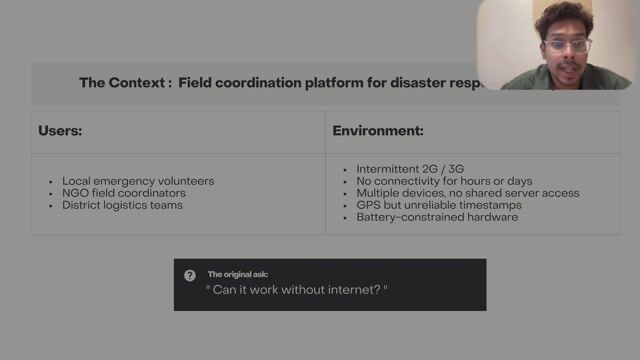
The 2015 Nepal earthquake revealed that reliable software in disaster zones requires rethinking fundamental network assumptions.

#2 about 3 min

Concurrent writes and the breakdown of naive caching approaches

Field coordination involves multiple concurrent users operating offline, rendering simple caching strategies ineffective.

#3 about 4 min

Abandoning the server as the single source of truth

Treating clients as authorities during network partitions shifts the architectural focus from central consistency to divergent state merging.

#4 about 5 min

Replacing unreliable physical clocks with hybrid logical clocks

Device clock drift necessitates using logical time structures like vector and hybrid logical clocks to accurately track causal ordering.

#5 about 8 min

Shifting from syncing state to replicating immutable operation logs

Modeling node architectures around append-only operation logs and materialized views enables robust offline synchronization.

#6 about 5 min

Designing domain-specific semantic merge rules for state conflicts

Relying on last-write-wins leads to silent data loss, making state machine-based semantic merging a safer approach.

#7 about 3 min

Applying conflict-free replicated data types for reliable convergence

Mathematical structures like grow-only counters and two-phase sets provide conflict-free merging for specific offline data types.

#8 about 7 min

Prioritizing availability and exposing staleness in the user interface

Selecting network partition tolerance mandates making data staleness and synchronization uncertainty transparent to users.

#9 about 3 min

Evaluating unexpected chaotic behaviors in offline field environments

Real-world testing reveals that phenomena like local storage exhaustion and social synchronization dictate actual system resilience.

#10 about 6 min

Weighing the heavy architectural complexity budget against offline capabilities

The massive engineering costs of peer-to-peer data synchronization are only justified when network partitions are unavoidable.

#11 about 4 min

Adopting practical engineering standard changes for resilient system architectures

Auditing connectivity assumptions, defining conflict semantics, and measuring replication lag serve as foundational steps for building reliable software.

Matching moments

6:09 min

Understanding offline first applications and the CAP theorem

Sebastien Stormacq Sebastien Stormacq · LIVE

6:50 min

Achieving application reliability and offline accessibility

Ire Aderinokun · JS Congress

2:08 min

Architecting web applications for seamless offline availability

Nico Martin · LIVE

3:09 min

Hardware evolution and offline-first network infrastructure

Phil Helliwell · World Congress 2023

3:04 min

Addressing network challenges and offline edge synchronization

Sasha Denisov Sasha Denisov +1 · World Congress 2026 Europe

2:07 min

Distinguishing offline-first capabilities from true local-first values

Alexander Opalic Alexander Opalic · World Congress 2026 Europe

Upcoming sessions on this topic

Open session

World Congress 2026 North America

September 24, 2026 · 17:30–18:00

Stage 4

Boring Failover: Predictable Region Recovery Across 5,000 Microservices

Garvit Kataria, Sahil Sabharwal

Garvit Kataria
Sahil Sabharwal
Open session

World Congress 2026 North America

September 25, 2026 · 12:55–13:25

Stage 3

Replay-Safe Architecture: Building Event-Driven Systems That Can Recover With Confidence

Ishan Shah

PayPal, Software Engineer | Distributed Systems, AI, and Platform Engineering

Ishan Shah
Open session

World Congress 2026 North America

September 24, 2026 · 12:50–13:20

Stage 3

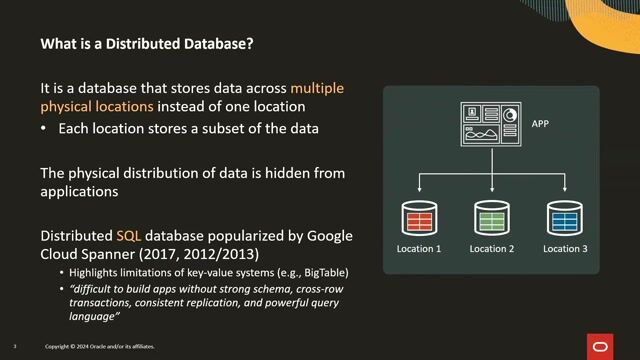
Fault Tolerance and Consistency at Scale: Harnessing the Power of Distributed SQL Databases

Wei Hu

Senior Vice President of Research and Development

Wei Hu
Open session

World Congress 2026 North America

September 25, 2026 · 15:30–15:40

Outdoor Stage

Offloading IoT State: Solving the Memory Crisis on Legacy Hardware

Pravin Nagare

Senior Software Engineer, Roku

Pravin Nagare
Open session

World Congress 2026 North America

September 24, 2026 · 14:10–14:40

Stage 3

Real-Time Data Platforms at Trillion-Event Scale

Diptamay Sanyal

Principal Engineer | Data, AI & Cybersecurity Platforms

Diptamay Sanyal
Open session

World Congress 2026 North America

September 24, 2026 · 14:50–15:20

Stage 9

How to generate business value through performance optimizations

Nikolai Sidiropulo

Software Engineer at Meta

Nikolai Sidiropulo