
World Congress 2026 Europe - Virtual Stage Jul 3, 2026 Session details

Unbiased Decision-Making: Designing Better Decisions in High-Pressure Engineering Teams

Anna W Kriss Petersson

In 2018, high-pressure deadlines and cognitive bias led to a fatal autonomous crash. Learn how to use the DECIDE framework to bypass blind spots and engineer better decisions.

Pause
Mute Enter Fullscreen
#1 about 6 min

The fatal consequences of biased decisions at Uber

Business pressure to deploy self-driving cars led leadership to ignore engineer warnings and shortcut safety testing.

#2 about 3 min

Understanding system one and system two thinking models

System one relies on fast emotional patterns, while system two handles complex analytical trade-offs.

#3 about 2 min

Recognizing survivorship bias through historical bomber plane data

Analyzing missing damage data from surviving planes reveals how quick pattern recognition leads to faulty conclusions.

#4 about 2 min

Contextual factors triggering cognitive biases in modern work

High stress, excessive data, and extreme time pressure force brains to default to fast autopilot reactions.

#5 about 2 min

Adopting a structured approach to reduce bias influence

Implementing disciplined decision-making processes helps counteract biases and activates analytical thinking during high-impact situations.

#6 about 5 min

Identifying and overcoming the sunk cost fallacy

Evaluating required measurable goals and opportunity costs prevents continuous investment in failing product development features.

#7 about 2 min

Applying the decide model for structured team choices

The five-step decide framework provides a systematic process for making high-stakes decisions without relying on individual intuition.

#8 about 3 min

Defining the core problem and establishing baseline assumptions

A problem statement canvas narrows down specific situations, affected stakeholders, and underlying assumptions before seeking solutions.

#9 about 3 min

Establishing consequence timelines with the 10-10-10 model

Projecting the organizational impact of decisions across short, medium, and long-term horizons prevents over-optimizing for immediate needs.

#10 about 2 min

Overcoming false binaries using the impossible scenario tool

Forcing the elimination of obvious paths generates viable new alternatives and prevents teams from stalling between two choices.

#11 about 1 min

Evaluating alternatives against criteria using weighted scoring

Ranking generated options against established timeline and cost criteria helps teams select the best path based on objective priorities.

#12 about 3 min

Drafting execution plans through milestone timeline mapping

Mapping weekly and monthly milestones rapidly validates whether team resources and technical skills can actually execute the chosen solution.

Matching moments

2:07 min

Mitigating hardwired cognitive biases in technical decision making

Alex Thurow Alex Thurow · Europe 2026 Virtual

2:12 min

Fostering empathy and accountability in engineering decisions

Andrew Paul Andrew Paul · Europe 2026 Virtual

3:28 min

Overcoming cognitive biases in software tool evaluation

Benjamin Bischoff Benjamin Bischoff · Europe 2026 Virtual

3:16 min

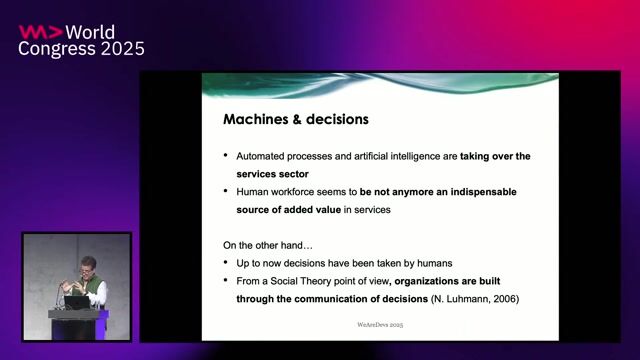
Cognitive bias and uncritical tech adoption in architecture

Hendrik Lösch Hendrik Lösch · World Congress 2025

2:00 min

Why existing knowledge fails to reach decision points

Magdalena Szumna Magdalena Szumna · Europe 2026 Virtual

1:23 min

Mitigating groupthink through diverse and inclusive software engineering teams

Prathyusha Charagondla · LIVE

Upcoming sessions on this topic

Open session

World Congress 2026 North America

September 25, 2026 · 09:00–09:30

Outdoor Stage

Where Judgment Went — and How to Put It Back

Shruti Tiwari

AI/ML product manager, Dell

Shruti Tiwari
Open session

World Congress 2026 North America

September 25, 2026 · 14:50–15:20

Outdoor Stage

Your Brain Is Lying to You: Cognitive Biases in Development

Kate Astrid

Senior Product Engineer

Kate Astrid
Open session

World Congress 2026 North America

September 24, 2026 · 12:15–12:45

Stage 4

It's Not About the Models

Bob Wambach

VP, Market and Customer Insights

Bob Wambach
Open session

World Congress 2026 North America

September 24, 2026 · 11:00–13:00

Stage 10

The AI-Native Engineer: From Business Problem to Prototype

Srishti Agrawal

Senior Product Manager at PwC US

Srishti Agrawal
Open session

World Congress 2026 North America

September 24, 2026 · 16:10–16:40

Stage 3

Sandboxing the Swarm: Building Secure, Serverless AI Agents with Wasm

Thorsten Hans

Sr. Developer Advocate @ Akamai Technologies

Thorsten Hans
Open session

World Congress 2026 North America

September 24, 2026 · 10:20–10:50

Stage 4

AI Decision Observability: Enabling Transparency and Trust in Intelligent Systems

Amjad Shaikh, Soumil Mandal

Amjad Shaikh
Soumil Mandal