
World Congress 2026 Europe - Virtual Stage Jul 3, 2026 Session details

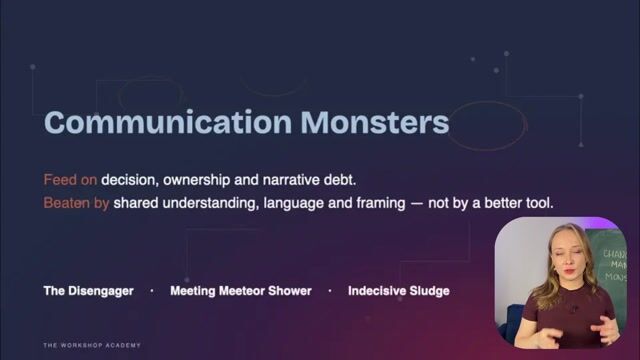
Software Rollouts Are a People Problem: Meet the Nine Change Management Monsters

Nina Malakhova

Software rollouts don't fail over code; they fail because of communication debt and human chaos. Learn to defeat the nine change management monsters sabotaging your next big deployment.

Pause
Mute Enter Fullscreen
#1 about 4 min

Differences between software development and enterprise software rollouts

Adapting to human unpredictability is necessary because organizational change operates differently than standardized software development.

#2 about 3 min

Fixing stakeholder disengagement using the DACI role framework

Re-engaging ghosting stakeholders requires aligning the product narrative and explicitly defining project decision roles.

#3 about 1 min

Preventing meeting bloat through single source of truth documentation

Repeated alignment meetings can be eliminated by enforcing a searchable and written source of truth.

#4 about 2 min

Breaking organizational indecision loops using the RAPID framework

Clarifying decision-making roles accelerates project progress in organizational cultures that hesitate to commit.

#5 about 2 min

Mitigating single points of failure in software project teams

Rotating tasks and documenting processes prevents project stalls when key individuals are suddenly unavailable.

#6 about 2 min

Overcoming user resistance to change through the ADKAR model

Building user awareness and desire before teaching new functionality increases overall software adoption success.

#7 about 1 min

Empowering local champions for effective organizational software training

Leveraging respected peers for localized enablement yields substantially better training outcomes than formal sessions alone.

#8 about 2 min

Controlling project scope creep using the MoSCoW prioritization matrix

Communicating precise boundaries on what will not be built prevents unmanageable project feature requests.

#9 about 2 min

Phasing out legacy software via the strangler fig approach

Slicing away functionality piece by piece significantly reduces the friction of abandoning familiar legacy systems.

#10 about 1 min

Eliminating overlapping software toolsets with the TIME framework

Categorizing tool redundancies into tolerate, invest, migrate, or eliminate clarifies the organizational technology stack.

#11 about 4 min

Documenting project reasoning to avoid architectural decision debt

Recording the rationale behind previous choices prevents future teams from blindly accepting or completely breaking systems.

#12 about 3 min

Resolving diffuse responsibility to prevent project ownership debt

Assigning directly responsible individuals guarantees that critical decisions and complex workflows are actively managed.

#13 about 4 min

Standardizing project narratives to reduce stakeholder misunderstanding

Retelling a consistent core message across multiple channels cements strategic alignment throughout the organization.

#14 about 2 min

Restructuring communication flows to prevent institutional knowledge loss

Designing intentional asynchronous information repositories stops valuable context from leaking out of suboptimal chat threads.

#15 about 4 min

Strategic acceptance and management of enterprise communication debt

Recognizing when to tactically defer alignment allows teams to balance thorough documentation with shipping velocity.

Matching moments

4:09 min

Overcoming developer resistance to accelerate software deployments

Mesut Ayata Mesut Ayata · WWC 2024

1:04 min

Recognizing the social realities of technical migrations

Robert Lehmann Robert Lehmann · WWC Europe 2026

4:42 min

Communicating purpose during organizational software transformations

Anu Bharadwaj Anu Bharadwaj +3 · WWC 2025

1:19 min

Key takeaways for navigating software evolution and technical debt

Luisa Rink Luisa Rink +1 · WWC Europe 2026

2:24 min

Using failed adoption to drive necessary architectural improvements

Sonja Nesic Sonja Nesic · WWC Europe 2026

3:40 min

Identifying core challenges in modern software development

Markus Eisele Markus Eisele · WWC 2024

Upcoming sessions on this topic

Open session

World Congress 2026 North America

Agentic Drift: keeping pace with your agents

John Coghlan

Senior Director, Developer Advocacy at GitLab

John Coghlan
Open session

World Congress 2026 North America

Culture Doesn't Scale Itself: Leading Engineering Teams Through Hypergrowth and the AI Transition

Thanos Baskous

VP of Engineering and Co-founder of Cogent Security

Thanos Baskous
Open session

World Congress 2026 North America

From Static Rules to Reasoning Platforms: Scaling Intelligent Canary Delivery in 2026

Daniel Oh

Senior Principal Developer Advocate

Daniel Oh
Open session

World Congress 2026 North America

The Broken Rung: How AI is Rebuilding Software Development from the Ground Up

Tomislav Tipurić

Chief Technology Officer, Nephos

Tomislav Tipurić
Open session

World Congress 2026 North America

Engineering the Pivot: How Creative Strategy Solves the Hard Problems of AI Accuracy and Scale

Shruti Tiwari

AI/ML product manager, Dell

Shruti Tiwari
Open session

World Congress 2026 North America

Your Threat Model Is Lying to You: Why Modeling the Design Isn’t Enough in 2026

Farshad Abasi

CEO/Founder, Eureka DevSecOps + Forward Security

Farshad Abasi