

World Congress 2021 Jun 29, 2021

Seven Myths, Three Reasons, One Goal

Stefan Priebsch

Blindly layering a REST API over a legacy database creates a fragile distributed monolith. Learn to leverage use-case-driven architectures to modernize systems without triggering expensive, boil-the-ocean rewrites.

Pause
Mute Enter Fullscreen
#1 about 11 min

Comparing legacy architecture to the evolution of cities

How the continuous development of ancient cities provides a parallel for working with legacy systems.

#2 about 6 min

Failing to understand the intent of legacy code

Why the instinctive developer reaction to legacy code actually highlights a lack of communicated business intent.

#3 about 3 min

Dealing with outgrown assumptions in successful software systems

How software that drives business growth eventually breaks due to architectural assumptions that no longer scale.

#4 about 4 min

The lack of responsibility over technical debt

How placing technical debt into a product backlog diffuses responsibility and prevents architectural progress.

#5 about 3 min

The danger of adopting default REST APIs

Why defaulting to REST for internal communication often leads to the anti-pattern of a distributed monolith.

#6 about 4 min

Refuting the immediate need for newer frameworks

How wholesale technology replacements often just swap known problems for unknown ones without adding clear business value.

#7 about 4 min

Avoiding the temptation to rewrite legacy systems entirely

How to introduce new features without rewriting existing business cases by focusing on specific software use cases.

#8 about 4 min

Embracing polyglot persistence versus strictly relational databases

Why defining clear data working sets and canonical sources of truth defeats the requirement for strict database normalization.

#9 about 5 min

Overcoming the perceived expense of major system migrations

How separating functional platform migrations from code refactoring efforts helps consistently keep software upgrade costs manageable.

#10 about 6 min

Eliminating unnecessary layers of abstraction inside microservices

Why self-contained units of deployment do not require the internal layered abstractions typical of large enterprise applications.

#11 about 3 min

Introducing beneficial architectural patterns like event sourcing

How to gradually integrate new methodologies transparently by safely bridging the architectural gap between legacy and greenfield systems.

Matching moments

1:44 min

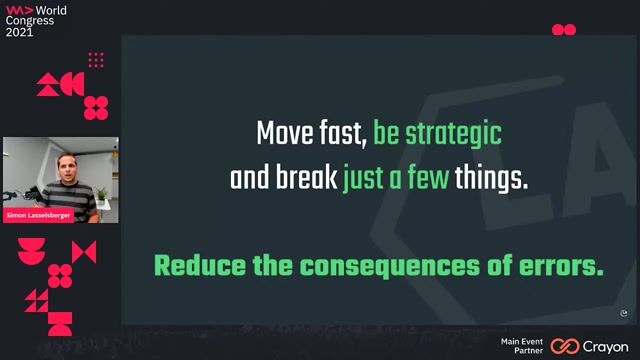
Strategies for modernizing and mitigating legacy system risks

Leszek Włodarski Leszek Włodarski · WWC Europe 2026

5:02 min

Transforming legacy monoliths into modern software systems

Henning Schwentner · LIVE

5:06 min

Modernizing legacy applications through proactive leadership

Babette Wagner Babette Wagner · Coffee With Developers

2:20 min

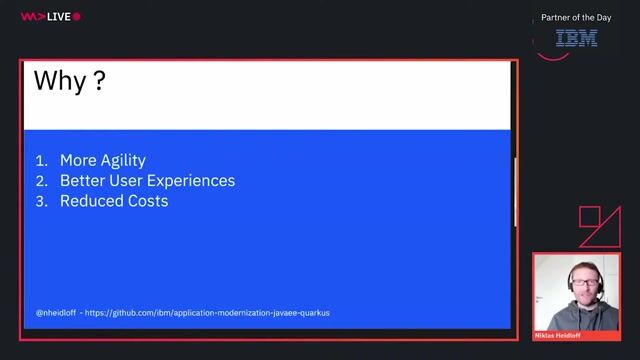
Five core strategies for handling legacy applications

Niklas Heidloff · LIVE

3:28 min

Managing technical debt in legacy web applications

Robby Russell · Coffee With Developers

3:00 min

Refactoring a complex legacy monolith into microservices

Andrew Holway · LIVE

Upcoming sessions on this topic

Open session

World Congress 2026 North America

From Legacy to Longevity – How a 17-Year-Old System stayed Modern

Alexander Arians

Empowering Engineers to drive innovation

Alexander Arians
Open session

World Congress 2026 North America

API = Some REST and HTTP, right? RIGHT?!

Rustam Mehmandarov

Passionate computer scientist

Rustam Mehmandarov
Open session

World Congress 2026 North America

Designing APIs That Survive AI Agents at Scale

Phani Pendurthi

Mastercard, Principal Software Engineer

Phani Pendurthi
Open session

World Congress 2026 North America

When Humans Stop Writing Code: Rethinking Languages, Compilers, and Responsibility

Simon Auer

Organizer of flutter vienna meetup and CEO of marqably

Simon Auer
Open session

World Congress 2026 North America

How to generate business value through performance optimizations

Nikolai Sidiropulo

Software Engineer at Meta

Nikolai Sidiropulo
Open session

World Congress 2026 North America

Boring Failover: Predictable Region Recovery Across 5,000 Microservices

Garvit Kataria, Sahil Sabharwal

Garvit Kataria
Sahil Sabharwal