



WeAreDevelopers LIVE Sep 1, 2021

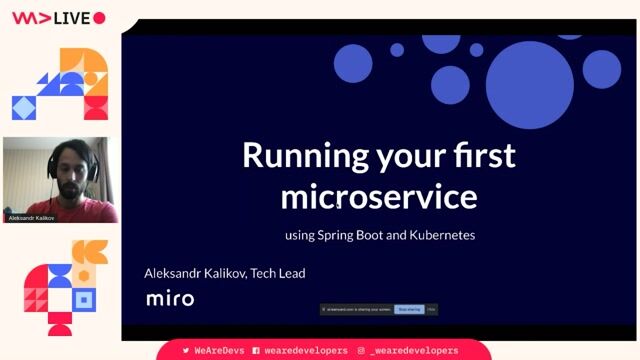
Microservices: how to get started with Spring Boot and Kubernetes

Aleksandr Kalikov

Miro escaped a slow-building monolith by strategically transitioning to microservices. Discover how they leveraged Spring Boot and Kubernetes to conquer distributed complexity and ensure zero-downtime deployments.

Pause
Mute Enter Fullscreen
#1 about 4 min

Transitioning from a monolith to a microservice architecture

Understanding the operational complexities that accompany splitting monolithic applications into scalable distributed systems.

#2 about 3 min

Evaluating orchestration tools for distributed container deployments

Evaluating container management solutions including Kubernetes, Docker Swarm, and HashiCorp Nomad helps scale modern workloads.

#3 about 4 min

Understanding Kubernetes core components and local environment tools

Understanding how controllers, pods, and schedulers operate alongside testing solutions like Minikube resolves local cluster setup frustrations.

#4 about 1 min

Choosing a Java framework for microservice development

Comparing prominent Java frameworks and selecting Spring Boot reduces transition uncertainty for established developer teams.

#5 about 4 min

Scaffolding a Spring Boot web application with Maven

Setting up a basic REST controller in a new Spring Boot application quickly establishes initial web service boundaries.

#6 about 5 min

Building and optimizing Docker images using Spring Boot layers

Structuring Docker images efficiently by separating application changes from static dependencies leverages caching to optimize slow build processes.

#7 about 6 min

Deploying the Docker image into a local Kubernetes cluster

Defining standard objects like namespaces, deployments, and ingress resources enables routing external traffic directly to local containers.

#8 about 5 min

Externalizing configuration using Kubernetes config maps

Managing application properties dynamically by binding ConfigMaps directly to Spring Cloud property sources prevents static hardcoded secrets leaking.

#9 about 14 min

Configuring application observability with Micrometer and Prometheus

Exposing actionable application metrics via Spring Actuator endpoints for scraping by Prometheus Operator improves runtime visibility.

#10 about 2 min

Managing container resource limits and Java memory options

Allocating heap versus non-heap memory arguments carefully prevents out-of-memory errors by respecting hard resource constraints configured in Kubernetes.

#11 about 3 min

Configuring automated liveness and readiness probes in Kubernetes

Using predefined Actuator health indicators to continuously evaluate whether a service can accept traffic prevents routing requests to unready pods.

#12 about 8 min

Managing graceful container shutdown during rolling updates

Delaying termination signals to safely drain in-flight network traffic prevents dropped client requests from occurring during seamless version rollout deployments.

#13 about 4 min

Evaluating communication protocols for high performance microservices

Considering alternative lightweight data structures like Protocol Buffers based on load balancer requirements optimizes high volume throughput requests.

#14 about 2 min

Securing Kubernetes workloads and containerized image layers

Applying least privilege principles and performing structural image scans mitigates operational vulnerabilities embedded within unverified dependencies.

#15 about 6 min

Reviewing deployment strategies and monitoring guidelines

Answering practical platform questions on vulnerability scanning options and endpoint monitoring distinctions clarifies essential operational responsibilities.

Matching moments

3:32 min

Transitioning from monolith architectures to microservices and Kubernetes

Liviu Costea · LIVE

2:10 min

Optimizing software development for production and Kubernetes

Josh Long · WWC 2022

3:00 min

Refactoring a complex legacy monolith into microservices

Andrew Holway · LIVE

1:39 min

Introduction to Kubernetes security challenges and opportunities

Marc Nimmerrichter · WWC 2022

1:18 min

Technology stack for building robust microservices applications

Niklas Heidloff · LIVE

3:25 min

Evaluating microservices against traditional monolithic application design

Oliver Zimmert · LIVE

Upcoming sessions on this topic

Open session

World Congress 2026 North America

Run your agents in Kubernetes: Build once, deploy anywhere. But really?

Michal Salanci

Senior Systems Engineer at ESET Cybersecurity

Michal Salanci
Open session

World Congress 2026 North America

Stop Running Mystery Meat in Production

Jeroen van Erp

Technical Advocate @ SUSE

Jeroen van Erp
Open session

World Congress 2026 North America

MicroAgents: The Microservices of the Agentic Era

Ashish Shubham

Runs the show bussiness at ThoughtSpot

Ashish Shubham
Open session

World Congress 2026 North America

Microservice Cognitive Index for Deploy Diagnosis and Change Impact

Sachin Gupta

Member of Technical Staff 2 at eBay

Sachin Gupta
Open session

World Congress 2026 North America

It’s Alive! Taming the MLOps Franken-Stack: Write, Run, and Serve with Michelangelo

Eric Wang, Paul Zimmerman

Eric Wang
Paul Zimmerman
Open session

World Congress 2026 North America

Boring Failover: Predictable Region Recovery Across 5,000 Microservices

Garvit Kataria, Sahil Sabharwal

Garvit Kataria
Sahil Sabharwal