


WeAreDevelopers LIVE Feb 6, 2024

Developing locally with Kubernetes - a Guide and Best Practices

Dan Erez

Are hardware limits and cloud bills bottlenecking your microservices? Discover how hybrid debugging routes remote Kubernetes traffic directly to your local IDE, saving you time and money.

Pause
Mute Enter Fullscreen
#1 about 7 min

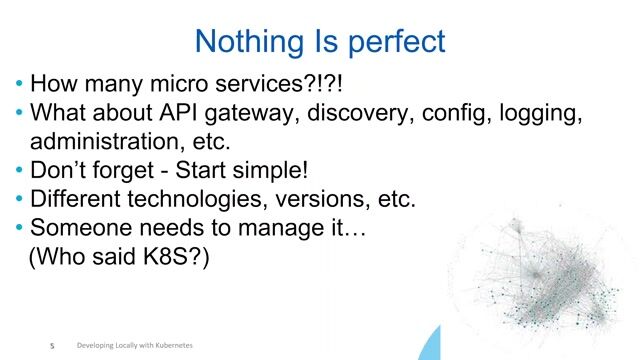
Advantages and complexities of microservice architectures

Breaking monoliths into independently scalable modules introduces massive routing and configuration overhead.

#2 about 6 min

Testing microservice integrations with containerized dependencies

Complex business logic requiring numerous distinct microservices quickly outgrows simple local unit testing flows.

#3 about 5 min

Comparing local, remote, and hybrid Kubernetes testing models

Traffic collisions and escalating public cloud costs necessitate strategic test environment design.

#4 about 4 min

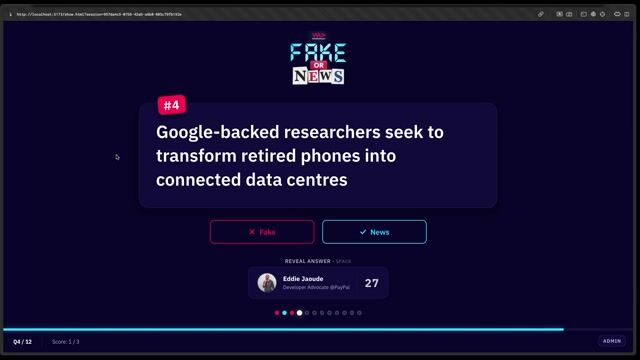
Utilizing idle employee devices for distributed cluster computing

Harnessing unused laptop memory across an enterprise hardware fleet drastically reduces private cloud expenses.

#5 about 5 min

Benefits and constraints of local Kubernetes development environments

Replicating production topologies locally avoids network dependencies but introduces steep learning curves for teams.

#6 about 5 min

Evaluating lightweight Kubernetes distributions for local development

Choosing between multi-node containers and simple binary distributions depends on specific developer resource availability.

#7 about 5 min

Debugging remote cluster workloads locally with network interception

Routing targeted testing flow traffic back to a local machine avoids rebuilding application images continually.

#8 about 5 min

Demonstrating cluster deployment and live traffic interception

Capturing remote service function calls directly handles live runtime calculations inside a local developer environment.

#9 about 2 min

Selecting the appropriate container development testing methodology

Engineering teams should progressively adopt container orchestrators only when multi-dependency environments dictate.

Matching moments

3:52 min

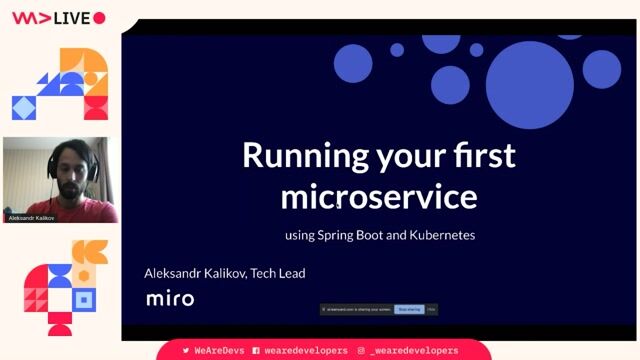
Understanding Kubernetes core components and local environment tools

Aleksandr Kalikov · LIVE

4:31 min

Addressing local development challenges with Podman Desktop

Stevan Le Meur Stevan Le Meur · WWC 2024

1:15 min

Deploying local container pods to Kubernetes clusters

Stevan Le Meur Stevan Le Meur · WWC 2024

3:01 min

Decomposing infrastructure problems using sandbox environments and networking tools

Ingvord Ingvord · WWC 2024

2:10 min

Optimizing software development for production and Kubernetes

Josh Long · WWC 2022

3:32 min

Transitioning from monolith architectures to microservices and Kubernetes

Liviu Costea · LIVE

Upcoming sessions on this topic

Open session

World Congress 2026 North America

Run your agents in Kubernetes: Build once, deploy anywhere. But really?

Michal Salanci

Senior Systems Engineer at ESET Cybersecurity

Michal Salanci
Open session

World Congress 2026 North America

One Repo, One Strategy: Scalable Full-Stack Testing in a Monorepo World

Bartosz Leczycki, Paweł Matynia

Bartosz Leczycki
Paweł Matynia
Open session

World Congress 2026 North America

From Cloud Native to Multi-Cloud Native: Write Once, Deploy Anywhere

Sandeep Pal

Principal Member of Technical Staff at Salesforce

Sandeep Pal
Open session

World Congress 2026 North America

Testing AI Workflows Locally with Testcontainers

Anna Chernyshova

Sr Solutions Engineer @ Docker

Anna Chernyshova
Open session

World Congress 2026 North America

Boring Failover: Predictable Region Recovery Across 5,000 Microservices

Garvit Kataria, Sahil Sabharwal

Garvit Kataria
Sahil Sabharwal
Open session

World Congress 2026 North America

public void saveMoney(AI): The Developer's Guide to Unit Economics

Hrushikesh Pokala

Senior Software Engineer Lead at Equifax

Hrushikesh Pokala