








BB
Benedikt Bischof
World Congress 2022
•
Jun 15, 2022
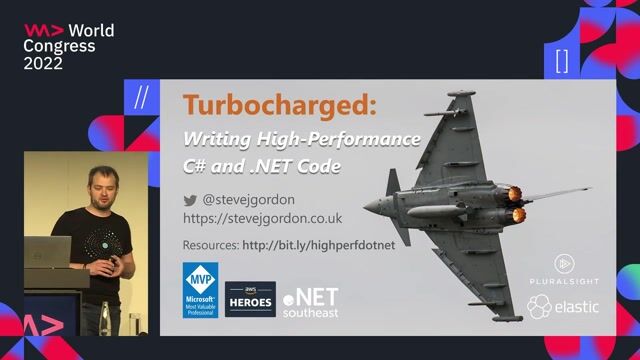
Turbocharged: Writing High-Performance C# and .NET Code
Steve Gordon
- Discuss this with your agent
- Open in Claude
- Open in ChatGPT
Steve Gordon proves that optimizing C# hot paths directly slashes your cloud costs. Master Span<T>, pipelines, and rigorous benchmarking to eliminate expensive garbage collection overhead.
Matching moments
1:55 min
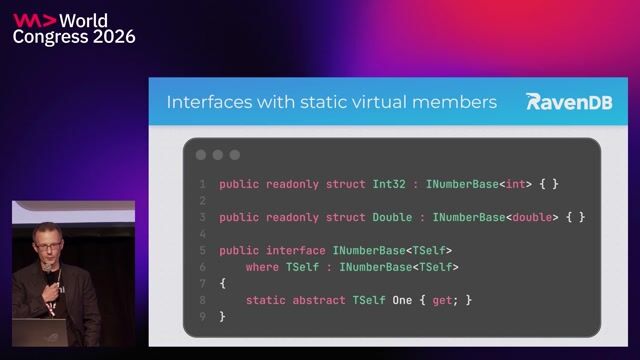
Introduction to systems programming and performance in .NET
 Szymon Kulec · World Congress 2026 Europe
8:29 min
Discussion on JIT memory parameters and cross-language benchmarking
Daniel Strmečki · LIVE
3:10 min
Debugging performance bottlenecks with developer tools
Cathrin Möller · World Congress 2023
3:37 min
Reviewing optimization improvements in Lighthouse
Laura Morinigo · World Congress 2022
4:47 min
Final performance results and key architectural takeaways
Yedidya Schwartz · LIVE
3:12 min
Prioritizing application startup efficiency over systemic throughput metrics
Holly Cummins · LIVE
More from World Congress 2022
Related videos
Related articles
.gif)
CH
Chris Heilmann

DC
Daniel Cranney

BB
Benedikt Bischof
.gif)
From learning to earning
Jobs that call for the skills explored in this talk.
about 2 months ago
Staff SoC Performance Architect - Next-Generation Server Platforms

ARM
San Diego, CA, United States
Expert
$198k–268k
SystemC
Profiling
InfiniBand
about 2 months ago
System Performance Analysis Engineer
ARM
Valbonne, France
Expert
Git
Ruby
Verilog
5 days ago
Staff SoC Performance Architect - Next-Generation Server Platforms
ARM
Austin, TX, United States
Expert
$198k–268k
SystemC
Profiling
InfiniBand
5 days ago
Principal SoC Performance Architect - Next-Generation Server Platforms
ARM
San Jose, CA, United States
Expert
$262k
SystemC
Profiling
InfiniBand
15 days ago
Principal Software Engineer, AI Inference Runtime
ARM
Seattle, WA, United States
Expert
$262k
Compilers
Low Latency
Concurrency
13 days ago
Staff SoC Integration and Performance Lead
ARM
Austin, TX, United States
Expert
$198k–268k
Git
Verilog
Firmware