

World Congress 2022 • Jun 15, 2022

It’s all about the domain, honey ! Experiences from 15 years of Domain-Driven Design

Carola Lilienthal

Are your microservices just a poorly managed distributed monolith? Discover why fifteen years of Domain-Driven Design proves that intentional boundaries are the true key to sustainable software architecture.

Pause
Mute Enter Fullscreen
#1 about 8 min

Building and maintaining sustainable software architectures

Maintaining a steady stream of feature delivery over multiple releases requires continuous attention to structural health and refactoring.

#2 about 4 min

Microservices and the distributed big ball of mud

Cutting a highly coupled monolith into networked pieces fails unless internal modularity and dependencies are properly resolved beforehand.

#3 about 2 min

Designing for high cohesion and loose coupling

Dependency control forms the core of sustainable design by defining a clear separation of concerns within and across modules.

#4 about 6 min

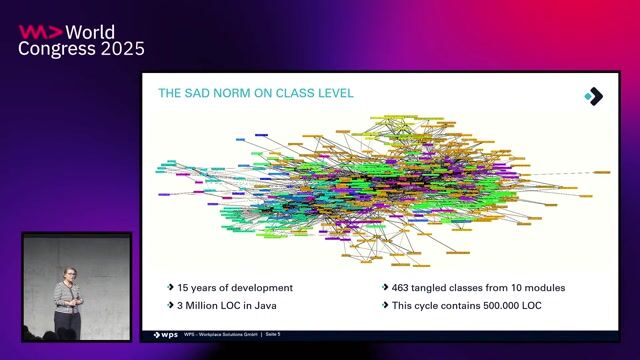
Resolving entangled domain models in legacy applications

Grouping software by use cases instead of business capabilities often results in deeply tangled core domain classes.

#5 about 4 min

Defining subdomains and bounded contexts in software

Strategic design sets explicit boundaries around small domain components to isolate requirements and empower independent engineering teams.

#6 about 5 min

Using domain storytelling to discover architectural boundaries

Recognizing distinct business triggers and one-way information flows helps locate natural architectural cuts in complex organizational workflows.

#7 about 6 min

Implementing distinct domain boundaries without tight coupling

Restricting module communication to asynchronous updates prevents the operational tight coupling caused by shared synchronous entity services.

#8 about 5 min

Evaluating codebases using the Modularity Maturity Index

Quantifying code structure provides an objective metric for evaluating how effectively an application separates independent business concepts.

#9 about 8 min

Managing domain duplication and evolving early architectures

Starting projects as well-structured monoliths allows domains to mature before teams implement complex microservices or event-driven communication layers.

Matching moments

1:55 min

Overview of domain-driven design techniques

Eberhard Wolff Eberhard Wolff · World Congress 2025

1:22 min

Structuring engineering teams around domain bounded contexts

Tom George · LIVE

1:58 min

Identifying bounded contexts using domain-driven design principles

Hendrik Lösch Hendrik Lösch · World Congress 2024

8:14 min

Restructuring the monolith using domain-driven design

Jens Happe Jens Happe · LIVE

4:33 min

Building long-term Angular architectures with domain-driven design

Manfred Steyer Manfred Steyer · LIVE

5:40 min

Applying domain-driven design principles to APIs

Jacek Milewski Jacek Milewski · Europe 2026 Virtual

Upcoming sessions on this topic

Open session

Designing for Every Direction: Logical CSS for Global, Adaptive, and Effortlessly Reversible UIs

  • Vidhya Krishnamoorthy

    Morgan Stanley

    VP, Software Engineering Manager

Open session

Multi-Cloud Isn't a Project. It's a Side Effect.

  • Antonio Mendoza Pérez

    Temporal Technologies

    Staff Developer Success Engineer

  • Gaurav Thadani

    Temporal

    Staff Developer Success Engineer

Open session

Beyond File Dumps: Context Engineering for Coding Agents

  • Animesh Dutta

    Arm

    Senior Software Engineer

Open session

Architecting Trusted AI: Coupling Multi-Agent Systems with dbt Semantic Store for Zero-Hallucination

  • Pushkar Mishra

    J.P. Morgan

    Senior Vice President

Open session

What I Got Wrong Shipping an MCP Server for Live Infrastructure

  • Pritesh Kiri

    Harness

    Developer Relations Engineer

Open session

We Deleted Our Observability Stack and Rebuilt It with OTEL: 12 Engineers to 4 at 20K+ clusters

  • Yash Sharma

    DigitalOcean

    Developer Advocate