







LM
Luis Minvielle
WeAreDevelopers LIVE
•
Oct 12, 2020
What do language models really learn
Tanmay Bakshi
- Discuss this with your agent
- Open in Claude
- Open in ChatGPT
Are large language models just sophisticated readers disguised as writers? Discover why autoregressive models lack underlying thought and how blank-filling architectures will finally teach neural networks to plan.
Matching moments
2:47 min
The fundamental mechanics of large language models
 Tomislav Tipurić · World Congress 2025
2:26 min
Capabilities and applications of large language models
Aditi Godbole · LIVE
2:25 min
Understanding the evolution and nature of large language models
 Krzysztof Cieślak · World Congress 2024
3:52 min
Evolution of large language models and natural language processing
Natalie Pistunovich · LIVE
2:53 min
Understanding capabilities and limitations of large language models
 Markus Walker · World Congress 2023
1:46 min
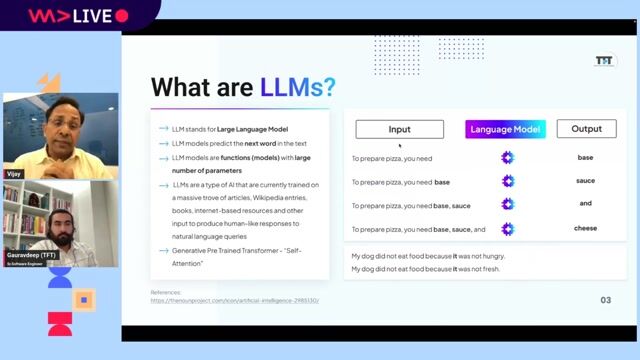
Evolution and impact of large language models
Vijay Krishan Gupta +1 · LIVE
More from WeAreDevelopers LIVE
Related videos
Related articles
.png)
KD
Krissy Davis
.png)
BB
Benedikt Bischof
.gif)
CH
Chris Heilmann
From learning to earning
Jobs that call for the skills explored in this talk.
about 1 month ago
Machine Learning Engineer

Twilio
United States
Experienced
Remote
Spacy
Pytorch
Chatbots
2 months ago
Machine Learning Engineer
TWILIO
Barcelona, Spain
€25k–60k
Remote
Spacy
Twilio
Pytorch
about 2 months ago
Machine Learning Engineer
TWILIO
Spain
Remote
Spacy
Twilio
Pytorch
about 2 months ago
Machine Learning Engineer
TWILIO
Madrid, Spain
Remote
Twilio
Pytorch
Chatbots
about 1 month ago
Machine Learning Engineer
TWILIO
Cantabria, Spain
Remote
Twilio
Chatbots
Tensorflow
3 months ago
Staff, Machine Learning Engineer (L4)
Twilio
Indianapolis, IN, United States
Expert
Remote
Keras
Presto
Twilio