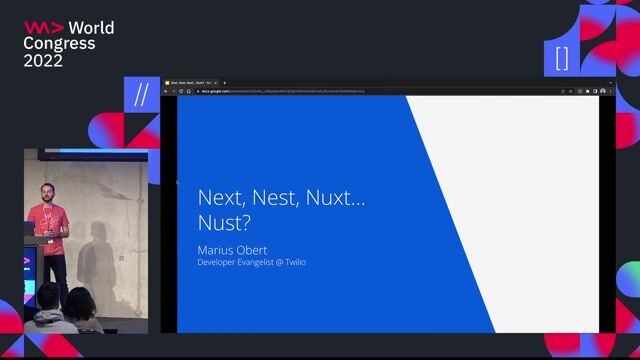
Stop choosing your framework first. This talk argues your rendering architecture should be the primary driver, making your choice between Next, Nuxt, and Nest simple.
#1about 5 minutes
Choosing a framework using the State of JS survey
The State of JS survey reveals that while Express.js is widely used, frameworks like Next.js, Gatsby, and Nuxt.js are rapidly gaining popularity.
#2about 5 minutes
Comparing web rendering strategies for modern applications
Understand the differences and trade-offs between client-side rendering, server-side rendering, static site generation, and pre-rendering for performance and SEO.
#3about 2 minutes
Building static sites with Gatsby and React
Gatsby is a React-based static site generator ideal for Jamstack applications with its rich plugin ecosystem and focus on performance.
#4about 4 minutes
Creating hybrid React applications with Next.js
Next.js extends React with pre-rendering, automatic static optimization, and serverless functions, making it a versatile choice for hybrid applications.
#5about 2 minutes
Using Nuxt.js for server-rendered Vue.js applications
Nuxt.js provides a powerful framework for building server-rendered applications with Vue.js, offering similar capabilities to Next.js.
#6about 3 minutes
Building a full-stack backend with NestJS
NestJS is a progressive Node.js framework for building efficient and scalable server-side applications with features like TypeORM and a modular architecture.
#7about 2 minutes
Comparing framework popularity and community support
A data-driven comparison of Next.js, Gatsby, Nuxt.js, and NestJS based on npm downloads, GitHub activity, and community size helps in choosing a well-supported tool.
#8about 2 minutes
How to choose the right JavaScript framework
Use a decision tree based on your application's architecture, such as full-stack needs or specific rendering strategies, to select the most suitable framework.
#9about 1 minute
Q&A on Deno's maturity and framework preference
The speaker discusses why Deno was not considered mature enough in 2020 and reaffirms a personal preference for using NestJS for backend development.
Related jobs
Jobs that call for the skills explored in this talk.
Exploring TypeScript: Benefits for Large-Scale JavaScript ProjectsJavaScript is the backbone of web development, powering everything from small websites to large-scale enterprise applications. However, as projects grow in complexity, maintaining JavaScript code can become increasingly difficult. This is where TypeS...
SciChart
The Fastest JavaScript Charts - Built for React and BeyondFor most developers, browser charting works fine — until it doesn’t. Once you push beyond tens of thousands of points, add live streaming, or need advanced interactions, the story changes: frame drops, frozen dashboards, memory issues.
That’s where S...
Benjamin Ruschin
The HTML Elements That You’re Probably Over-EngineeringAs frameworks have become more and more commonplace in the world of web development, so too has the over-engineering of features made possible by our humble old friend, HTML.
The mental models that come with using state management in React, Vue and o...
Luis Minvielle
The Best 7 Frontend Frameworks for Developers in 2025Which frontend frameworks should developers focus on in 2025? We’re listing them for you and showing advantages and drawbacks. You’ll notice we included some libraries as well, because you can’t miss those in 2025.What is the best front end framework...
From learning to earning
Jobs that call for the skills explored in this talk.