Ekaterina Sirazitdinova

Graph Neural Networks: What’s behind the Hype?

How does AI predict traffic, recommend friends, and discover new drugs? Learn how Graph Neural Networks derive insights from complex, unstructured data.

Graph Neural Networks: What’s behind the Hype?
#1about 2 minutes

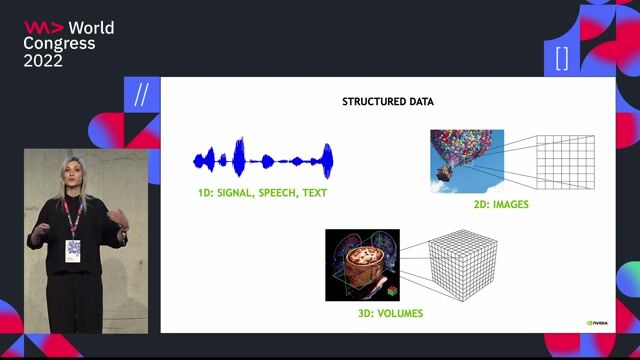
Why graph neural networks excel with unstructured data

Graph neural networks are uniquely suited for unstructured data like 3D meshes and social networks where traditional CNNs struggle.

#2about 3 minutes

Reviewing core concepts from graph theory

Key graph theory concepts are explained, including nodes, edges, directed vs undirected graphs, and homogeneous vs heterogeneous graphs.

#3about 2 minutes

Choosing the right data structure for graphs

An adjacency matrix is suitable for small graphs, while an adjacency list is more spatially efficient for large, sparse graphs.

#4about 3 minutes

A brief refresher on deep learning fundamentals

The core deep learning process of training and inference is reviewed, along with the distinction between supervised and unsupervised learning.

#5about 6 minutes

Exploring graph, node, and edge level prediction tasks

GNNs can perform predictions at the graph level (molecule properties), node level (community detection), and edge level (recommendation systems).

#6about 4 minutes

Understanding the GNN training and data splitting process

GNNs are trained using the message passing algorithm to create node embeddings, followed by a transductive split for training and validation sets.

#7about 2 minutes

Frameworks and resources for building GNNs

Popular frameworks like DGL, PyTorch Geometric, and TensorFlow GNN simplify the implementation of graph neural networks.

#8about 1 minute

Summary of key concepts in graph neural networks

The talk concludes with a recap of key takeaways, including graph modeling, data representation, prediction tasks, and the message passing algorithm.

#9about 3 minutes

Q&A on data leakage, knowledge graphs, and embeddings

The Q&A session addresses audience questions about data leakage in transductive splits, applying GNNs to semantic knowledge graphs, and comparing graph embeddings to word embeddings.

Related jobs
Jobs that call for the skills explored in this talk.

Featured Partners

Related Articles

View all articles
DC
Daniel Cranney
How to Use Generative AI to Accelerate Learning to Code
It’s undeniable that generative-AI and LLMs have transformed how developers work. Hours of hunting Stack Overflow can be avoided by asking your AI-code assistant, multi-file context can be fed to the AI from inside your IDE, and applications can be b...
How to Use Generative AI to Accelerate Learning to Code
DC
Daniel Cranney
DeepSeek R1 vs ChatGPT o1: How Do They Compare?
It’s fair to say DeepSeek has arrived. The Chinese startup and its R1 model exploded onto the AI scene last week, and - at least temporarily - turned the industry on its head. With OpenAI having established itself as the market leader over the last ...
DeepSeek R1 vs ChatGPT o1: How Do They Compare?
DD
Dilek Demir
Data Science & more: The Lopez dilemma
Catwalk, Data Science, Hollywood, Google Images, Haute Couture, StackOverflow, Comfort Zone, Dota 2 and Versace – all these topics are connected and influenced by each other. Read here how and why!In 2000 Jennifer Lopez's green Versace dress went vi...
Data Science & more: The Lopez dilemma

From learning to earning

Jobs that call for the skills explored in this talk.