

World Congress 2022 Jun 15, 2022

A Data Mesh needs Open Metadata

Ferd Scheepers

Decentralized data meshes fail without standardized interoperability. Discover how the open-source metadata standard Egeria automates end-to-end governance and eliminates integration bottlenecks across multi-cloud environments.

Pause
Mute Enter Fullscreen
#1 about 2 min

Embracing open source engineering in a digital bank

Building internal engineering talent to actively contribute to open source software establishes technical leadership.

#2 about 3 min

Standardizing data consumption with a common language

Defining shared business terms through a canonical format simplifies data movement between producers and consumers.

#3 about 2 min

Challenges of manual data mapping and localization

Moving and transforming data across global private and public clouds remains a highly manual logistical hurdle.

#4 about 3 min

Applying flower auction logistics to data metadata

Using metadata as a physical label enables highly automated transportation and logistics for moving diverse items.

#5 about 3 min

Bundling data and metadata for seamless integration

Shipping technical descriptions directly alongside assets eliminates friction during platform exchanges.

#6 about 2 min

Introducing data mesh and localized autonomy

Breaking down centralized dependencies empowers local groups to construct autonomous data products while maintaining global governance.

#7 about 3 min

Navigating the lack of mature data mesh tooling

Implementing localized data autonomy currently requires massive engineering effort to wire together disparate vendor products.

#8 about 2 min

Building the open source fabric data mesh product

Collaborating across organizations to build automated policies and data movement guardrails accelerates data mesh adoption.

#9 about 2 min

Bridging the semantic gap with interoperable metadata

Connecting different platforms requires reliable APIs and formats that preserve context and data quality.

#10 about 3 min

Creating standard APIs via the Egeria open metadata project

Two layers of integration and consumption APIs allow disparate catalogs and repositories to sync structural definitions seamlessly.

#11 about 3 min

Applying the Egeria metadata mesh for federated catalogs

Connecting multiple vendor setups into a federated cohort enables single-pane visibility across independent data environments.

#12 about 4 min

Fostering open source contributions in corporate engineering teams

Allowing engineers to prioritize community-driven open source features over traditional internal business requests fosters innovation.

#13 about 2 min

Enabling cross-platform metadata search and discovery

Indexing business terms, assets, and streaming topics allows technical teams to instantly locate enterprise-wide definitions.

#14 about 2 min

Mapping end-to-end data lineage for regulatory compliance

Rendering reality-based flow graphs proves compliance to auditors without relying on outdated manual documentation.

#15 about 3 min

Advancing industry standards by open sourcing core capabilities

Sharing intellectual property publicly encourages vendor adoption and prevents proprietary lock-in for critical infrastructure.

#16 about 3 min

Shifting culture toward monetizing data as a product

Treating data pipelines as primary revenue drivers incentivizes upstream teams to claim ownership and ensure quality.

#17 about 2 min

Incentivizing domains to produce rich data descriptions

Applying regulatory mandates forces baseline documentation, but rewarding domains for dataset creation drives sustainable metadata quality.

#18 about 2 min

Comparing Egeria to alternative open metadata solutions

A richer core type system provides deeper technical integration capabilities compared to visually appealing but shallow alternatives.

Matching moments

1:50 min

The future of data engineering and AI mesh

Sandhya Menon Sandhya Menon · World Congress 2026 Europe

3:11 min

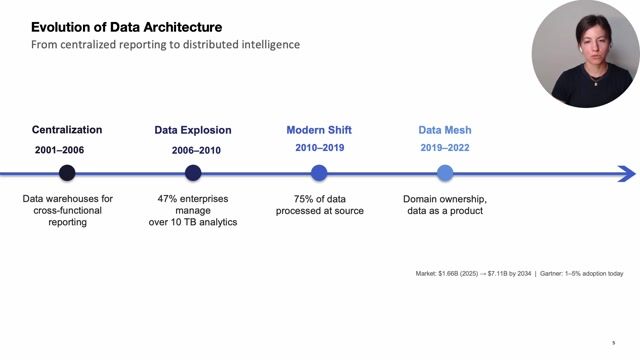
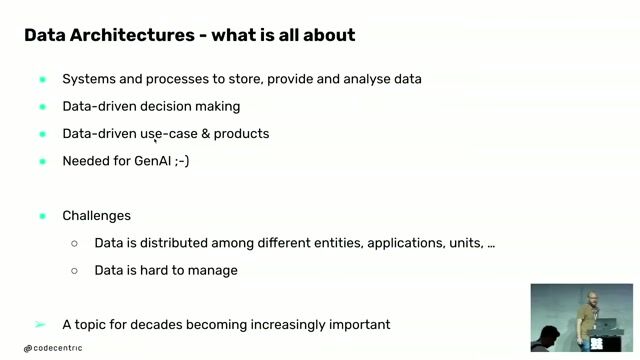
Decentralizing data bottlenecks with data mesh principles

Matthias Niehoff Matthias Niehoff · World Congress 2024

2:25 min

Adopting a decentralized data mesh architecture model

Sandhya Menon Sandhya Menon · World Congress 2026 Europe

2:18 min

Core principles of decentralized data mesh architecture

Olga Woschitz Olga Woschitz +1 · Europe 2026 Virtual

1:38 min

Understanding data mesh as an organizational design shift

Mario Meir-Huber · LIVE

2:50 min

Adopting data mesh ownership and aggregated data models

Kateřina Ščavnická Kateřina Ščavnická · World Congress 2025

Upcoming sessions on this topic

Open session

World Congress 2026 North America

September 24, 2026 · 16:50–17:20

Stage 9

From Guesswork to Governance: Data Contracts Bring API Discipline to Apache Kafka

Sandon Jacobs

Senior Developer Advocate at IBM

Sandon Jacobs
Open session

World Congress 2026 North America

September 24, 2026 · 11:40–12:10

Stage 7

Clean Rooms Demystified: Architecture and Patterns for Privacy-Safe Data Collaboration

Anurag Malik

Data Tech Lead @ Intuit

Anurag Malik
Open session

World Congress 2026 North America

September 25, 2026 · 16:50–17:20

Stage 4

Engineering Moneyball: How We Benchmarked Google vs Meta

Jirka Bachel

Co-Founder & CEO

Jirka Bachel
Open session

World Congress 2026 North America

September 25, 2026 · 10:20–10:50

Tech Leaders Stage

Democratizing AI: Why Open Models Are Essential for the Next Era

Mitesh Patel

NVIDIA Corporation, Developer Advocate -- Manager

Mitesh Patel
Open session

World Congress 2026 North America

September 24, 2026 · 11:00–11:30

Stage 3

Making Science Larger, not just Faster

Yuval Dvir

Commercial Executive, SandboxAQ

Yuval Dvir
Open session

World Congress 2026 North America

September 25, 2026 · 16:10–16:40

Stage 6

Beyond SQL Generation: How to Teach Agents What Your Database Actually Means

Kris Jenkins

Host / Developer Voices

Kris Jenkins