World Congress 2023 Sep 27, 2023

Implementing an Event Sourcing strategy on Azure

Eldert Grootenboer , Olena Borzenko-Turianska

Are CRUD bottlenecks limiting your application's scale? Discover how to architect an append-only event sourcing strategy on Azure to unlock infinite scalability and lightning-fast materialized views.

Pause
Mute Enter Fullscreen
#1 about 3 min

Understanding the basics of event sourcing patterns

Replaying sequential events rebuilds the current state of an entity.

#2 about 4 min

Solving traditional database locking and scaling challenges

Insert-only workloads eliminate update locks and provide built-in audit trails.

#3 about 1 min

Scaling event sourcing systems in cloud environments

Cloud platforms natively support high-throughput insert operations for massive scale.

#4 about 3 min

Storing events using globally distributed databases

Multimodal document databases offer native change feeds for separation of commands and queries.

#5 about 2 min

Ingesting streaming data securely with managed hubs

Fully managed ingestion engines capture millions of stream messages per second without exposing data stores.

#6 about 1 min

Publishing discrete event notifications for broad consumption

System triggers send independent push notifications to alert external applications of status changes.

#7 about 1 min

Managing intent-based workloads using message queues

Reliable messaging queues handle explicit transactional commands and prevent data loss during processing failures.

#8 about 3 min

Processing event streams linearly through serverless compute

Native platform bindings eliminate boilerplate code when deploying reactive cloud processing units.

#9 about 3 min

Designing data ingestion architecture with system integration

Swapping connection strings migrates existing external streaming applications directly into managed cloud infrastructure.

#10 about 3 min

Routing discrete events to trigger independent workflows

Aggregating historical records uncovers the necessary operational context to execute downstream automated tasks.

#11 about 3 min

Options for extracting and processing historical events

Pulling batches, subscribing to real-time pushes, or running automated scripts determines how data gets consumed.

#12 about 4 min

Precalculating queries using automatic materialized views

Aggregating transactional data immediately upon insertion optimizes subsequent application read performance.

#13 about 2 min

Embracing data duplication to replace complex normalization

Duplicating aggregate data across distinct partition keys avoids expensive relational joins.

#14 about 2 min

Integrating analytical dashboards and real-time client notifications

Downstream applications consume preprocessed snapshots to instantly drive live analytics and interactive experiences.

#15 about 3 min

Benefits of adopting scalable event sourcing architecture

Append-only persistent stores combine natively with serverless components to securely manage extreme enterprise workloads.

#16 about 2 min

Handling data retention and archiving in event stores

Continuous changelogs naturally retain historical actions to simplify data recovery and long-term storage.

Matching moments

3:19 min

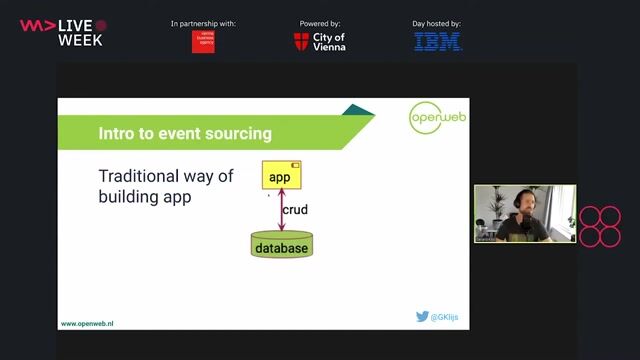
Core principles of transitioning to full event sourcing

Gerard Klijs · LIVE

5:37 min

Transitioning from synchronous microservices to event sourcing

Denis Washington +1 · World Congress 2021

6:15 min

Routing events between sources and handlers with event grid

Menaka Baskerpillai · LIVE

2:08 min

Introducing beneficial architectural patterns like event sourcing

Stefan Priebsch · World Congress 2021

4:28 min

Differentiating event streaming from true event sourcing

Allard Buijze · World Congress 2021

4:30 min

Introducing data management and the shift to streaming

Mary Grygleski Mary Grygleski · LIVE

Upcoming sessions on this topic

Open session

World Congress 2026 North America

September 24, 2026 · 14:10–14:40

Stage 3

Real-Time Data Platforms at Trillion-Event Scale

Diptamay Sanyal

Principal Engineer | Data, AI & Cybersecurity Platforms

Diptamay Sanyal
Open session

World Congress 2026 North America

September 25, 2026 · 12:55–13:25

Stage 3

Replay-Safe Architecture: Building Event-Driven Systems That Can Recover With Confidence

Ishan Shah

PayPal, Software Engineer | Distributed Systems, AI, and Platform Engineering

Ishan Shah
Open session

World Congress 2026 North America

September 24, 2026 · 17:30–18:00

Stage 3

Scaling Distributed Queues for AI workloads

Jasmit Kaur Saluja

Software Engineer at Meta Platforms Inc

Jasmit Kaur Saluja
Open session

World Congress 2026 North America

September 24, 2026 · 16:50–17:20

Stage 9

From Guesswork to Governance: Data Contracts Bring API Discipline to Apache Kafka

Sandon Jacobs

Senior Developer Advocate at IBM

Sandon Jacobs
Open session

World Congress 2026 North America

September 24, 2026 · 14:50–15:20

Stage 2

Databases in the Agent Era

Monica Sarbu

Founder and CEO of xata.io

Monica Sarbu
Open session

World Congress 2026 North America

September 24, 2026 · 17:30–18:00

Stage 4

Boring Failover: Predictable Region Recovery Across 5,000 Microservices

Garvit Kataria, Sahil Sabharwal

Garvit Kataria
Sahil Sabharwal