World Congress 2021 Jun 29, 2021

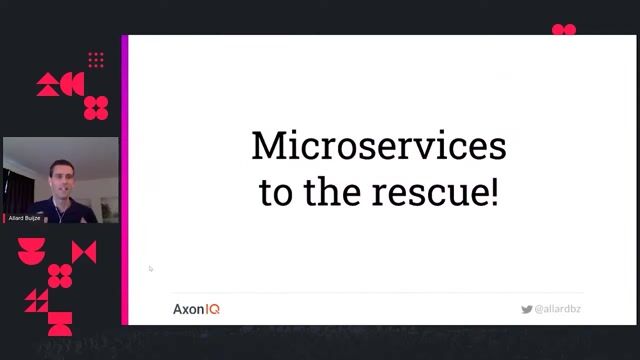
CQRS and Event Sourcing without the pixie dust

Allard Buijze

Microservices aren't magic. An event bus alone just creates a distributed ball of mud. Learn how true CQRS and event sourcing achieve genuine architectural modularity.

Pause
Mute Enter Fullscreen
#1 about 3 min

The evolution of monolithic layered architectures

How the traditional layered architectural pattern inevitably evolves into an unmaintainable big ball of mud.

#2 about 3 min

Splitting monoliths into distributed microservices architectures

Increasing the number of deployment units without increasing modularity results in a distributed big ball of mud.

#3 about 2 min

Combating technical debt and anti-modularity forces

Day-to-day workarounds and deferred refactoring actively degrade application architecture over time by accumulating unstructured dependencies.

#4 about 4 min

Decoupling microservices using event-driven communication models

Using publish-subscribe event models reduces direct service coupling but can obscure execution flow and logical dependency tracking.

#5 about 3 min

The false promises of event-driven microservices

Applying simplistic monolithic methodologies to modern message brokers often reproduces identical coupling issues inside distributed systems.

#6 about 5 min

Differentiating event streaming from true event sourcing

Event sourcing uses historical past decisions to explicitly dictate future application states rather than safely streaming update notifications between tables.

#7 about 4 min

Preserving historical state interactions for reliable auditability

Persisting absolute raw state modification sequences ensures uncompromised audit trails and simplifies managing inherently complex conceptual domain representations.

#8 about 4 min

Managing current state with CQRS and data projections

CQRS safely circumvents the query limitations of aggregated event logs by cleanly separating write models from read-optimized data projections.

#9 about 5 min

Building disciplined domain models for event-driven systems

Sustaining a successful event-centric integration strategy requires embracing domain-driven design modeling techniques instead of purely relying upon broker technologies.

#10 about 3 min

Defining commands, events, and queries in messaging

Understanding the explicit routing behaviors of different interaction patterns provides significantly better runtime decoupling between bounded domain functionalities.

#11 about 2 min

Achieving location transparency across distributed deployment units

Designing modules to communicate agnostically removes the brittle requirement to explicitly hardcode particular network recipient locations.

#12 about 4 min

Implementing CQRS and event sourcing in Java

Demonstrating a robust command validation model that safely enforces consistent backend business behaviors under concurrent transaction loads inside a monolithic setup.

#13 about 8 min

Dynamically splitting monoliths into distributed microservice components

Extracting previously composed backend modules into independent operational runtimes verifies the deployment agility produced by strict interface decoupling.

Matching moments

3:19 min

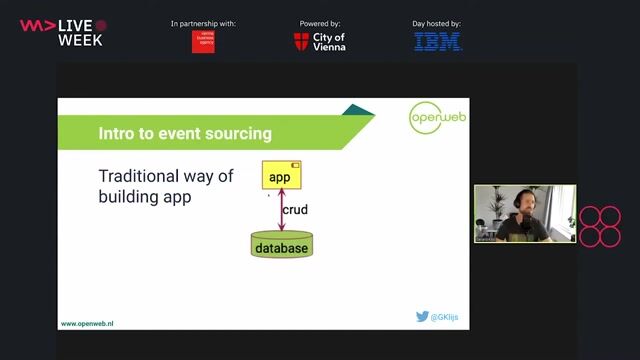
Core principles of transitioning to full event sourcing

Gerard Klijs · LIVE

5:37 min

Transitioning from synchronous microservices to event sourcing

Denis Washington +1 · World Congress 2021

4:23 min

Clarifying terminology around different event computing software forms

Mary Grygleski Mary Grygleski · LIVE

1:26 min

Implementing diverse architectural patterns beyond basic data operations

Vincent Amstoutz Vincent Amstoutz · Europe 2026 Virtual

2:08 min

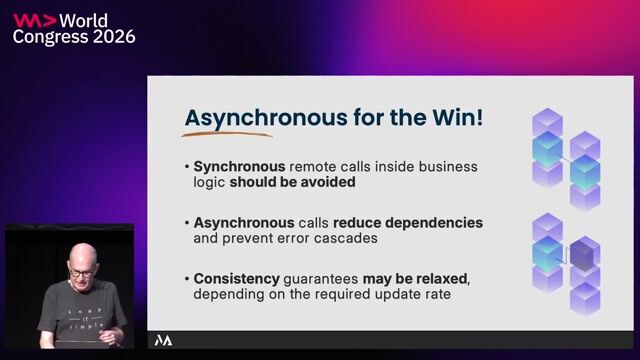
Introducing beneficial architectural patterns like event sourcing

Stefan Priebsch · World Congress 2021

5:02 min

Audience Q&A on monolithic versioning and configuration boundaries

Oliver Bestwalter · LIVE

Upcoming sessions on this topic

Open session

World Congress 2026 North America

September 25, 2026 · 10:20–10:50

Outdoor Stage

MicroAgents: The Microservices of the Agentic Era

Ashish Shubham

Runs the show bussiness at ThoughtSpot

Ashish Shubham
Open session

World Congress 2026 North America

September 24, 2026 · 17:30–18:00

Stage 3

Scaling Distributed Queues for AI workloads

Jasmit Kaur Saluja

Software Engineer at Meta Platforms Inc

Jasmit Kaur Saluja
Open session

World Congress 2026 North America

September 25, 2026 · 14:50–15:20

Stage 6

Look What Java Can Do Now: Live-Coding a GenAI MCP Server with the JAQ Stack

Suren Konathala

Senior Engineering Leader, Marketing & AdTech, AI GTM & Digital Experience Platforms, Java x AI

Suren Konathala
Open session

World Congress 2026 North America

September 24, 2026 · 14:10–14:40

Stage 3

Real-Time Data Platforms at Trillion-Event Scale

Diptamay Sanyal

Principal Engineer | Data, AI & Cybersecurity Platforms

Diptamay Sanyal
Open session

World Congress 2026 North America

September 25, 2026 · 09:00–09:30

Stage 1

Test Before Release, Enforce at Runtime: Governance for Tool-Using AI Agents

Sachin Gupta

Member of Technical Staff 2 at eBay

Sachin Gupta
Open session

World Congress 2026 North America

September 24, 2026 · 16:10–16:40

Stage 1

Sandboxing the Swarm: Building Secure, Serverless AI Agents with Wasm

Lena Hall, Thorsten Hans

Lena Hall
Thorsten Hans