World Congress 2024 Aug 20, 2024

Transforming Education: A Journey from interactive Markdown to Remote-Labs

André Dietrich

Can you build interactive, serverless remote labs using only Markdown? Discover how LiaScript uses peer-to-peer protocols to transform static text into collaborative educational environments.

Pause
Mute Enter Fullscreen
#1 about 4 min

Challenges in open educational resources

The limitations of fragmented authoring tools and the lack of collaboration formats in OER creation.

#2 about 3 min

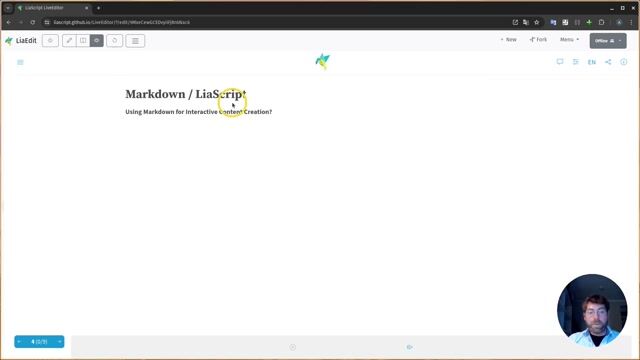
Creating interactive educational content with LiaScript

Using an extended version of Markdown to build versionable, multimedia-rich textbooks and presentations.

#3 about 2 min

Embedding interactive quizzes in Markdown documents

Building single-choice and multiple-choice quizzes using simple bracket and parenthesis syntax.

#4 about 3 min

Executing code snippets directly within the browser

Turning static code blocks into immediately executable environments for JavaScript, C++, and algebra systems.

#5 about 2 min

Importing functional Markdown templates and text-to-speech modules

Loading external Markdown libraries to add configurable features like ABC music notation rendering and interactive speech.

#6 about 2 min

Building reactive content with dynamic script tags

Using script tags to fetch live data and link inputs to reactive outputs for inspectable calculations.

#7 about 1 min

Executing serverless course distribution via URL parameters

Loading and rendering interactive courses entirely within the browser using raw Markdown URLs.

#8 about 4 min

Distributing educational content with peer-to-peer protocols

Distributing educational materials securely and resiliently using distributed file systems and WebTorrent.

#9 about 3 min

Enabling real-time shared classrooms and collaborative editing

Connecting users into synced, peer-to-peer spaces for real-time collaboration and chat using browser state.

#10 about 3 min

Simplifying peer-to-peer connections using WebRTC abstraction libraries

Bypassing complex WebRTC signaling by using abstraction libraries like Trystero to construct decentralized rooms.

#11 about 2 min

Synchronizing decentralized application state with CRDTs

Handling conflict-free decentralized state synchronization using data structures like Yjs without centralized authorities.

#12 about 6 min

Sharing physical hardware access in remote browser laboratories

Utilizing Web Serial APIs, WebRTC, and CRDTs to remotely stream and interact with embedded hardware like Arduino.

Matching moments

2:26 min

Publishing decentralized interactive open educational resources

André Dietrich André Dietrich +1 · Europe 2026 Virtual

1:23 min

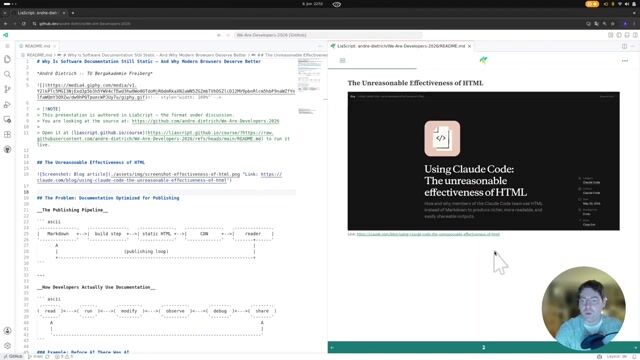
Setting up a live Markdown preview environment

André Dietrich André Dietrich +1 · Europe 2026 Virtual

3:47 min

Showcasing emerging tools for collaborative coding and moderation

Chris Heilmann +2 · LIVE

6:40 min

Powering interactive JavaScript learning environments in the browser

Chris Heilmann +2 · LIVE

8:29 min

Scripting interactive technical presentations inside the editor environment

Chris Heilmann +9 · LIVE

3:35 min

Designing interactive social learning experiences for distributed remote teams

Erik Wiedenmann Erik Wiedenmann · Europe 2026 Virtual

Upcoming sessions on this topic

Open session

World Congress 2026 North America

September 24, 2026 · 16:10–16:40

Stage 5

From Software Agents to Physical Devices: Inside the Agentic Hardware Stack

Michael Yuan, Vivian Hu

Michael Yuan
Vivian Hu
Open session

World Congress 2026 North America

September 23, 2026 · 15:00–15:30

Stage 2

How GitHub Helps Two Maintainers Serve 6,000 Learners

Gwyneth Peña-Siguenza

Senior Cloud Advocate at GitHub
Gwyneth Peña-Siguenza
Open session

World Congress 2026 North America

September 25, 2026 · 15:30–16:00

Stage 6

Small LLM in your Browser: Huge Opportunities for Web Applications

Daniel Ostrovsky

UI/UX Architect at Payoneer | AI Architect | Full Cycle Development Expert | Public Speaker | Open Source Contributor |

Daniel Ostrovsky
Open session

World Congress 2026 North America

September 25, 2026 · 16:50–17:20

Stage 1

Honey, look! I vibe-coded an OS!

Ian Smith

CTO of LYOS

Ian Smith
Open session

World Congress 2026 North America

September 24, 2026 · 11:30–11:35

Outdoor Stage

Loominus Studio: The AI Workbench for Labs and Factories

Filippos Tourlomousis

Founder of Biological Lattice Industries (BLI)

Filippos Tourlomousis
Open session

World Congress 2026 North America

September 24, 2026 · 16:10–16:40

Outdoor Stage

When Humans Stop Writing Code: Rethinking Languages, Compilers, and Responsibility

Simon Auer

Organizer of flutter vienna meetup and CEO of marqably

Simon Auer